海洋大模型

Search documents
7个方面攻坚!青岛科创大走廊激活创新发展“新磁场”
Qi Lu Wan Bao· 2026-01-15 14:28
Core Viewpoint - The Qingdao Science and Technology Innovation Corridor aims to become a competitive innovation development hub both nationally and globally, focusing on integrating technology innovation with economic growth and enhancing the region's innovation ecosystem [1][4]. Group 1: Corridor Overview - The Qingdao Science and Technology Innovation Corridor officially started construction on November 7, 2025, stretching 53 kilometers along the coastal road and covering an area of approximately 190 square kilometers, connecting Laoshan District, Licang District, and Qingdao Blue Valley [1][2]. - The corridor is designed to highlight the natural features of mountains, seas, bays, rivers, islands, springs, and beaches, with a well-developed road network and metro connectivity [2]. Group 2: Innovation Resources - The corridor will leverage the Laoshan Laboratory as a leading entity, concentrating on marine science initiatives such as the "Transparent Ocean" project, and boasts the highest number of marine academicians in the country [2]. - It will gather eight universities, including Ocean University of China and Shandong University (Qingdao), along with eight national key laboratories, two national manufacturing innovation centers, 14 provincial-level research institutes, and 21 provincial-level new R&D institutions [2]. Group 3: Strategic Focus Areas - The construction plan includes seven focus areas and 24 specific tasks, such as establishing a global marine technology innovation source, building a high-level innovation platform system, and accelerating the integration of innovation chains and industrial chains [3]. - The corridor will also emphasize attracting high-level global innovation talent through the "Talent Strong Qingdao" initiative, enhancing the environment for talent development and entrepreneurship [3]. Group 4: Industry Development - The corridor will focus on four major industry directions: marine, digital intelligence, life sciences, and future technologies, creating an industry system referred to as "242N" [3]. - This includes high-end marine equipment, artificial intelligence, new generation information technology, and various advanced fields such as quantum information and satellite internet [3]. Group 5: Regional Cooperation and Environment - The initiative aims to foster regional innovation cooperation, engaging in international collaborations and integrating with advanced domestic innovation corridors [3]. - Efforts will be made to enhance the quality of the living and working environment, including smart city development and improving urban service facilities [3][4].
全国首份海洋经济综合性应用场景机会清单发布
Feng Huang Wang Cai Jing· 2025-12-04 06:09
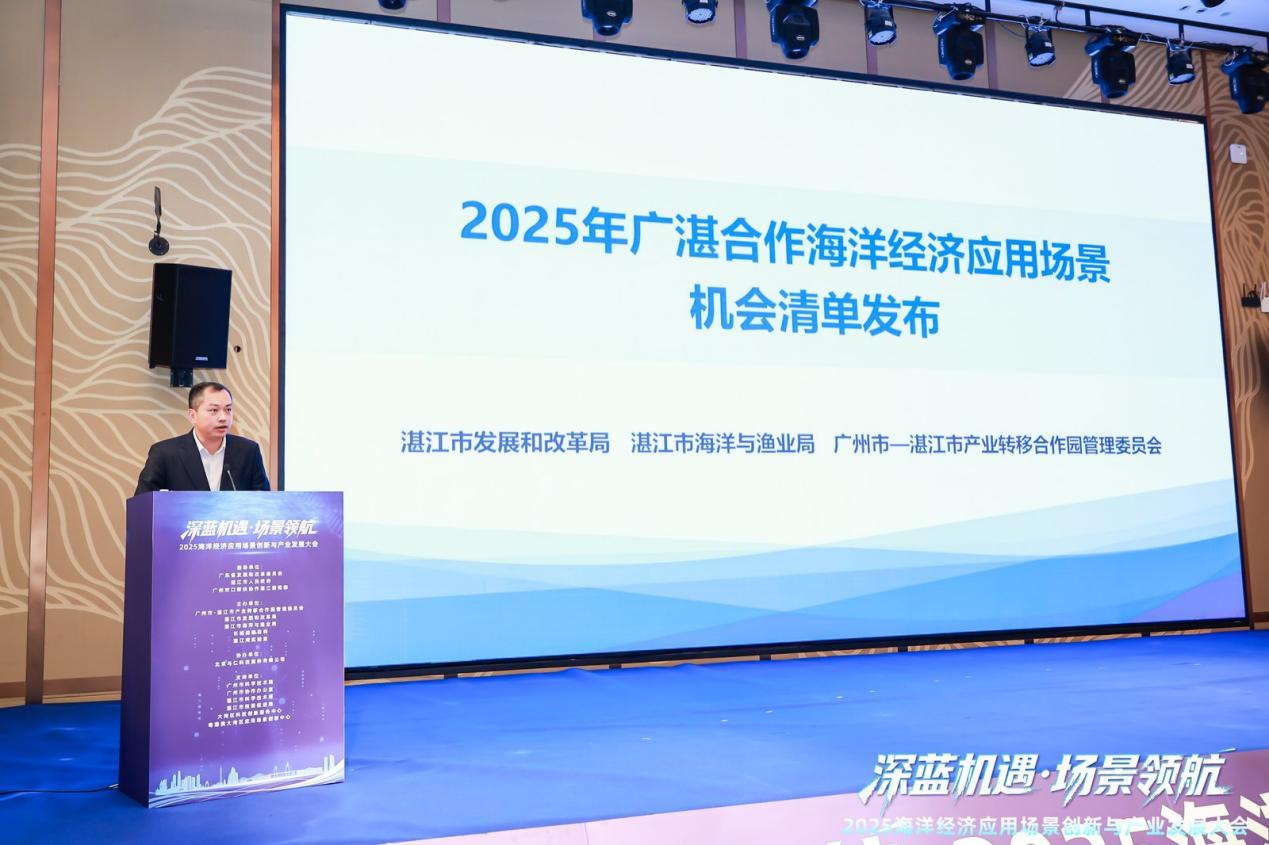
Core Insights - The first comprehensive marine economy application scenario opportunity list in China, titled "2025 Guang-Zhan Cooperation Marine Economy Application Scenario Opportunity List," was officially released at the "2025 Marine Economy Application Scenario Innovation and Industry Development Conference" [1] - This list is a significant initiative to implement national application scenario innovation work and the requirements for building a strong marine province in Guangdong, marking a new phase of cross-regional collaboration between Guang and Zhan [3] Group 1: Application Scenario Opportunities - The list was compiled by the Zhanjiang Development and Reform Bureau, Zhanjiang Ocean and Fisheries Bureau, and the Guangzhou-Zhanjiang Industrial Transfer Cooperation Park Management Committee, resulting in 48 specific application scenario opportunity projects [3][4] - These projects cover nine major fields, including deep-sea aquaculture, marine + low-altitude applications, marine biomedicine, marine engineering, and marine resource energy development, aligning with national priorities for marine economy application scenario innovation [3][4] Group 2: Deep-Sea Aquaculture Focus - Among the application scenarios, 13 projects related to deep-sea aquaculture account for over 27%, addressing diverse needs such as smart aquaculture platforms, seed industry research, and disease prevention [4] - The technical demands are highly concentrated, focusing on cutting-edge areas like marine big models, unmanned ships, underwater robots, deep-sea wind power equipment, and new anti-corrosion materials, providing a rich environment for pilot testing and product maturation [4] Group 3: Conference Highlights - The conference was guided by the Guangdong Provincial Development and Reform Commission and the Zhanjiang Municipal Government, with participation from over 200 representatives from government, innovative enterprises, top think tanks, and research institutions [4][5] - A report titled "China Marine Economy Application Scenario Innovation Development Report 2025" was released, outlining a comprehensive mapping of marine economy application scenarios across seven fields and 45 key scenarios [5] Group 4: Discussions and Insights - The conference featured discussions on modern marine ranch application scenario innovation, the current state and challenges of deep-sea development, and the acceleration of the marine ranch industry through leading enterprises [6][7] - A consensus emerged that real scenarios must be opened up to allow technology to iterate in practice and business models to be tested in the market, which is essential for unlocking vast "deep blue opportunities" [7]

数读3.2万亿北部海洋经济圈 蓝色引擎激活发展新动能
Zheng Quan Shi Bao· 2025-08-06 18:33
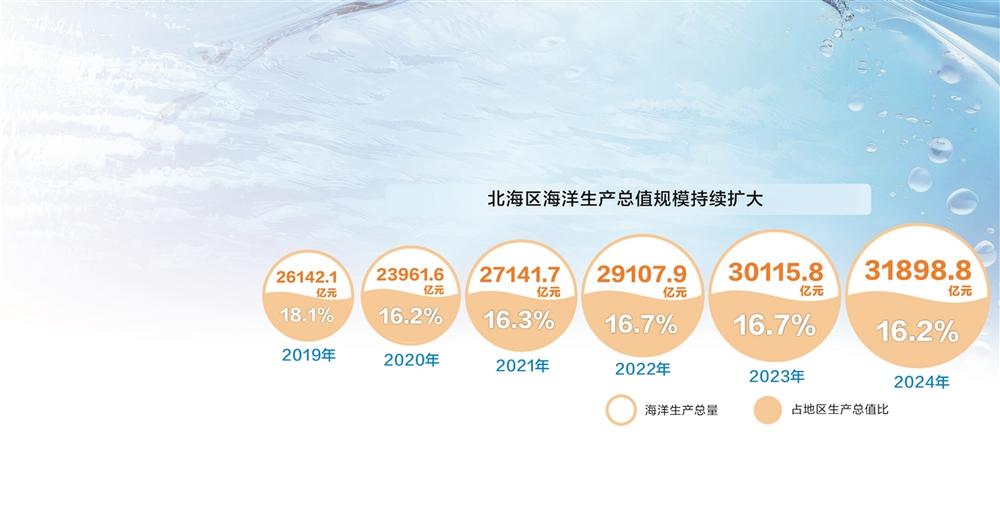
Core Insights - The northern marine economy is experiencing high-quality development, with significant contributions from the provinces of Shandong, Liaoning, Hebei, and the municipality of Tianjin [4][5]. Group 1: Marine Economic Performance - In 2024, the marine GDP of the northern marine economic zone reached 31,898.8 billion yuan, with a nominal growth rate of 5.9%, accounting for 16.2% of the regional GDP and 30.3% of the national marine GDP [5]. - Shandong Province's marine GDP surpassed 18,011.8 billion yuan, growing by 6.1% year-on-year, contributing 23.9% to the province's economic growth [6]. - Hebei Province's port cargo throughput exceeded 1.4 billion tons for the first time in 2024, with Tangshan Port handling 862 million tons, marking a 2.37% increase from the previous year [9]. Group 2: Sector Contributions - The marine tourism industry is the dominant sector in the northern marine economy, contributing 30.8% to the marine industry value added in the northern region [5]. - In Shandong, the marine fishery, marine product processing, marine mining, marine salt, and marine chemical industries all ranked first nationally in value added [6]. - In Tianjin, the marine oil and gas industry achieved a value added of 1,280.3 billion yuan, accounting for 41.7% of the city's marine industry value added [13]. Group 3: Growth Drivers and Innovations - The marine shipbuilding industry in the northern region saw the highest growth rate at 28.5% year-on-year [5]. - Shandong has developed a robust marine biopharmaceutical industry, holding over 50% of the national market share and ranking first in value added for three consecutive years [8]. - Liaoning Province is focusing on clean marine energy, with wind and solar power installations exceeding 50% of total energy capacity [11][12]. Group 4: Future Outlook - Hebei plans to accelerate port project construction with an investment of 8.5 billion yuan in 2025, aiming to enhance its port capacity significantly [10]. - Tianjin's cruise economy is rapidly growing, with a 67% increase in cruise ship entries and a 93% rise in passenger numbers from May 2024 to May 2025 [14].