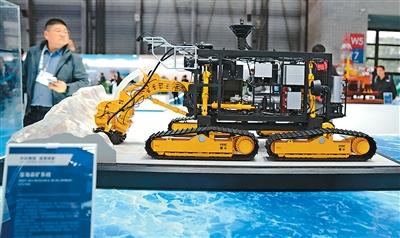
深海采矿试验系统

Search documents
找矿走向深蓝,未来中国深海采矿如何发展?
Ren Min Ri Bao Hai Wai Ban· 2026-01-04 03:04
Core Viewpoint - China is enhancing its mineral exploration efforts by integrating land and sea strategies, focusing on deep-sea resource investigation to secure critical metal supplies for its economy and technological advancement [1][2]. Group 1: Importance of Deep-Sea Mining - The demand for key metals such as nickel, cobalt, and copper is surging globally, making deep-sea mining a new frontier for technological and strategic competition among nations [2]. - China's reliance on foreign sources for certain metals is high, with cobalt dependency reaching nearly 99% and copper at 77%, highlighting the need for domestic resource security [4]. - The economic value of deep-sea mining is significant, with the potential value of metals extracted from seabed nodules estimated at 6,000 to 7,000 yuan per ton, compared to much lower values for land-based sources [4]. Group 2: Technological and Environmental Challenges - Deep-sea mining presents challenges in technology, environmental impact, and cost, requiring advanced solutions for stable and reliable operations in extreme underwater conditions [6][7]. - Recent breakthroughs in deep-sea mining technology, such as the "Kai Tuo No. 2" mining vehicle, demonstrate China's growing capabilities in this field, achieving operational depths of 4,000 meters [7]. - Environmental concerns arise from insufficient understanding of deep-sea ecosystems, with mining activities potentially causing unpredictable disturbances [8]. Group 3: Strategic Development and Future Directions - The Chinese government is planning a long-term roadmap for deep-sea mining, emphasizing the need for sustainable practices and international cooperation in technology development [9][10]. - Local initiatives, such as those in Qingdao, are focusing on enhancing deep-sea mining capabilities and integrating marine industries [9]. - The future of deep-sea mining in China will depend on solidifying foundational technologies, reducing uncertainties, and establishing responsible supply chain standards [10].
找矿走向深蓝
Ren Min Ri Bao Hai Wai Ban· 2026-01-01 00:05
Core Viewpoint - The deep-sea mining sector is emerging as a new frontier for technological and strategic competition among nations, driven by the increasing global demand for critical metals such as nickel, cobalt, copper, and others found in polymetallic nodules on the ocean floor [4][6]. Group 1: Importance of Deep-Sea Mining - Deep-sea mining is crucial for enhancing the supply chain autonomy of strategic minerals, with China's reliance on imports for metals like cobalt reaching nearly 99% and copper at 77% [7]. - The economic value of deep-sea mining is significant, with the value of extracted minerals from the ocean floor estimated to be 6,000 to 7,000 yuan per ton, compared to only a few hundred yuan for land-based sources [7]. - The development of deep-sea mining technology is expected to drive upgrades across multiple industries, including high-end equipment, marine engineering, and new materials [8]. Group 2: Challenges in Deep-Sea Mining - The primary challenges in deep-sea mining include technological difficulties, environmental concerns, and high costs [9]. - Technological challenges involve ensuring the reliability and efficiency of mining equipment under extreme conditions, such as high pressure and low temperatures, which require advanced materials and systems [10]. - Environmental challenges stem from insufficient understanding of deep-sea ecosystems, leading to potential irreversible impacts from mining activities [10]. - Cost-related challenges include high capital and operational expenses, fluctuating metal prices, and potential regulatory barriers, making commercial viability uncertain [11]. Group 3: Future Development and Strategic Planning - China has outlined a long-term roadmap for deep-sea mining, emphasizing the need for coordinated resource exploration and sustainable development [12]. - Recent initiatives include collaborative exploration efforts with countries like the Cook Islands to assess deep-sea mineral resources and establish environmental baselines [13]. - The focus for future development should be on foundational research, international cooperation, and creating sustainable frameworks for deep-sea mining [14].