
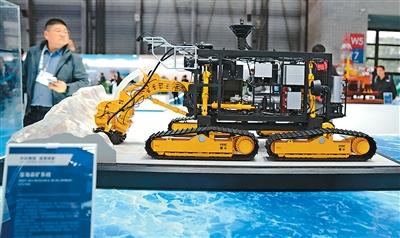
开拓二号

Search documents
找矿走向深蓝,未来中国深海采矿如何发展?
Ren Min Ri Bao Hai Wai Ban· 2026-01-04 03:04
Core Viewpoint - China is enhancing its mineral exploration efforts by integrating land and sea strategies, focusing on deep-sea resource investigation to secure critical metal supplies for its economy and technological advancement [1][2]. Group 1: Importance of Deep-Sea Mining - The demand for key metals such as nickel, cobalt, and copper is surging globally, making deep-sea mining a new frontier for technological and strategic competition among nations [2]. - China's reliance on foreign sources for certain metals is high, with cobalt dependency reaching nearly 99% and copper at 77%, highlighting the need for domestic resource security [4]. - The economic value of deep-sea mining is significant, with the potential value of metals extracted from seabed nodules estimated at 6,000 to 7,000 yuan per ton, compared to much lower values for land-based sources [4]. Group 2: Technological and Environmental Challenges - Deep-sea mining presents challenges in technology, environmental impact, and cost, requiring advanced solutions for stable and reliable operations in extreme underwater conditions [6][7]. - Recent breakthroughs in deep-sea mining technology, such as the "Kai Tuo No. 2" mining vehicle, demonstrate China's growing capabilities in this field, achieving operational depths of 4,000 meters [7]. - Environmental concerns arise from insufficient understanding of deep-sea ecosystems, with mining activities potentially causing unpredictable disturbances [8]. Group 3: Strategic Development and Future Directions - The Chinese government is planning a long-term roadmap for deep-sea mining, emphasizing the need for sustainable practices and international cooperation in technology development [9][10]. - Local initiatives, such as those in Qingdao, are focusing on enhancing deep-sea mining capabilities and integrating marine industries [9]. - The future of deep-sea mining in China will depend on solidifying foundational technologies, reducing uncertainties, and establishing responsible supply chain standards [10].
找矿走向深蓝
Ren Min Ri Bao Hai Wai Ban· 2026-01-01 00:05
Core Viewpoint - The deep-sea mining sector is emerging as a new frontier for technological and strategic competition among nations, driven by the increasing global demand for critical metals such as nickel, cobalt, copper, and others found in polymetallic nodules on the ocean floor [4][6]. Group 1: Importance of Deep-Sea Mining - Deep-sea mining is crucial for enhancing the supply chain autonomy of strategic minerals, with China's reliance on imports for metals like cobalt reaching nearly 99% and copper at 77% [7]. - The economic value of deep-sea mining is significant, with the value of extracted minerals from the ocean floor estimated to be 6,000 to 7,000 yuan per ton, compared to only a few hundred yuan for land-based sources [7]. - The development of deep-sea mining technology is expected to drive upgrades across multiple industries, including high-end equipment, marine engineering, and new materials [8]. Group 2: Challenges in Deep-Sea Mining - The primary challenges in deep-sea mining include technological difficulties, environmental concerns, and high costs [9]. - Technological challenges involve ensuring the reliability and efficiency of mining equipment under extreme conditions, such as high pressure and low temperatures, which require advanced materials and systems [10]. - Environmental challenges stem from insufficient understanding of deep-sea ecosystems, leading to potential irreversible impacts from mining activities [10]. - Cost-related challenges include high capital and operational expenses, fluctuating metal prices, and potential regulatory barriers, making commercial viability uncertain [11]. Group 3: Future Development and Strategic Planning - China has outlined a long-term roadmap for deep-sea mining, emphasizing the need for coordinated resource exploration and sustainable development [12]. - Recent initiatives include collaborative exploration efforts with countries like the Cook Islands to assess deep-sea mineral resources and establish environmental baselines [13]. - The focus for future development should be on foundational research, international cooperation, and creating sustainable frameworks for deep-sea mining [14].

深海经济:引领海洋经济未来发展的新引擎,未来产业规模化与集群化发展加速
Da Gong Guo Ji· 2025-12-31 03:20
Investment Rating - The report indicates that the deep-sea economy is positioned as a strategic emerging industry and is expected to accelerate in scale and cluster development, driven by technological breakthroughs and policy support [2][19]. Core Insights - The deep-sea economy is transitioning from technological validation to commercialization, becoming a core area of strategic competition in emerging industries, with China gaining a local leading advantage in deep-sea equipment and resource exploration [2][6]. - The global deep-sea economy is characterized by a complex industrial chain that includes upstream resource exploration, midstream equipment manufacturing, and downstream application expansion, with a focus on balancing ecological protection and sustainable development [7][18]. - The report highlights the strategic importance of deep-sea resources, which are seen as a new battleground for global competition, with various countries enhancing their strategic frameworks and investments in deep-sea technologies [6][11]. Summary by Sections 1. Overview and Current Status of the Deep-Sea Economy - The deep-sea economy encompasses diverse industrial clusters formed through the development and utilization of deep-sea resources, which are rich in minerals, oil, gas, and biological resources [3][4]. - The deep-sea is defined as waters deeper than 200 meters, with varying definitions across different fields, and is characterized by extreme conditions that require advanced technology for resource extraction [3][5]. 2. Industrial Chain Analysis - The deep-sea economy's industrial chain is structured as "upstream support - midstream core equipment - downstream application expansion," with a focus on technological complexity and military-civil fusion [7][8]. - The report notes significant growth in the titanium alloy market, projected to reach $15.8 billion by 2024, with a year-on-year increase of 13.7% [8]. 3. Global and Chinese Market Competition Landscape - The report compares the strategic frameworks of various countries, noting that the U.S. emphasizes unilateralism and has developed a comprehensive technology system for deep-sea exploration and mining [11][12]. - China has established a policy framework that includes legal guarantees, strategic guidance, and financial support, positioning deep-sea technology as a key emerging industry [14][19]. 4. Development Prospects and Challenges of China's Deep-Sea Economy - The report emphasizes the strategic value of deep-sea resources for national security and the need for a robust policy framework to support industry growth [19][20]. - Emerging fields such as offshore wind power and marine pharmaceuticals are highlighted as areas for potential growth, with a focus on integrating advanced technologies like AI and big data into the deep-sea economy [20].
深耕蔚蓝壮大海洋新兴产业
Jing Ji Ri Bao· 2025-12-17 00:05
Core Insights - The marine economy in China has shown steady progress in the first three quarters of this year, particularly in emerging marine industries, with marine engineering equipment deliveries and hand-held order amounts increasing by 13.6% and 7.0% year-on-year, respectively [1] - Emerging marine industries are crucial for cultivating new productive forces in the marine sector and expanding blue development spaces, serving as a core engine for high-quality development of the marine economy [1] Group 1: Industry Development - China's marine engineering equipment has maintained the largest share in the international market for seven consecutive years, with a projected value-added growth of 9.1% in 2024 [1] - The successful design and construction of advanced marine engineering equipment, such as the "Hai Kui No. 1" floating production storage and offloading unit and the "Kai Tuo No. 2" deep-sea heavy-duty mining vehicle, signify a leap from following to leading in high-end marine engineering equipment [1] - The marine biopharmaceutical industry is accelerating the transformation of results based on the "blue pharmacy" plan, showcasing the synergistic effects of regional differentiated layouts and innovation factor aggregation [1] Group 2: Global Context and Challenges - Globally, emerging marine industries have become a strategic high ground for developed countries, with China demonstrating unique institutional advantages and scale effects in this sector [2] - China's offshore wind power installed capacity has ranked first in the world for four consecutive years, providing significant support for the technological iteration of high-end equipment such as wind installation vessels and submarine cables [2] - Challenges remain, including low self-sufficiency rates in core deep-sea technologies and insufficient mechanisms for the transformation of scientific and technological achievements [2] Group 3: Future Strategies - To address these challenges, a multi-faceted approach is needed, including strengthening technological innovation to break through key core technologies and forming a marine technology innovation consortium involving national laboratories, key universities, and leading enterprises [2] - Establishing a national marine industry investment fund to guide social capital into key areas such as high-end marine engineering equipment and marine biomedicine through equity investment and risk compensation [3] - Enhancing infrastructure networks, including the construction of a marine three-dimensional observation network and the promotion of 5G communication networks to extend into marine areas, is essential for improving industry support capabilities [3]
向技术要矿产资源(编辑手记)
Ren Min Ri Bao· 2025-10-21 21:47
Core Insights - The article emphasizes the innovation in mineral resource exploration technology as a reflection of the need for resources through technology [1][2] - New technologies are becoming crucial for breakthroughs in mineral exploration due to the decreasing availability of shallow mineral deposits and increasing demand for sustainable resources [2] Group 1: Technological Innovations - The Shandong Provincial Geological Bureau's Sixth Geological Team utilizes 3D visualization technology to construct multi-scale models, enabling insights into geological structures up to 3000 meters deep [2] - The "Kaituo No. 2" deep-sea exploration has successfully tested at depths exceeding 4000 meters, collecting numerous samples of polymetallic nodules and crusts, laying the groundwork for future deep-sea mineral resource development [2] - The first space mining robot in China has achieved walking, anchoring, and sampling in a simulated lunar environment, expanding the possibilities for mining resources from near-Earth celestial bodies [2] Group 2: Implications for Resource Development - The new exploration technologies and equipment enhance the efficiency and accuracy of mineral exploration, further promoting the development and utilization of mineral resources [2] - The commitment of geological workers in China to leverage technology for resource acquisition is expected to yield significant results in the new round of mineral exploration strategic actions [2]
三亚:向种突破,向海图强|活力中国调研行
2 1 Shi Ji Jing Ji Bao Dao· 2025-09-30 01:11
Core Insights - The article highlights the development of the Sanya Yazhou Bay Science and Technology City, which focuses on agricultural technology and salt-tolerant rice breeding to enhance food security in China [1][3]. Agricultural Innovation - The Sanya Yazhou Bay Science and Technology City has introduced numerous salt-tolerant rice varieties, achieving yields of 327.2 kg per mu under 5‰ saline conditions and over 400 kg per mu under 3‰ to 5‰ saline conditions [1]. - Over 70% of the more than 20,000 crop varieties developed since the founding of New China have been nurtured through the South Breeding program [1]. - The city has evolved from a traditional breeding base to a comprehensive service hub for research, production, sales, and technology transfer, referred to as the "South Breeding Silicon Valley" [1]. Industry Collaboration - The technology city has attracted over 20 leading national seed companies and more than 100 ecosystem enterprises, forming a robust seed industry cluster [3]. - A collaborative platform for breeding innovation has been established, integrating research institutions, universities, and enterprises to provide full-chain services from research to field management [3]. Talent Acquisition - The city has successfully attracted over 1,300 high-level talents in the South Breeding field, including five academicians, and has set up multiple innovation centers and workstations [4]. - It has also established branches of ten agricultural universities, enrolling 2,178 graduate students in agricultural disciplines [4]. Technological Advancements - The Sanya Yazhou Bay Science and Technology City has made significant strides in deep-sea research, with the successful sea trial of a deep-sea mining vehicle capable of operating at depths of 4,000 meters [5]. - The proximity to deep-sea areas enhances the city's capabilities for deep-sea research and experimentation, with major research institutions and enterprises establishing a presence in the area [7][8]. Intellectual Property and Technology Transfer - A national-level intellectual property protection center has been established in the city, facilitating accelerated patent authorization for seed-related innovations [4]. - As of December 2024, the city has registered 186 contracts for the transfer of South Breeding technology, with a total transaction value of 270 million yuan [4].
活力中国调研行|从“一粒种子”到“万里海疆” 三亚崖州湾崛起科创新高地
Xin Hua She· 2025-09-27 09:18
Core Insights - The article highlights the transformation of Sanya's Yazhou Bay into a high-tech innovation hub, showcasing advancements in agricultural technology and deep-sea research [1][2][3] Group 1: Agricultural Innovation - The introduction of salt-tolerant rice varieties has led to significant agricultural productivity, with "Jinsi You 98" yielding 327.2 kg per mu and "Qingliang You 3261" exceeding 400 kg per mu under saline conditions [1] - The establishment of the Yazhou Bay Seed Laboratory in May 2021 has facilitated collaboration among top research institutions and industry leaders, enhancing breeding innovation [1][2] Group 2: Deep-Sea Research - The successful sea trial of the deep-sea heavy-load mining vehicle "Kaituo No. 2" at a depth of 4000 meters marks a significant achievement in deep-sea research [2] - Yazhou Bay's proximity to deep-sea areas, with the nearest 1000-meter depth only 164 kilometers away, provides a unique advantage for conducting deep-sea research and experiments [2] Group 3: Future Prospects - The ongoing development of Yazhou Bay Technology City reflects a commitment to both agricultural and marine innovation, with expectations for further breakthroughs as more research resources converge [3]