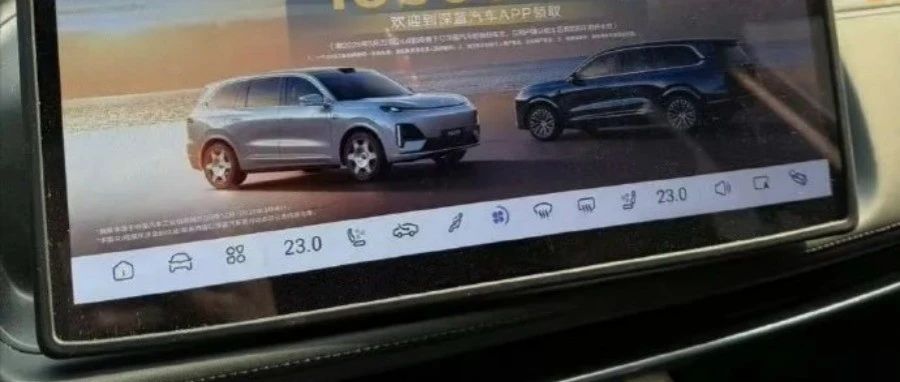
深蓝汽车APP

Search documents
长安汽车1月份汽车总销量腰斩
Shen Zhen Shang Bao· 2026-02-04 16:00
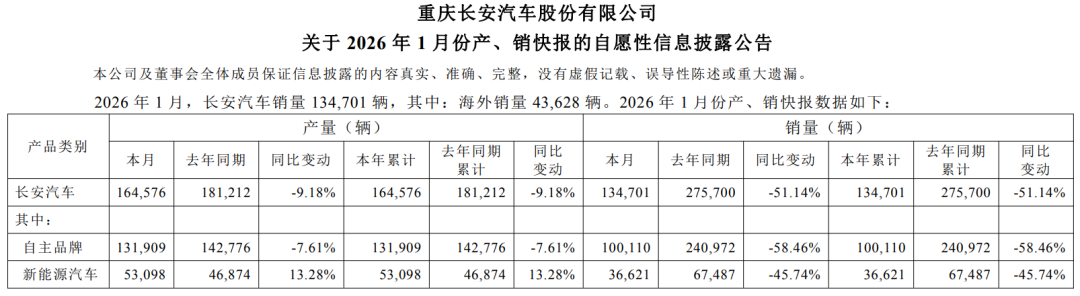
Core Viewpoint - Changan Automobile reported a significant decline in sales for January 2026, with total sales dropping by 51.14% year-on-year to 134,701 units, including overseas sales of 43,600 units [1][3]. Group 1: Sales and Production Data - In January 2026, Changan Automobile's production was 164,576 units, a decrease of 9.18% compared to the same month last year [3]. - The company's sales of self-owned brands were 100,110 units, down 58.46% year-on-year [3]. - The production of new energy vehicles (NEVs) reached 53,098 units, an increase of 13.28% year-on-year, while sales were 36,621 units, reflecting a decrease of 45.74% [3]. Group 2: Financial and Investment Activities - Changan Automobile plans to raise up to 6 billion yuan through a private placement of A-shares, with 4.5 billion yuan allocated for the development of new energy vehicles and smart platforms [4]. - The remaining 1.5 billion yuan will be used for the construction of a global R&D center and enhancement of core capabilities [4]. - In the first three quarters of the year, Changan Automobile reported a revenue of 114.93 billion yuan, a year-on-year increase of 3.58%, while net profit attributable to shareholders decreased by 14.66% to 3.06 billion yuan [5].


3家车企APP被通报
Xin Lang Cai Jing· 2026-01-08 22:04
Group 1 - The core issue identified is the violation of personal information protection laws by 71 mobile applications, including those from automotive companies such as Fengshen, Ledao, and Shenlan [1][2] - The detection was conducted based on the Cybersecurity Law and the Personal Information Protection Law, as part of a special action announced by multiple government agencies [1] - The report highlights 13 types of violations, including failure to inform users about the collection of personal information and lack of rules for processing information of minors under 14 [1] Group 2 - Specific violations were noted for the Fengshen app, which failed to inform users about the sharing of their personal information with other processors without obtaining separate consent [2] - The Ledao and Shenlan apps did not implement necessary security measures such as encryption and de-identification [2] - A previous report had identified 69 non-compliant applications, with 27 still having issues upon re-evaluation, leading to their removal from distribution platforms [2]
几十万元买的车,中控屏感觉不是自己的,蔚来、奔驰、宝马等都被投诉过
21世纪经济报道· 2025-07-25 02:52
Core Viewpoint - The article discusses the controversy surrounding in-car advertising on digital screens, highlighting the lack of user control and regulatory clarity in the automotive industry [1][6][12]. Group 1: Advertising Controversy - The emergence of in-car advertising has sparked significant backlash from car owners, who feel that they have not consented to such advertisements [1][3]. - A specific incident involving Deep Blue Automotive's pop-up ads has led to complaints from numerous car owners, raising questions about the consent process and the visibility of advertising policies [3][5]. - The automotive display market is projected to grow from $16 billion in 2024 to $48.9 billion in 2034, indicating a lucrative opportunity for advertising [6]. Group 2: User Control and Privacy - Many car owners are now scrutinizing the privacy policies of automotive apps, which often include clauses about advertising and user consent [9][10]. - Users who refuse to accept privacy agreements may lose access to essential vehicle functions, leading to frustration and confusion about ownership rights [10][11]. - Legal experts argue that car owners should have full control over their vehicle's information and advertising content, but the current ecosystem is often closed and lacks transparency [12][14]. Group 3: Regulatory Challenges - The automotive industry is still in the exploratory phase regarding advertising regulations, with significant differences in how companies implement compliance measures [12][14]. - Current regulations for internet advertising do not adequately cover in-car advertising, leading to frequent complaints and confusion among users [16][18]. - The distinction between service notifications and advertisements is often blurred, complicating the consent process for users [17][18]. Group 4: Safety Concerns - The potential for in-car advertisements to distract drivers raises serious safety concerns, with no standardized technical guidelines to prevent such occurrences [18][19]. - The article draws parallels between the early days of smartphone advertising and the current state of in-car advertising, emphasizing the need for clearer regulations to ensure user safety [19].