混动SUV

Search documents
欣旺达在韩再遭诉讼,专利与质量双重围剿下溃败在即?
3 6 Ke· 2026-01-29 13:24
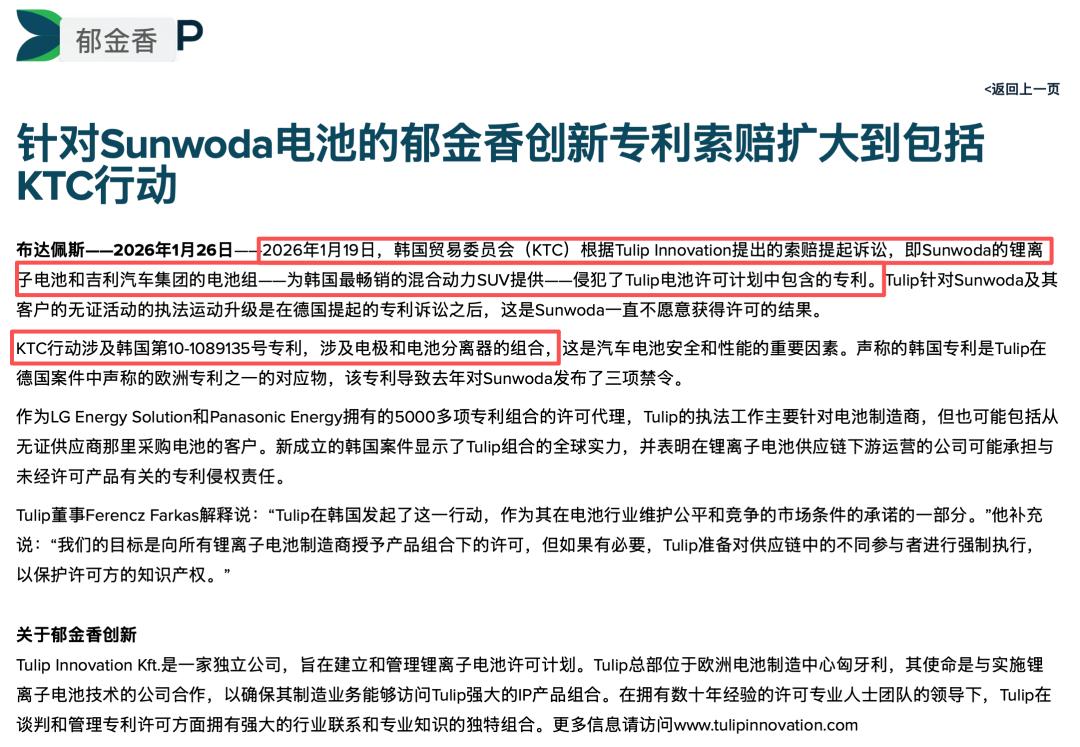
Core Viewpoint - The patent alliance "Tulip Innovation," formed by LG Energy and Panasonic, has initiated a patent infringement lawsuit against Xinwanda in South Korea, claiming that Xinwanda's lithium-ion battery cells and battery packs for Geely's popular hybrid SUV violate a specific patent related to electrode and separator technology [1][4]. Group 1: Patent Infringement and Legal Challenges - The lawsuit in South Korea is part of a broader strategy similar to previous actions taken in Germany, targeting core battery technologies that are critical for energy, safety, and lifespan [4][7]. - Xinwanda has previously faced three defeats and sales bans in Germany regarding the same patent, indicating the strength of the patent barriers established by the alliance [4][7]. - The lawsuit poses risks not only to Xinwanda but also to its customers, as the involved battery technology is used in Geely's hybrid SUV sold in South Korea, potentially affecting market prospects [7][11]. Group 2: Domestic Quality Issues and Financial Implications - Xinwanda is also facing a domestic lawsuit from Geely's Weirui company, claiming damages of 2.313 billion RMB due to serious quality issues with battery cells supplied between 2021 and 2023 [4][11]. - The quality issues have led to significant vehicle recalls, with estimates suggesting that tens of thousands of vehicles may be affected, aligning with the compensation amount sought [11][15]. - The financial impact of the 2.313 billion RMB claim is severe, potentially consuming 90% of Xinwanda's net profit for 2023 and 2024, with insufficient reserves to cover such liabilities [15][16]. Group 3: Industry Implications and Strategic Reflections - Xinwanda's situation serves as a warning for the industry, highlighting the risks of prioritizing cost over quality, as aggressive pricing strategies may compromise essential safety and reliability standards [20][24]. - The dual challenges of patent infringement and quality issues are forcing a reevaluation of supplier assessments, emphasizing the need for robust quality systems and independent patent strategies [20][24]. - The case of Xinwanda illustrates the complexities of international expansion for Chinese companies, where legal and technical challenges are becoming increasingly intertwined [20][24].