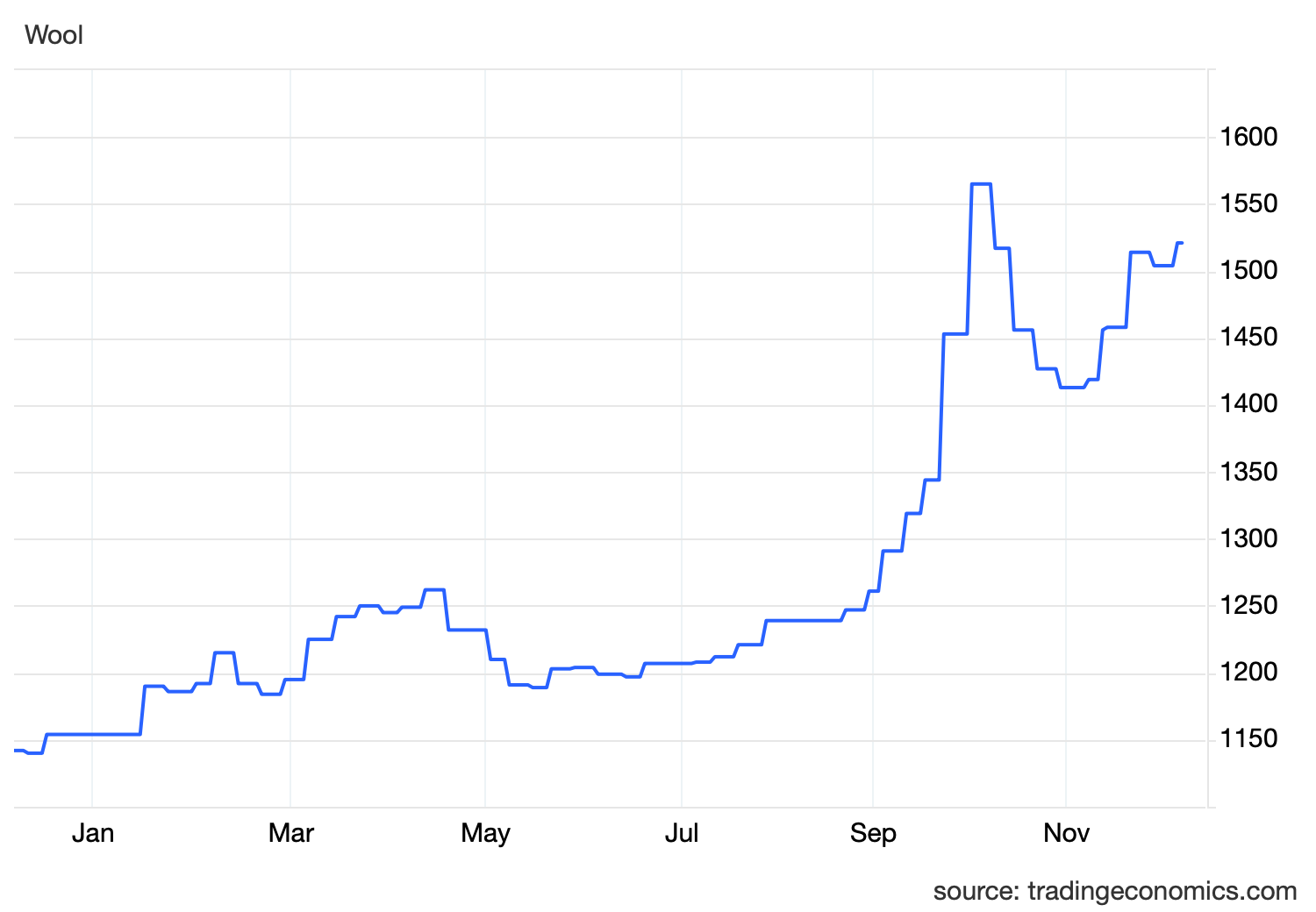
澳大利亚羊毛

Search documents
商务部、海关总署公布2026年新西兰羊毛和毛条、澳大利亚羊毛进口国别关税配额管理实施细则
Zheng Quan Shi Bao Wang· 2025-12-31 09:41
Group 1 - The core point of the article is the announcement of the import tariff quota management implementation details for New Zealand and Australian wool and wool tops by the Ministry of Commerce and the General Administration of Customs for the year 2026 [1] - The total import tariff quota for New Zealand wool is set at 36,936 tons, while for New Zealand wool tops it is 665 tons, and for Australian wool, it is 44,324 tons [1] - The distribution of the country-specific tariff quotas will be based on a first-come, first-served basis according to contracts, and the Ministry of Commerce will stop accepting applications once the cumulative issuance reaches the total quota for 2026 [1]
纺织服饰行业深度报告:品牌端以产品力破局,制造端把握龙头复苏节奏
Capital Securities· 2025-12-30 07:36
Investment Rating - The report rates the textile and apparel industry as "Positive" [1] Core Insights - The textile and apparel sector has underperformed the market, with a year-to-date increase of 12%, lagging behind the CSI 300 index by 4.1 percentage points, ranking 18th among 31 first-level industries [4][10] - The apparel and home textile segment has seen an 11.3% increase, while the textile manufacturing segment rose by 9.6%, and the accessories segment outperformed with a 17.4% increase [4][10] - The report highlights a potential recovery in demand for textile manufacturing due to stable domestic consumption and a resilient export market, particularly in the U.S. [4][19] - The sleep economy is expanding rapidly, driven by increasing health awareness and consumer spending on sleep-related products [4][63] - The gold and jewelry sector faces short-term demand suppression due to rising gold prices, but consumer spending on gold jewelry remains strong [4][63] Summary by Sections Market Overview - The textile and apparel sector has a TTM price-to-earnings ratio of 27.48, above the historical average since January 2020 [4][14] - The apparel and home textile segment has a TTM P/E ratio of 29.07, while the textile manufacturing segment stands at 23.9, and the accessories segment at 30.27, all above historical averages [4][14] Textile Manufacturing - Raw material prices are at historical lows, with cotton and synthetic fiber prices declining, while Australian wool prices have recently increased [4][19] - Domestic retail sales are showing steady growth, with apparel sales experiencing a slight recovery [4][30] - Export performance is affected by fluctuating tariffs and weak external demand, with a 4.4% year-on-year decline in apparel exports from January to November [4][43] Apparel and Home Textiles - The sleep economy is projected to grow significantly, with the market size expected to exceed 500 billion yuan in 2024, driven by increased consumer awareness and spending on sleep health products [4][66] - The outdoor sports market is also expanding, with a trend towards specialization and segmentation, supported by rising consumer income levels [4][63] Gold and Jewelry - Gold prices have surged over 50% this year, temporarily suppressing demand for gold jewelry, but overall consumer budgets for gold jewelry are increasing [4][63] - The report notes that consumer preferences are shifting towards lighter and more innovative gold products, with a focus on craftsmanship and cultural connections [4][63] Investment Strategy - The report recommends investing in leading companies with strong barriers in production capacity, technology, and customer relationships within the textile manufacturing sector, such as Shenzhou International and Huayi Group [4][63] - For the apparel and home textile sector, it suggests focusing on high-growth segments related to the sleep economy and outdoor sports [4][63]


原料“过山车”行情冲击产业链:“澳毛”价格较去年同期上涨逾三成
Xin Hua Cai Jing· 2025-12-08 11:29
Core Insights - Australian wool prices have recently entered a new upward trend, with a 7.64% increase in November and reaching 1521 AUD per 100 kg (approximately 6963.14 RMB per 100 kg) by December 5, marking a 33.19% increase compared to the same period last year [1][3] - China accounts for 80% to 85% of Australia's wool exports, with strong demand for wool raw materials driven by low domestic inventory and pre-holiday stocking by traders and factories [3][4] - The Australian wool market is expected to develop positively by 2026, contingent on improved seasonal conditions and deeper cooperation between Australia and China in the wool industry [3] Price Trends - Year-to-date, Australian wool prices have increased by 31.80%, with November marking the second wave of price increases following a surge in late September and early October [1] - The price volatility of wool has led to challenges for manufacturers in managing inventory and costs, with high-end textile products maintaining strong prices while mid-range products see slight adjustments [4] Market Demand - Wool products such as wool sweaters, scarves, and blankets are popular this winter, with some imported Australian wool blankets selling over 100,000 units on e-commerce platforms [3] - There is a noticeable price disparity in wool garments, with consumers reporting higher prices for similar styles compared to last year, and a reduction in the availability of cost-effective options [4]