火山大模型

Search documents
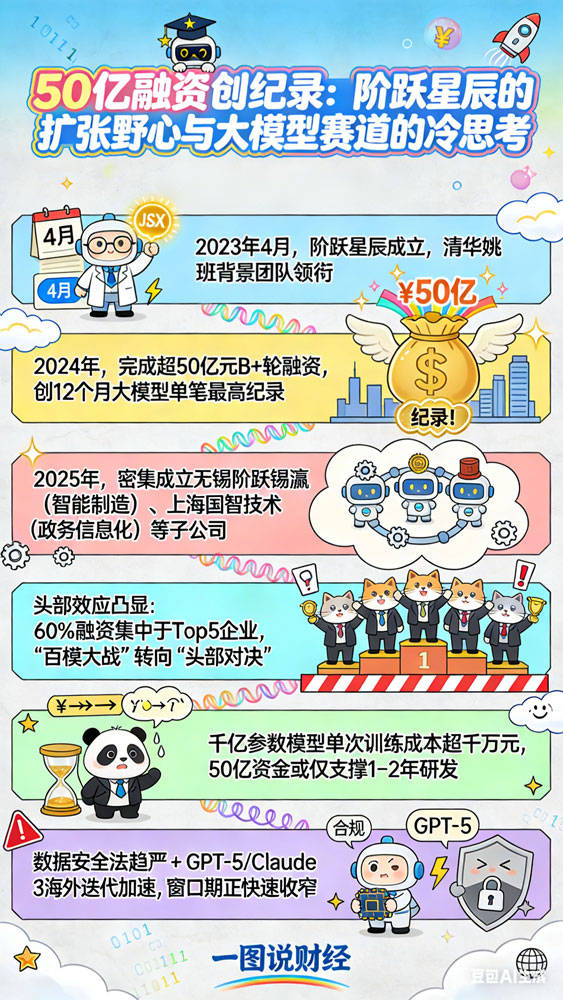
50亿融资创纪录:阶跃星辰的扩张野心与大模型赛道的冷思考
Sou Hu Cai Jing· 2026-01-27 04:25
Core Viewpoint - The recent completion of over 5 billion yuan in Series B+ financing by Shanghai Jumpspace Intelligent Technology Co., Ltd. marks the highest single financing record in China's large model sector in the past 12 months, reflecting both the industry's rapid expansion and the presence of valuation bubbles [3][4]. Group 1: Company Overview - Shanghai Jumpspace was established in April 2023 and has already invested in 10 companies within a year, indicating aggressive growth and strategic positioning in the market [3]. - The company is led by renowned figures in the AI field, including Yao Ban talent Yin Qi, which enhances investor confidence in the technology's practical applications [3][4]. Group 2: Industry Trends - The large model sector is experiencing a shift from a "hundred model battle" to a "head-to-head competition," with over 60% of financing going to leading companies, indicating a trend towards resource concentration [3][4]. - The rapid expansion of Jumpspace is a strategic move to capture industry opportunities, focusing on high-value sectors such as healthcare, manufacturing, and government information technology [4]. Group 3: Financial Insights - The cost of training a large model with hundreds of billions of parameters can reach several million yuan, raising concerns about the sustainability of the 5 billion yuan funding if profitable applications are not quickly identified [4][5]. - There is a mismatch between the scale of financing and the company's current commercialization capabilities, which could lead to a "pre-expectation" bubble [4][5]. Group 4: Challenges Ahead - The industry faces challenges related to valuation bubbles and the sustainability of business models, as companies must convert financing advantages into lasting competitive strengths [5]. - Increasing regulatory requirements for data compliance and the rapid technological advancements of overseas models like GPT-5 and Claude 3 may dilute the financing advantages of domestic companies [4].

神农陈宇:房价未见底买房别着急,Ai应用5年内将迎上市潮,中国创新药未来将占全球3成份额
Sou Hu Cai Jing· 2026-01-09 14:38
Group 1 - The core viewpoint of the article is that the investment landscape is shifting towards artificial intelligence (AI) applications and innovative pharmaceuticals, with a strong emphasis on the potential of these sectors for future growth [3][4]. - In 2025, the A-share market performed well, largely due to increased policy support for the stock market, with the non-ferrous metals sector being one of the best-performing industries [3]. - The real estate market in Beijing is currently experiencing a downward trend, with rental yields not meeting the industry standard of 3%, suggesting that potential investors should wait before purchasing property [3]. Group 2 - The investment focus for 2026 is on AI applications, which are likened to the real estate investment opportunities of 2006, indicating a significant potential for growth in this sector [4]. - The current investment environment for AI is compared to the early days of the internet, with a strong belief that now is the time to invest in leading AI companies, similar to investing in Tencent in 2004 [4]. - The company has shifted its research focus entirely towards AI applications and AI computing power, abandoning other areas to maximize efficiency and returns [4]. Group 3 - The innovative pharmaceutical sector has been under research since 2016, with significant advancements being made in China, particularly in areas such as dual antibodies, ADC, and cell gene therapy [5]. - The growth of China's innovative pharmaceuticals is expected to follow a long-term cycle, with projections indicating that China could produce 20%-30% of innovative drugs in the next decade [5]. - Data shows a dramatic increase in the outbound business development transactions for innovative drugs, with the total transaction amount rising from $0.9 billion in 2019 to $135.655 billion by the end of 2025, marking a significant growth in both transaction volume and value [5].