烟卡

Search documents
南都电商观察|董宇辉带货沙发被疑代工;“烟卡第一案”落槌
Nan Fang Du Shi Bao· 2025-12-31 03:07
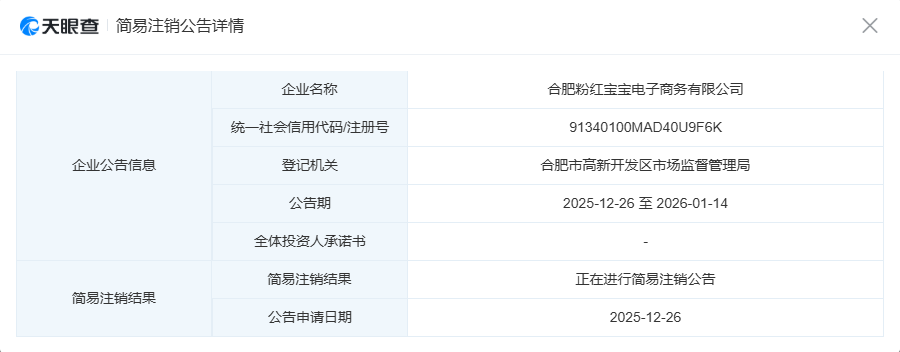
Group 1: Company Developments - Pink Baby E-commerce Company under Sanziyang plans to deregister, with the announcement period from December 26, 2025, to January 14, 2026 [1] - Hefei Sanziyang's subsidiary, Hefei Oupu Sanyang Technology Co., has also recently been deregistered [3] - The company was established in November 2023, with a registered capital of 1 million RMB, focusing on personal business services, internet live streaming services, and cultural activities [2] Group 2: Live Streaming and E-commerce Issues - Li Jiaqi's live streaming room faced allegations of selling "premature seaweed," with a consumer claiming the production date was later than the shipping date [3][5] - The customer received a product with a production date of December 27, 2025, after a logistics delay, which the seller attributed to a lost shipment [5] - Dong Yuhui's live streaming event achieved a record sales figure of 3.56 billion RMB, but there are concerns regarding whether the products were produced by third-party manufacturers [7] - There are rumors that major manufacturers are hesitant to accept orders due to high costs and risks associated with the sales generated by Dong Yuhui [7] Group 3: Industry Trends and Regulations - From January to November, China's logistics total reached 331.2 trillion RMB, with a year-on-year growth of 5.0% [10] - The Qinghai Provincial Market Supervision Administration is conducting a special action to regulate live streaming sales, focusing on three major issues: incomplete business qualifications, misleading product claims, and fraudulent practices [11][13] - The special action has monitored over 1,600 live streamers and addressed 12 suspected illegal cases [15] - A recent court ruling in Beijing ordered a store to refund a consumer for purchasing a toy "cigarette card," emphasizing the need for higher standards in protecting minors [16][18]


“烟卡第一案”落槌,烟草衍生品监管还需补上空白
Nan Fang Du Shi Bao· 2025-12-30 23:06
Group 1 - The Beijing Internet Court ruled on the "first public interest lawsuit regarding cigarette cards," ordering the relevant store to refund consumers for toy cigarette cards purchased on an e-commerce platform, while dismissing other claims [1] - The court emphasized the need to prohibit the sale of cigarette cards to minors, highlighting the responsibility of e-commerce platforms in this regard, thus marking a significant stance from the judiciary on the issue [1] - The ruling identified the sale of cigarette cards as a violation of public order and good morals, declaring the contract for their sale invalid under the Civil Code, which may serve as a reference for similar cases in the future [1] Group 2 - The court's ruling did not address whether platforms are required to remove related products, as the specific store involved had ceased operations, leaving other platforms still selling cigarette cards [2] - The effectiveness of the ruling is questioned, as many e-commerce platforms continue to list cigarette cards for sale, indicating that the legal action alone may not be sufficient to curb the issue [2] - There is a call for stronger legislation to clearly define the regulatory principles for tobacco derivatives to better protect minors' health, as the actual dangers of cigarette cards may not be fully recognized by many, especially minors [3]
法院判决首次认定销售烟卡“违反公序良俗”,电商平台何为?
Nan Fang Du Shi Bao· 2025-12-29 12:31
Core Viewpoint - The Beijing Internet Court ruled against the sale of "smoking cards" to minors, emphasizing the need for e-commerce platforms to take responsibility in protecting minors from tobacco-related products [1][7][9]. Group 1: Court Ruling and Analysis - The court determined that selling smoking cards as toys violates public order and morals, as it poses a risk to minors' health and promotes tobacco-related imagery [9][11]. - The ruling highlighted that the sale of smoking cards undermines the legal framework designed to protect minors from tobacco exposure, despite existing laws not explicitly banning such products [8][9]. - The court's decision reflects a broader societal goal of safeguarding minors' physical and mental well-being, aligning with the principles established in the Minor Protection Law [8][9]. Group 2: E-commerce Platform Responsibilities - The defendant e-commerce platform argued that it merely serves as a marketplace and does not control the products sold by third-party vendors, claiming no legal basis for banning smoking cards [5][12]. - Despite the platform's implementation of a "Green Network Plan" to filter out smoking card listings, the effectiveness of these measures has been questioned, as many listings remain accessible [11][12]. - The court indicated that the platform must enhance its oversight and regulatory measures to better protect minors, suggesting that current efforts are insufficient [12][15]. Group 3: Public and Regulatory Response - The case has drawn attention to the rising popularity of smoking cards among schoolchildren, prompting concerns from health experts about their potential to normalize smoking behavior [2][14]. - Regulatory bodies, including the State Tobacco Monopoly Administration, have initiated actions to address the sale of smoking cards, urging e-commerce platforms to self-regulate and remove such products [14][15]. - Despite these efforts, the ongoing availability of smoking cards on various platforms indicates that previous regulatory actions have not achieved lasting results [15].
在这个遍地陷阱的时代,一个孩子的成长要扛过多少上瘾性行为?
洞见· 2025-12-25 12:35
Core Viewpoint - The article discusses the increasing addiction of children to games and collectibles, emphasizing that this issue is not solely the children's fault but a reflection of the societal environment that fosters such behaviors [8][33]. Group 1: Children's Addiction to Games and Collectibles - A 15-year-old girl in Shandong demanded money from her mother to buy "guzi," which refers to collectibles related to anime and games, highlighting the extreme lengths children may go to for these items [3][7]. - The article contrasts past childhood experiences with the current environment, noting that today's children face numerous addictive behaviors due to the pervasive presence of technology and social media [8][27]. - The phenomenon of children becoming obsessed with collectibles, such as "smoking cards," is discussed, illustrating how these items have transformed into a social currency that can lead to unhealthy behaviors [18][22]. Group 2: The Role of Parents and Society - The article argues that parents should not solely blame children for their addictive behaviors, as the current environment is designed to be addictive, making it difficult for children to resist [33][39]. - It suggests that parents need to engage with their children’s interests and provide guidance rather than criticism, as this can help children navigate their challenges [34][36]. - The importance of providing children with enriching experiences outside of screens, such as sports and cultural activities, is emphasized as a way to divert their attention from addictive behaviors [39][40].