特斯拉全自动驾驶(FSD)软件

Search documents
(全文+要点)马斯克在达沃斯论坛上的访谈
阿尔法工场研究院· 2026-01-26 10:45
Core Viewpoint - The future of humanity includes the potential to reverse aging, but this may lead to societal stagnation. Optimism about the future is encouraged, even in the face of mistakes [2][44]. Group 1: Artificial Intelligence and Energy - The biggest bottleneck for large-scale AI application is power supply, as the production of chips in the U.S. cannot keep up with the power system's capacity [21][22]. - Solar energy is identified as the future of energy, with China leading in solar panel production, capable of generating 1500 GW annually, translating to about 250 GW of stable power output [22][23]. - A solar power plant of 100 miles by 100 miles could meet the entire electricity demand of the U.S., occupying a small fraction of land [24]. Group 2: Autonomous Driving - Full Self-Driving (FSD) is expected to receive approval for supervised full autonomy in Europe soon, with similar progress anticipated in China [30]. - The technology for autonomous driving is considered to be fundamentally solved, with expectations for widespread deployment by the end of the year [29][30]. Group 3: Robotics and Economic Growth - The proliferation of humanoid robots is predicted to lead to unprecedented economic growth, with robots potentially outnumbering humans [11][12]. - The average productivity of robots multiplied by their number will define economic output, suggesting a future where material abundance is achieved [12][13]. Group 4: Aging and Longevity - While not heavily invested in anti-aging research, there is a belief that reversing aging is a solvable problem, with the synchronization of cellular aging being a key factor [17]. - The existence of death is acknowledged as having evolutionary significance, and the potential for immortality could lead to societal stagnation [17]. Group 5: Space Exploration - SpaceX aims to achieve full reusability of rockets, which could reduce launch costs by a factor of 100, making space more accessible [33]. - The efficiency of solar power in space is projected to be five times greater than on Earth, due to constant sunlight exposure and minimal atmospheric interference [34][35]. - The establishment of AI data centers in space is seen as a viable future option, leveraging the unique environmental conditions of space [35].


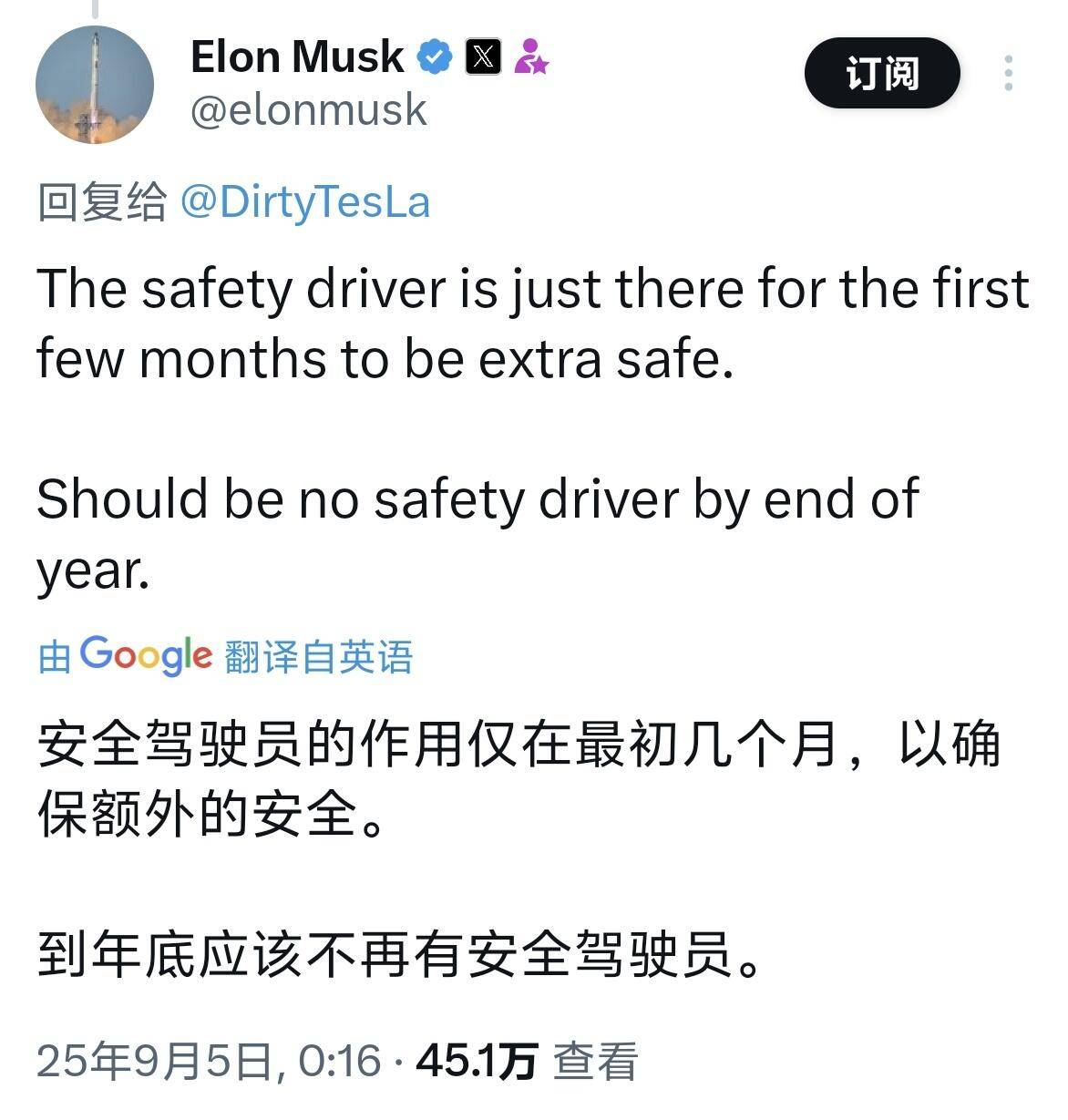
马斯克官宣:Robotaxi年底将无安全员!你敢上吗?
Sou Hu Cai Jing· 2025-09-05 08:02
Core Insights - Tesla plans to eliminate safety drivers in its Robotaxi service by the end of 2025, marking a significant step towards fully autonomous driving [1] - The Robotaxi app is now available for download in the U.S. and Canada, with initial operations in Austin, Texas, and a gradual rollout expected [2] - Tesla's pricing strategy for Robotaxi is aggressive, with a fixed fare of $4.2 per ride in Austin, significantly lower than Uber's average fare of $15 [8] Group 1 - Tesla has launched the Robotaxi app for users in the U.S. and Canada, allowing them to join a waiting list for access [2] - Currently, about 20 Robotaxis are operating in Austin, Texas, with safety drivers present as a temporary measure for initial safety [2] - The National Highway Traffic Safety Administration (NHTSA) is investigating Tesla's Full Self-Driving (FSD) software following a fatal accident involving over 2.4 million vehicles [4] Group 2 - Competitor Waymo has adopted a more cautious approach by keeping safety drivers during its testing phase and using a combination of cameras and lidar sensors for its autonomous operations [4] - Tesla's Robotaxi service aims to cultivate user habits rather than focusing on short-term profits, as indicated by its low pricing strategy [8] - Goldman Sachs estimates that if Tesla's Robotaxi fleet reaches 100,000 vehicles, it could generate annual revenues of $8 billion with a gross margin exceeding 30% [8] Group 3 - Achieving profitability for Tesla's Robotaxi service may be challenging, as industry leader Waymo only reached $100 million in annual revenue with a fleet of 1,500 vehicles [10] - The entry of Tesla's Robotaxi into the market is expected to intensify competition in the autonomous driving commercialization space [10]