独库公路

Search documents
Vlog | 沿着公路瞰新疆:贯通天山南北——独库公路
Xin Hua She· 2025-09-27 08:42
Core Viewpoint - The Duku Highway, spanning 561 kilometers, serves as a vital connection between northern and southern Xinjiang, transforming into a significant tourist route and economic lifeline for local herders, while commemorating the sacrifices of 168 soldiers during its construction [1][1][1] Group 1 - The Duku Highway connects Dushanzi in northern Xinjiang to Kuqa City in the south, traversing diverse landscapes such as canyons, forests, lakes, and grasslands [1] - Constructed in the 1970s over a decade, the highway is a tribute to 168 PLA soldiers who lost their lives due to avalanches and mudslides, now honored at the Qiaojierma Martyrs' Cemetery [1] - The highway is not only a scenic route but also a crucial economic pathway for local herders, enhancing their livelihoods and promoting regional development [1][1] Group 2 - The Duku Highway is celebrated as the "most beautiful Tianshan road," symbolizing a legendary journey forged by heroes that fosters development and unity [1][1][1]


沿着公路瞰新疆:贯通天山南北——独库公路
Xin Hua She· 2025-09-27 08:23
Core Viewpoint - The Duku Highway, spanning 561 kilometers, serves as a vital connection between northern and southern Xinjiang, showcasing diverse landscapes and promoting tourism and local economic development [1] Group 1: Infrastructure and Historical Significance - The Duku Highway was constructed in the 1970s over a decade, during which 168 soldiers lost their lives due to natural disasters such as avalanches and mudslides [1] - The highway is not only a scenic route but also a symbol of heroism and development, enhancing unity among the local population [1] Group 2: Economic Impact - The Duku Highway has become a golden passage for local herders, significantly contributing to their prosperity [1] - It is recognized as a "golden tourism corridor" that links the natural beauty of the Tianshan Mountains, attracting visitors and boosting the local economy [1]
新疆迎暑期旅游热 自驾游“多线开花”
Zhong Guo Xin Wen Wang· 2025-07-12 08:05
Core Insights - The tourism sector in Xinjiang is experiencing a significant surge, particularly with the newly opened Ahe Highway, which has attracted over 100,000 tourists since its opening in late June [1][2] - The Ahe Highway, spanning over 200 kilometers, connects various natural attractions and has reduced travel time between key destinations, enhancing the appeal of self-driving tours in the region [1] - The overall infrastructure for tourism in Xinjiang has improved, with a total road length of 230,000 kilometers and over 94% of counties connected by expressways, facilitating the growth of the "internet celebrity highway economy" [2] Tourism Growth - Xinjiang received over 130 million visitors in the first half of the year, marking a year-on-year increase of 11.15% [3] - The popularity of self-driving tours is rising, with the Ahe Highway and the established Duku Highway both contributing to this trend [1][2] - The improvement of transportation infrastructure, including better road conditions and facilities, has made Xinjiang a must-visit destination for self-driving tourists [2]
端午假期首日,预计全社会跨区域人员流动量22997万人次
Ren Min Ri Bao· 2025-05-31 07:38
Group 1: Transportation and Travel Trends - The total inter-regional mobility is expected to reach 22,997 million trips, with a month-on-month increase of 13.9% and a year-on-year increase of 10.2% [1] - Railway passenger volume is projected at 17.8 million trips, showing a month-on-month increase of 12.8% and a year-on-year increase of 3.2% [1] - Road travel volume is expected to be 20,922 million trips, with a month-on-month increase of 14.1% and a year-on-year increase of 10.9% [1] - Waterway passenger volume is anticipated to be 1 million trips, reflecting a month-on-month increase of 52.8% and a year-on-year increase of 26.5% [1] - Civil aviation passenger volume is projected at 1.95 million trips, with a month-on-month decrease of 9.8% but a year-on-year increase of 1.76% [1] Group 2: Infrastructure and Tourism Development - The Duku Highway has fully reopened, allowing small passenger vehicles to pass, enhancing connectivity between northern and southern Xinjiang [2] - The Duku Highway, a scenic route of 561 kilometers, is favored by self-driving tourists and is only open from June to October each year due to natural conditions [2] - The reopening this year is earlier than last year, with safety measures implemented by multiple departments to ensure safe passage [2] - Upgrades to facilities along the route, including parking areas and viewing platforms, have been made to meet tourist demands for a comfortable travel experience [2]
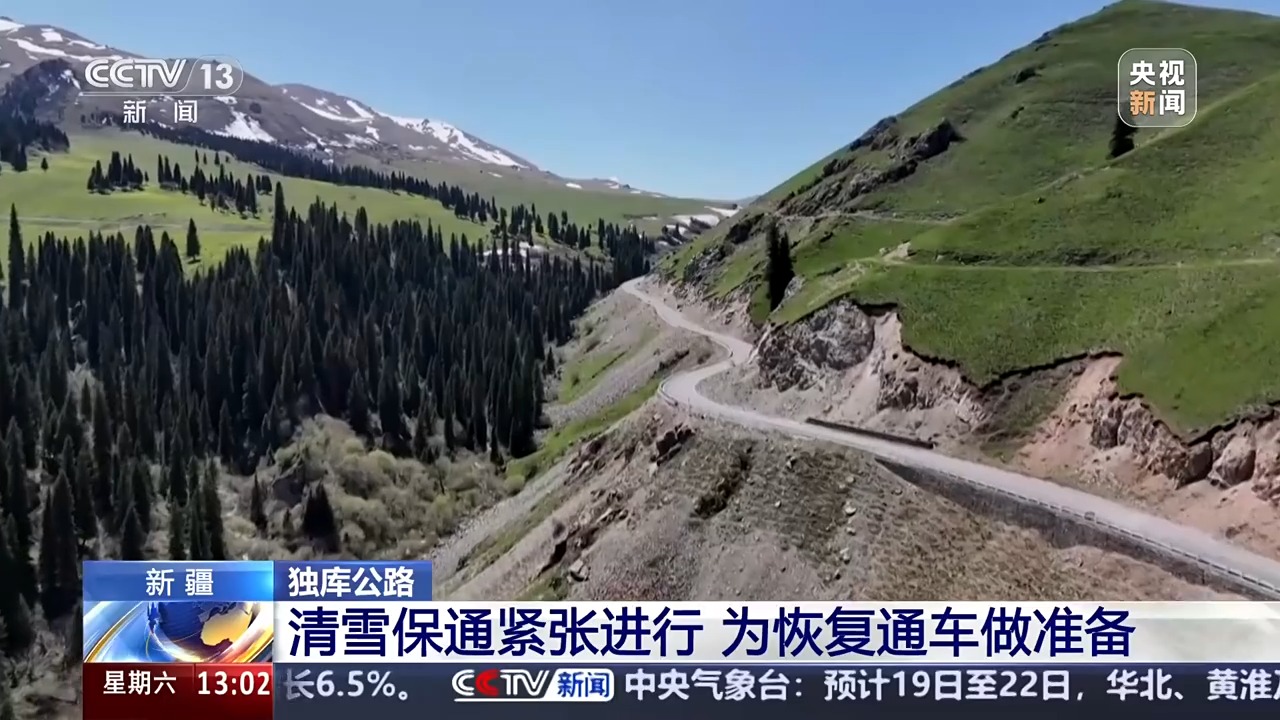
独库公路通车倒计时 准备好“一天游四季”了吗?
Yang Shi Xin Wen· 2025-05-17 08:02
Core Viewpoint - The Duku Highway, a scenic route spanning 561 kilometers through the Tianshan Mountains, is preparing to reopen for traffic after winter snow removal efforts, showcasing its unique landscapes and geological diversity [1][4][17]. Group 1: Road Conditions and Maintenance - The Duku Highway has 205 kilometers of closed sections requiring snow removal, with the last segment of approximately 500 meters being cleared [4][17]. - Snow depths in some areas can reach up to 6-7 meters, complicating the snow removal process [4][8]. - As of now, a total of 161,000 cubic meters of snow have been cleared, equivalent to the volume of 1.7 Water Cube facilities [8]. Group 2: Snow Removal Equipment and Techniques - The snow removal operations utilize advanced machinery, including rotary snowplows capable of handling snow depths over 2 meters [6][13]. - Various types of snow removal equipment, nearly 10 different kinds, are deployed along the highway to ensure efficient snow clearance [6][8]. Group 3: Geological and Environmental Challenges - The Duku Highway is prone to geological hazards such as landslides and rockfalls, earning it the nickname "Museum of Road Diseases" [9][15]. - The road's construction and maintenance face challenges due to its high-altitude, cold climate, and the presence of permafrost [11][15]. Group 4: Historical Context and Significance - The Duku Highway was completed in 1983, significantly reducing travel distance between northern and southern Xinjiang by nearly half [19]. - The construction of the highway involved significant sacrifices, with 168 builders losing their lives during its development [18][21].