
玉露

Search documents
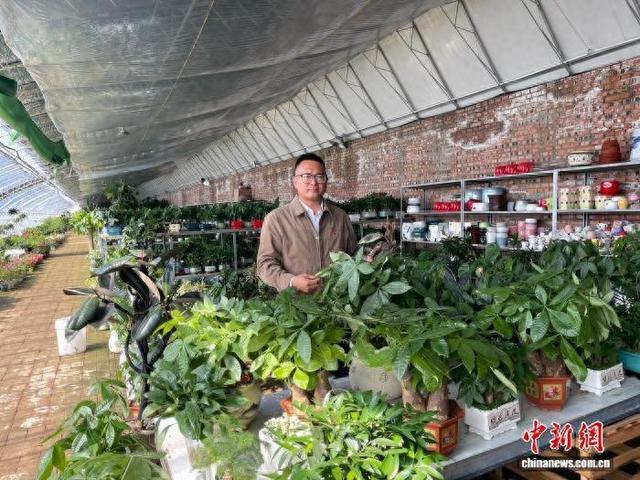
(乡村兴·看振兴)喜欢侍弄花卉的“90后”村党总支部书记
Zhong Guo Xin Wen Wang· 2025-10-14 13:13
Core Viewpoint - The article highlights the efforts of Liu Dapeng, a village party secretary, in promoting flower cultivation as a means of economic development and community engagement in Yongsheng Village, Inner Mongolia [1][3]. Group 1: Background and Development - Liu Dapeng, born in 1990, is the party secretary of Yongsheng Village in the Dongsheng District of Ordos City, Inner Mongolia [3]. - Since 2015, some villagers began experimenting with flower cultivation, but initial efforts were small-scale and lacked significant impact [3]. - The local government recognized the potential of flower cultivation and initiated the establishment of standardized greenhouses to support this industry [3][4]. Group 2: Economic Impact - From 2015 to 2023, flower cultivation has generated an annual income of 50,000 yuan for the village's collective economy [3]. - After Liu Dapeng's appointment in 2023, he expanded the flower cultivation area to 30 acres, projecting an annual income of approximately 300,000 yuan for the village [4]. - The flower greenhouses now feature over a thousand varieties, attracting customers from nearby regions and significantly boosting local sales [4]. Group 3: Community Engagement and Future Plans - Liu Dapeng has actively involved villagers in the flower cultivation process, providing job opportunities that can yield over 200 yuan per day during off-peak farming seasons [4]. - The village plans to integrate idle land for expanding flower cultivation and diversifying into fruits and vegetables, aiming for a holistic development approach that combines agriculture with tourism and commerce [5]. - Economic expert Gai Zhiyi commended Liu Dapeng's initiatives, noting the transformation of "flower economy" into tangible economic value, which is a distinctive aspect of rural revitalization [5].

2025中国人送礼不完全指南
Hu Xiu· 2025-05-17 12:33
Group 1 - The article discusses the art of gifting tea in a culturally nuanced manner, emphasizing the importance of understanding both tea and the recipient's preferences [1][2][3] - It outlines 20 subtle rules for gifting tea, aiming to help individuals navigate the complexities of tea gifting without falling for misleading sales tactics [3][4] - The guide is not intended to make someone a tea expert but serves as a practical "avoidance guide" to prevent awkward gifting situations [4][5] Group 2 - The article highlights that gifting tea should not be confused with business dealings; it is more about maintaining personal relationships [8] - It stresses the importance of knowing the recipient's taste in tea, as preferences can vary widely, and a mismatched gift can be seen as thoughtless [9][10] - Seasonal considerations are also important when selecting tea, with specific types recommended for different times of the year [11] Group 3 - The article provides a mnemonic for selecting universally accepted teas, suggesting that red and green teas are generally well-received [12] - It advises on the significance of the recipient's tea-drinking habits and the quality of tea to be gifted, indicating that higher quality is often appreciated [12][13] - Regional preferences for tea are noted, with specific recommendations for different areas in China, suggesting that thoughtful selection can enhance the gift's impact [13] Group 4 - The article suggests modern twists on traditional tea gifting, such as presenting tea in a way that appeals to younger audiences, like incorporating trendy tea drinks [13] - It warns against gifting certain types of tea, such as "小青柑," unless the quality is assured, indicating a focus on quality over quantity [14] - The significance of tea in social contexts, such as during family introductions or workplace interactions, is emphasized, highlighting its role in building relationships [15] Group 5 - The article discusses the importance of how one presents the tea, including the language used when discussing the gift, to avoid potential faux pas [16] - It introduces a "blame-shifting" tactic for discussing the quality of the tea, allowing the giver to deflect any criticism [17] - Finally, it suggests alternative gifts, such as cherries or crabs, if one is unsure about tea, emphasizing the principle of giving gifts that do not require reciprocation [18]