瓦

Search documents
重庆市市场监督管理局发布2025年烟花爆竹等13种产品质量市级监督抽查情况通报
Zhong Guo Zhi Liang Xin Wen Wang· 2026-02-14 09:18
Core Viewpoint - The Chongqing Municipal Market Supervision Administration has released a report on the quality supervision and inspection of 13 products, including fireworks and firecrackers, revealing that 67 batches of products were found to be non-compliant in 2025 [2][3]. Group 1: Inspection Results - A total of 67 batches of products were identified as non-compliant, including 11 batches of fireworks and firecrackers, 3 batches of architectural coatings, 3 batches of waterproof coatings, 4 batches of pavement bricks, and various other products [3][10]. - Specific non-compliance issues for fireworks included drug quantity, measurement errors, ignition line firmness, ignition time, and performance during discharge [4]. - Non-compliance in architectural coatings involved the bonding strength of interior wall putty [5]. - For waterproof coatings, issues included solid content, tensile strength, elongation at break, tear strength, water absorption, and volatile organic compounds (VOC) [6]. - Pavement bricks failed to meet wear resistance standards [7]. - Other products such as concrete bricks, tiles, plugs, sockets, high and low voltage equipment, and fire safety products also had various non-compliance issues [9][10]. Group 2: Regulatory Actions - The Market Supervision Administration will enforce measures such as sealing and confiscating non-compliant products, and will require manufacturers and sellers to implement corrective actions [10][11]. - Companies found to be in violation may face legal consequences, including referral to judicial authorities if criminal activities are suspected [10]. - The administration emphasizes the importance of quality safety management, requiring companies to appoint quality safety supervisors and establish risk control lists [10].


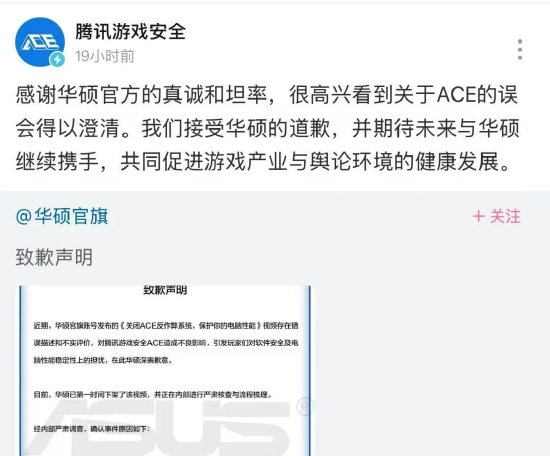
腾讯回应华硕致歉:接受道歉,期待未来继续携手
Xin Lang Ke Ji· 2025-11-05 14:07
Core Viewpoint - ASUS issued an apology for a video that misrepresented Tencent's ACE anti-cheat system, causing concerns among players regarding software security and computer performance [1][2] Group 1: Incident Overview - The incident began when ASUS's official Bilibili account released a video titled "Disable ACE Anti-Cheat System to Protect Your Computer Performance," which quickly sparked discussions among players [2] - The video claimed that "Tencent ACE may not prevent cheats, but it will definitely scan your hard drive," and suggested that ACE would consume significant memory, leading to game lag and frame drops [2] Group 2: ASUS's Response - ASUS confirmed that the issue arose from a lack of stringent content review processes and management oversights regarding the supplier team [1] - The company has taken immediate action by removing the video and conducting an internal investigation [1] - ASUS plans to implement stricter multi-level content review mechanisms to ensure the accuracy and truthfulness of published content in the future [1] Group 3: Tencent's Reaction - Tencent's game security official account expressed gratitude for ASUS's sincere apology and acknowledged the clarification regarding ACE [2] - Tencent looks forward to continued collaboration with ASUS to promote a healthy development of the gaming industry and public discourse [2]

文博日历丨南越国工匠干活不留名?那就留个“自拍”
Yang Shi Xin Wen· 2025-10-25 02:04
Core Insights - The article discusses the historical origins of facial recognition, tracing it back over 2000 years to the Southern Yue Kingdom, where a piece of pottery with human faces was discovered, indicating early forms of identity verification [6][19]. Group 1: Historical Context - Archaeological findings from the Southern Yue Kingdom reveal a pottery shard with unique human face designs, suggesting that early forms of "selfie" or identity representation existed [6]. - The hairstyle depicted on the pottery, known as "椎髻" (zhuī jì), was popular among workers from Hainan Island, indicating the cultural exchange and migration patterns of that era [12][15]. - The practice of marking products with the craftsman's name for accountability, known as "物勒工名," was implemented during the Spring and Autumn period and continued into the Qin and Han dynasties, serving as an ancient product traceability system [17][19]. Group 2: Cultural Significance - The pottery not only reflects individual identity but also the broader societal practices of the Southern Yue Kingdom, which mirrored the central plains' governance systems [19]. - The discovery of various pottery inscriptions, including names and roles, highlights the organized structure of labor and production in ancient China, akin to modern-day identity verification systems [20][25]. - The article concludes by emphasizing that the concept of "real-name system" in ancient times has left a lasting legacy, showcasing the deep-rooted traditions of craftsmanship and accountability in Chinese manufacturing [31].