生活家居机器人

Search documents
中国经济面面观|“人工智能+” 如何重塑生产生活范式?
Xin Hua She· 2025-10-22 08:07
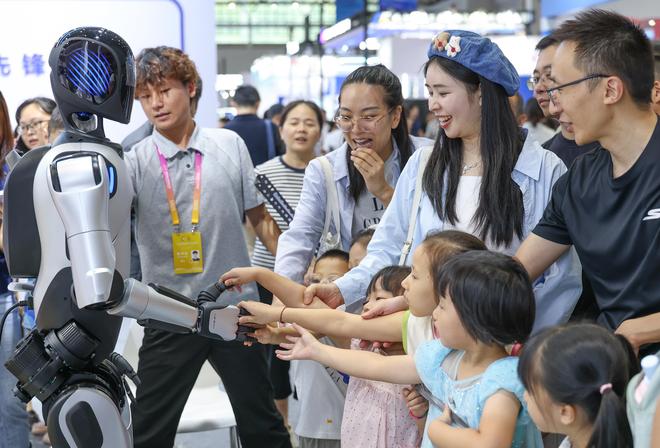
Core Insights - The Chinese government has issued an opinion on the implementation of "Artificial Intelligence +" to accelerate the formation of a new intelligent economy and society characterized by human-machine collaboration and cross-industry integration [2][8] - AI is deeply integrating into various sectors such as healthcare and finance, transforming traditional processes and enhancing quality of life [2][4] Healthcare Sector - AI is reshaping medical processes, shifting from passive patient services to proactive care, enabling doctors to form multidisciplinary teams for more comprehensive and precise treatment [4] - The integration of real-time updated medical knowledge through AI significantly improves diagnostic accuracy and efficiency, enhancing the quality of healthcare services [4] Financial Sector - In finance, AI acts as a guardian of consumer finances, with systems in place to accurately identify customer intentions and provide 24/7 support for safeguarding funds [6] - Financial institutions are expected to evolve from offering standardized products to becoming more customer-centric and secure "intelligent partners" [6] Technological and Policy Integration - The implementation of relevant policies, along with technological and industrial collaboration, is expected to accelerate the transition of AI from a tool to a partner, creating a healthier, safer, and more convenient lifestyle [8]

财经聚焦|核心CPI重回1%,9月物价数据透出哪些信号?
Xin Hua She· 2025-10-15 14:12
Group 1 - The consumer price index (CPI) in September showed a month-on-month increase of 0.1%, with the core CPI (excluding food and energy) rising by 1% year-on-year, marking the first return to a 1% increase in nearly 19 months [1] - Food prices contributed to the CPI increase, with a 0.7% rise in food prices month-on-month, impacting the CPI by approximately 0.13 percentage points [1] - The decline in CPI year-on-year was 0.3%, with the drop narrowing by 0.1 percentage points compared to the previous month, primarily due to the "tail effect" [3] Group 2 - The Producer Price Index (PPI) showed a year-on-year decline of 2.3% in September, with the decrease narrowing by 0.6 percentage points from the previous month, indicating positive changes in industrial pricing [4] - The prices in certain industries, such as coal processing and black metal smelting, showed a narrowing decline, reflecting improved market competition and capacity management [5] - The new energy and technology sectors are experiencing growth, with emerging consumption patterns leading to price increases in related industries, such as a 1.4% rise in aircraft manufacturing prices [6][8] Group 3 - The demand for quality consumption is increasing, with a shift from quantity expansion to quality enhancement as GDP per capita exceeds $13,000 [8] - Prices for high-quality consumer goods, such as arts and crafts, saw significant increases, with a 14.7% rise in the manufacturing price of arts and crafts and a 4% increase in sports equipment manufacturing [8] - Policies aimed at boosting consumption are expected to further support price trends in various industries, leading to improved market supply and demand relationships [8]