生物样本库

Search documents
Azenta(AZTA) - 2026 Q1 - Earnings Call Transcript
2026-02-04 14:32
Financial Data and Key Metrics Changes - Total revenue for Q1 2026 was $149 million, up 1% reported but down 1% organically, with a 2% headwind from foreign exchange [16][18] - Non-GAAP EPS for the first quarter was $0.09, and adjusted EBITDA margin was 8.5%, down approximately 230 basis points year-over-year [17][19] - Free cash flow, including B Medical, was $15 million for the quarter, with cash, cash equivalents, and marketable securities totaling $571 million, an increase of $25 million quarter-over-quarter [17][18] Business Line Data and Key Metrics Changes - In Sample Management Solutions, revenue was $81 million, flat on a reported basis and down 2% organically, with growth in biorepositories offset by softness in automated stores [20] - Multiomics revenue was $67 million, up 1% on a reported basis and flat organically, with growth in next-generation sequencing and gene synthesis, but continued weakness in Sanger sequencing [21][22] Market Data and Key Metrics Changes - North America experienced softness due to macro-driven budget constraints and a government shutdown, while Europe and Asia showed positive momentum [9][22] - China reported 26% organic growth in Multiomics, driven by strong demand in biotech and pharma [22][76] Company Strategy and Development Direction - The company aims to embed operational excellence, accelerate growth, and expand margins as part of its turnaround strategy [8][10] - Focus on core portfolio and strategic capital deployment, including a $250 million share repurchase authorization [12][18] Management's Comments on Operating Environment and Future Outlook - Management expressed cautious optimism about improvement in capital markets and government funding, expecting greater clarity in the coming months [9][10] - 2026 is viewed as a transitional year for the life sciences sector, with expectations for acceleration in the second half of the year [10][23] Other Important Information - The sale of B Medical Systems is expected to close on or before March 31, 2026, further sharpening the company's focus on its core portfolio [12][16] - The company is committed to maintaining financial flexibility to support disciplined capital deployment [18] Q&A Session Questions and Answers Question: Can you talk about your level of confidence in getting the SMS margins back to where you want them to be? - Management acknowledged challenges due to product mix and quality issues but reiterated confidence in achieving margin targets through operational improvements [25][26] Question: Can you characterize the conversations you've had with customers in the academic and government segments? - Management reported positive conversations and momentum in North America, indicating a bullish outlook for the back half of the year [32][33] Question: What are your expectations for top-line performance in Q2 and the cadence from Q2 to Q3? - Management indicated an uplift in Q2 revenue but emphasized that significant growth is expected in the second half of the year [40][41] Question: How are you thinking about performance in the U.S. academic market given flat NIH budgets? - Management noted a shift in funding priorities and expressed confidence in supporting core labs and driving productivity [46][47] Question: What are you seeing from pharma and biotech customers right now? - Management observed more clarity and commitment from pharma and biotech customers, indicating a positive sentiment moving forward [48][49] Question: Where do you think you can find some of the offset to achieve the 300 basis point expansion? - Management highlighted several levers, including increased sales volume and operational efficiencies, to achieve margin expansion [51][53]

港深创科园第一批首三座大楼落成 李家超:将优化制度衔接及积极引入优质企业
智通财经网· 2025-12-22 11:11
Core Insights - The first phase of the Hong Kong-Shenzhen Innovation and Technology Park has completed three buildings, with two wet laboratory buildings housing over 60 enterprises and institutions from overseas, mainland China, and local areas, achieving an occupancy rate of nearly 80% [1][2] - The remaining five buildings are scheduled for completion starting in 2027, with the total area of the second phase planned to reach 20 million square meters, a 70% increase from the original plan [2] Development and Infrastructure - The opening ceremony of the Hong Kong-Shenzhen Innovation and Technology Park was attended by key officials, including the Chief Executive of Hong Kong, who emphasized the park's role as a significant cooperation platform under the national 14th Five-Year Plan for the Guangdong-Hong Kong-Macao Greater Bay Area [1] - A new cross-river bridge project connecting the two parks has officially commenced, aimed at enhancing the transportation network of the cooperation zone and facilitating cross-border personnel movement [2] Future Plans - The government plans to continue advancing the development of the Hong Kong park by optimizing institutional connections, deepening policy support, and actively attracting high-quality enterprises and world-class research teams [2] - The goal is for the cooperation zone to become a leading hub and demonstration area for innovation and technology development in Hong Kong [2]
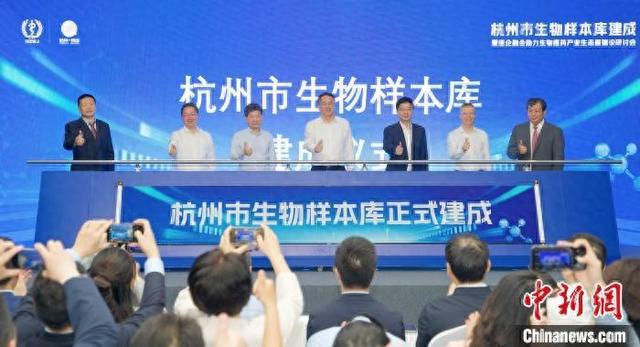
全省首个!杭州市“生物银行”建成投用
Hang Zhou Ri Bao· 2025-04-23 02:31
Core Insights - The establishment of the Hangzhou Biobank aims to enhance precision medical services through resource integration, technological innovation, and standardized management, contributing to high-quality development in the biopharmaceutical sector [1] Group 1: Biobank Overview - The biobank, also known as a "biological bank," is designed to store various human biological materials for clinical treatment and life science research, serving as a critical national strategic resource [2] - The newly constructed biobank can store approximately 2 million biological samples, including cells, organs, and nucleic acids, in a deep low-temperature storage area [2] - The biobank includes various experimental technology platforms in genomics, proteomics, and pathology, facilitating collaborative development under compliance guidelines [2] Group 2: Collaborative Projects and Research - Eight institutions, including the First Hospital and the Seventh Hospital, have signed agreements to collaborate with the biobank on projects related to early cancer screening, depression treatment, and research on rare diseases [3] - The biobank aims to support the development of new drugs and testing methods for rare diseases, leveraging data sharing among participating institutions [3] - The biobank's operational structure is based on a "2+3+4" framework, integrating decision-making, scientific technology, and ethical oversight with resource management and operational centers [3] Group 3: Future Development and Goals - The biobank plans to build a comprehensive biological sample resource network covering the entire lifecycle of samples, focusing on standardized construction [4] - Through deep collaboration with universities and enterprises, the biobank aims to accelerate the clinical translation of cutting-edge technologies such as gene testing and cell therapy [4] - The integration of medical and enterprise ecosystems in Hangzhou is expected to create a virtuous cycle of data-driven research, industry leadership, and health service provision, contributing to the "Healthy China" strategy [4]
杭州打造生物样本库 加速生物医学前沿技术临床转化
Huan Qiu Wang Zi Xun· 2025-04-22 16:36
Core Viewpoint - The establishment of the Hangzhou Biobank aims to create an international-level resource-sharing service hub for biological samples, promoting a deep integration of government, industry, academia, research, and application in the biomedicine sector [1]. Group 1: Biobank Establishment - The biobank was initiated in 2020 and features a "2+3+4" operational structure, which includes dual leadership from the Hangzhou Health Commission and Qiantang District, along with three committees for management, scientific technology, and regional ethics, and four centers for preservation, information, transformation, and operation [3]. - The biobank has attracted over 80 partner organizations, including leading institutions such as the Beijing Biobank, West Lake University, Liangzhu Laboratory, and East China Pharmaceutical, aiming to connect clinical research with industrial transformation [3]. Group 2: Collaborative Projects - During the signing ceremony, partnerships were established with eight units, covering projects in areas such as early cancer screening, depression treatment, and amyotrophic lateral sclerosis research [3]. - The biobank will serve as a bridge in the "basic research - clinical validation - industrial transformation" process, showcasing projects like "AI and omics-enabled next-generation biobanks" and "gene multi-omics plan for skin diseases" [4]. Group 3: Future Development - The biobank plans to focus on standardized construction to create a comprehensive biological sample resource network throughout its lifecycle, accelerating clinical transformation of cutting-edge technologies like gene testing and cell therapy through deep collaboration with universities and enterprises [4]. - As the medical-enterprise integration ecosystem improves, Hangzhou is expected to establish a virtuous cycle in biomedicine characterized by "data-driven research, research leading industry, and industry serving health" [4].