申万宏源证券APP

Search documents
驫腾万里贺新春丨2026春节休市安排(内附假期闲钱理财攻略)
申万宏源证券上海北京西路营业部· 2026-02-05 02:30
Core Viewpoint - The article discusses the arrangements for the 2026 Spring Festival market closure and provides strategies for participating in government bond reverse repos during this period, highlighting the potential for earning fixed interest income with low risk [5][9]. Market Closure Arrangements - The A-shares market will be closed from February 15 (Sunday) to February 23 (Monday) for the Spring Festival, reopening on February 24 (Tuesday) [3][4]. - The Hong Kong Stock Connect will also suspend services from February 15 to February 23, resuming on February 24 [4]. Government Bond Reverse Repo Overview - Government bond reverse repos are short-term loans where individuals lend their funds to earn fixed interest, with government bonds used as collateral, considered as safe as the bonds themselves [5]. - The interest rates for government bond reverse repos typically rise significantly before month-end, quarter-end, year-end, and holidays, making them an attractive option for idle funds [5]. Participation Strategies for 2026 Spring Festival - A detailed table outlines the participation dates, product terms, available fund dates, and interest days for various reverse repo products, indicating that investors can choose from different terms based on their needs [7][9]. - For example, a 14-day term starting on February 4 will have a fund availability date of February 24 and an interest period of 20 days [7]. Tips for Participation - The minimum investment for government bond reverse repos is 1,000 yuan, with various term options available [8]. - Investors are advised to consider higher-yielding products when interest days are the same across different terms and to execute a one-day reverse repo two days before the market closure to earn holiday interest without affecting other account operations [8].


券商APP月活保持高位,18家月均破百万,AI成迭代核心
Xin Lang Cai Jing· 2026-01-08 09:01
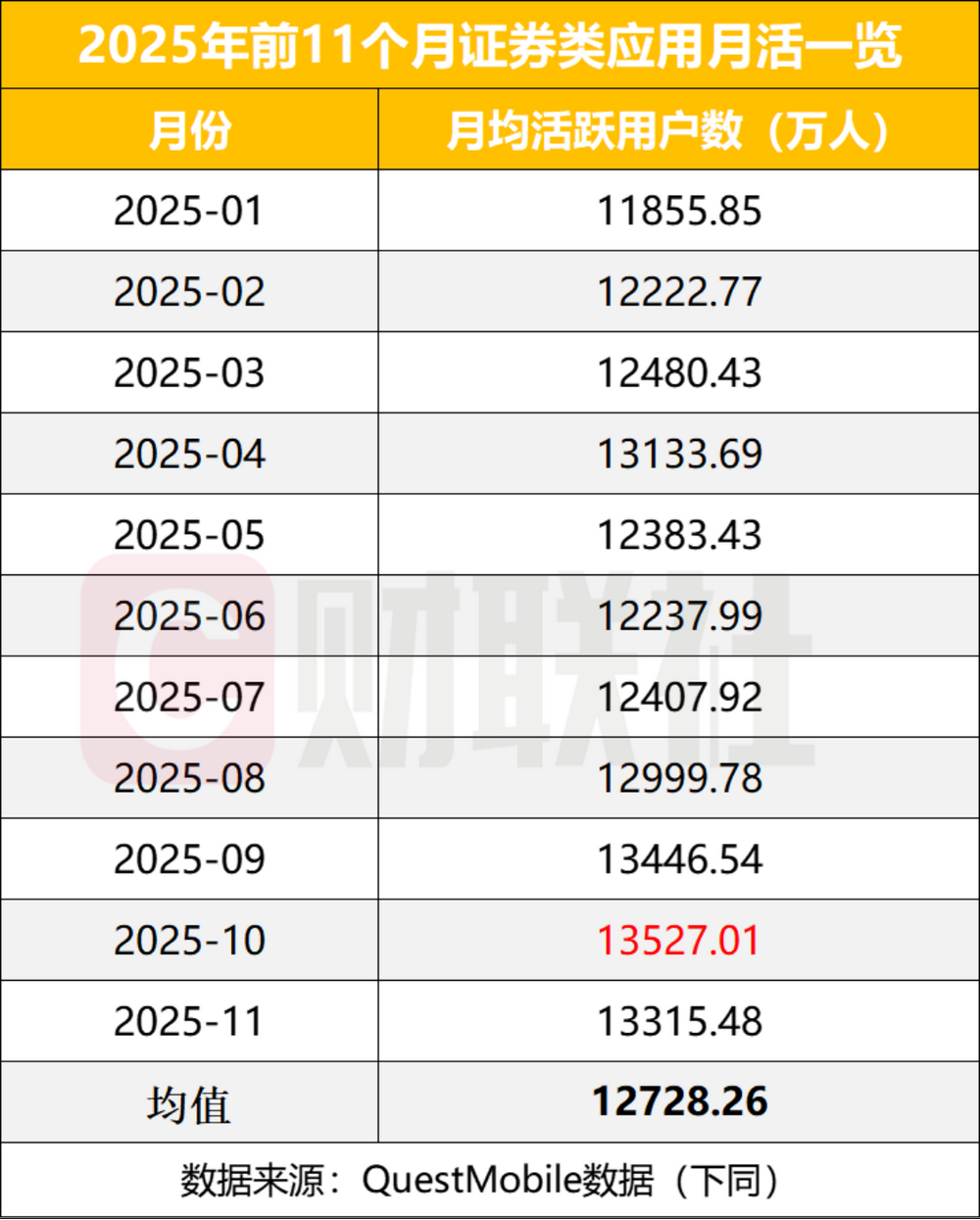
Core Insights - The securities app market demonstrates strong resilience amid market fluctuations and technological changes, with an average monthly active user (MAU) of 127.28 million in the first 11 months of 2025, peaking at over 135 million in October [1][2]. User Engagement - The top 10 securities firms by MAU include Huatai Securities, Guosen Securities, and China Galaxy Securities, with Huatai's app achieving an average MAU of 8.25 million [4][5]. - A total of 18 firms reported an average MAU exceeding 1 million, indicating a competitive landscape [2][4]. App Development Trends - "High-frequency iteration" is a key trend, with the top 10 apps averaging 9 updates this year, focusing on trading features, market services, and AI capabilities [3][13]. - Guotai Junan's apps led the industry with 25 updates each, showcasing a commitment to continuous improvement [3][13]. Growth Metrics - Several apps achieved significant growth, with the highest increase seen in Industrial Securities' app, which grew by 67.64% from January to November [7][8]. - Year-over-year, 18 apps reported growth, with only two experiencing a decline [9][10]. Daily Active Users (DAU) - Huatai's app leads in DAU with an average of 337.97 million, significantly higher than the second-place app from招商证券 at 199.29 million [11][12]. AI Integration - The integration of AI in investment advisory services is a major focus, with firms like Guotai Junan and China Galaxy enhancing their apps with AI-driven features [13][14]. - The trend towards digital transformation is evident as firms aim to improve user experience and service efficiency through AI [13][14].




申万宏源IPO保荐屡受罚 两月前APP登侵害用户权益名单
Zhong Guo Jing Ji Wang· 2026-01-07 06:49
Group 1 - The core viewpoint of the articles highlights the decline in the investment banking quality rating of Shenwan Hongyuan, which dropped from A to C in the recent evaluation by the Securities Association of China, raising market concerns [1] - In the 2025 evaluation, out of 93 securities firms, 12 were rated A, 66 rated B, and 15 rated C, indicating a significant drop for Shenwan Hongyuan [1] - Shenwan Hongyuan has faced multiple regulatory penalties over the past year, which are likely the main reasons for its downgrade [1] Group 2 - Specific incidents leading to penalties include disciplinary actions from the Shanghai Stock Exchange for inadequate performance of sponsorship duties during the IPO application process for Guohong Tools, resulting in a public reprimand and a six-month ban on certain representatives [1] - The Shenzhen Stock Exchange also issued self-regulatory measures against Shenwan Hongyuan for issues related to internal controls and accounting practices in the IPO project of Hainuoer, indicating a lack of due diligence [1] - Additionally, the Shanghai Municipal Communications Administration reported that two apps associated with Shenwan Hongyuan were found to have user rights infringement issues, specifically difficulties in account cancellation [2]

71款APP侵害用户权益 含申万宏源与国信证券子公司
Zhong Guo Jing Ji Wang· 2025-12-23 06:57
Core Viewpoint - The Shanghai Municipal Communications Administration reported that 71 apps (SDKs) were found to infringe on user rights, highlighting ongoing issues with user data protection in the app industry [1]. Group 1: Company Issues - Guoxin Futures Co., Ltd.'s app, Guoxin Futures (version 1.0.8), was flagged for illegally collecting personal information [2]. - Shenwan Hongyuan Securities Co., Ltd.'s apps, Shenwan Hongyuan (version 1.3.81) and Shenwan Hongyuan Securities (version 6.0.6), faced issues related to difficulties in account cancellation [3][4]. - Guoxin Futures is a wholly-owned subsidiary of Guoxin Securities, as indicated in its annual report [5]. - Shenwan Hongyuan Securities is a wholly-owned subsidiary of Shenwan Hongyuan, as per its annual report [5].

申万宏源证券荣获“2025中国证券业君鼎奖”多项大奖
申万宏源证券上海北京西路营业部· 2025-10-10 01:55
Core Viewpoint - The company has achieved significant recognition in wealth management and digital practices, winning four major awards at the 2025 Wealth Securities Digital Annual Ecological Summit hosted by Securities Times [2] Group 1: Awards and Recognition - The company received the 2025 China Securities Industry Institutional Service Provider Jun Ding Award for Public Fund Services, highlighting its excellence in this area [4] - The company was awarded the 2025 China Securities Industry APP Operation Team Jun Ding Award, reflecting its continuous upgrades in wealth management digital capabilities [5] - The company also won the 2025 China Securities Industry Wealth Brokerage Digital Practice Case Jun Ding Award, showcasing its effective use of AI algorithms to enhance customer service and investment experience [5] - The company secured the 2025 China Securities Industry Digital Innovation Service Practice Case Jun Ding Award for its advanced low-latency options market-making platform, which has significantly improved market liquidity [5] Group 2: Service Innovations - The company provides comprehensive service solutions for public fund clients, integrating financial technology and various business resources to achieve information sharing and business collaboration [5] - The company focuses on "customer lifecycle management" to maximize customer value through a closed-loop system of "reach-cultivation-conversion" [5] - The company has developed a multi-center architecture for its options market-making platform, enhancing automated quoting capabilities and achieving a leading market share in options trading volume [5]

中小公募APP退场加速:天弘、鹏华、博时陷关停倒计时,低效清退成行业共识
Xin Lang Ji Jin· 2025-08-11 09:43
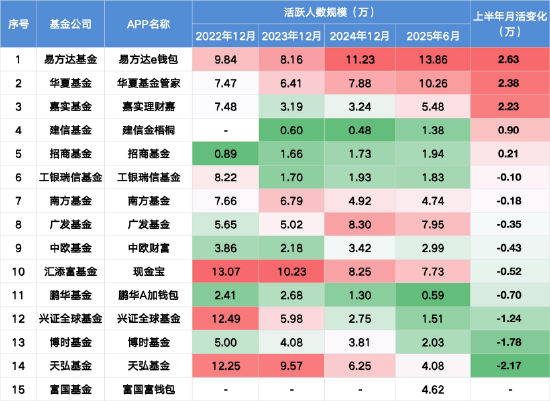
Core Viewpoint - The trend of fund companies shutting down their mobile apps is accelerating, driven by high operational costs and declining user engagement, leading to a shift towards simplified operational strategies in the industry [1][6]. Group 1: Industry Trends - Since 2019, several mid-sized public fund companies have closed their independent app operations, including Qianhai Kaiyuan Fund and Guoshou Anbao Fund [1]. - The overall pressure on fund apps includes shrinking net values, declining monthly active users (MAU), and low operational scales [1]. - The initial goal of fund companies developing their own apps was to reduce reliance on third-party distribution channels, but this has changed due to high maintenance costs and limited direct sales revenue [1][5]. Group 2: User Engagement Data - In the first half of 2025, only five fund apps saw positive growth in monthly active users: E Fund e-Wallet (+26,300 to 138,600), Huaxia Fund Manager (+23,800 to 102,600), and others [2]. - Conversely, many fund apps are experiencing significant user losses, with Tianhong Fund's app dropping to 40,800 MAU, about one-third of its user base three years ago [2]. - Other fund apps, such as Bosera and Xingsheng Global, also reported declines of over 10,000 MAU [2]. Group 3: Competitive Landscape - The competitive landscape shows that brokerage apps maintain higher user engagement, with monthly active users in the hundreds of thousands, contrasting sharply with fund apps [2][5]. - The top-performing brokerage app, "Zhang Le Cai Fu Tong," had 10.97 million MAU, while the second, Ping An Securities, had 8.14 million [5]. - The decline in user numbers for fund apps is attributed to the siphoning effect of third-party distribution platforms, which have rapidly grown due to their traffic and product offerings [5][6]. Group 4: Regulatory Impact - The China Securities Regulatory Commission's 2025 action plan encourages fund companies to optimize resource allocation and reduce inefficient investments, further accelerating the trend of app closures [6]. - The industry is transitioning from "heavy asset direct sales" to "lightweight operations," with a focus on cost-effective models [6]. Group 5: Future Outlook - The future of direct sales channels in public funds is expected to diversify, with smaller institutions likely abandoning independent apps in favor of lighter platforms like WeChat services and official websites [6]. - The industry is predicted to deepen investment advisory services, enhancing competitiveness through professional services and brand building rather than high-frequency trading [6].