
癌症体检

Search documents
十年未检出癌症确诊即晚期,女律师状告爱康国宾索赔处理意见公布
Di Yi Cai Jing· 2025-12-13 15:07
Core Viewpoint - The investigation into Aikang Guobin's medical examination centers revealed issues such as unregistered multiple practice locations for physicians, incomplete health examination reports, and improper medical waste collection records, leading to a supervisory notice for rectification [1][3]. Group 1: Investigation Findings - The Beijing Municipal Health Commission's response indicated that no major violations such as misdiagnosis or data falsification were found in the core examination services of Aikang Guobin's facilities, although some institutions had issues with medical waste management and incomplete physician registrations [1][2]. - Specific violations included the West Sanqi Clinic having unregistered multiple practice locations for physicians and improper medical waste collection records, resulting in a supervisory notice and negative practice scoring [3]. - The West Neimen Clinic received a warning and a fine of 2,000 yuan for non-compliance with health standards regarding medical waste storage [3]. Group 2: Legal and Regulatory Actions - Aikang Guobin has filed a lawsuit against Zhang Xiaoling for defamation, seeking 10 million yuan in damages due to claims of misdiagnosis and data falsification related to her cancer diagnosis [4]. - The investigation into the qualifications of the involved physicians found no evidence of fraud in their academic credentials or publications, and the Beijing Municipal Health Commission plans to conduct a technical appraisal of the medical incidents raised by the complainant [3]. Group 3: Medical Examination Insights - The cancer marker CEA, which Zhang Xiaoling questioned, is a glycoprotein used to detect gastrointestinal tumors, and its abnormal levels indicate the need for further screening [4]. - Experts suggest that while early detection of cancer through examinations is theoretically possible, it depends on various factors including the characteristics of the cancer and the methods used for testing [5].

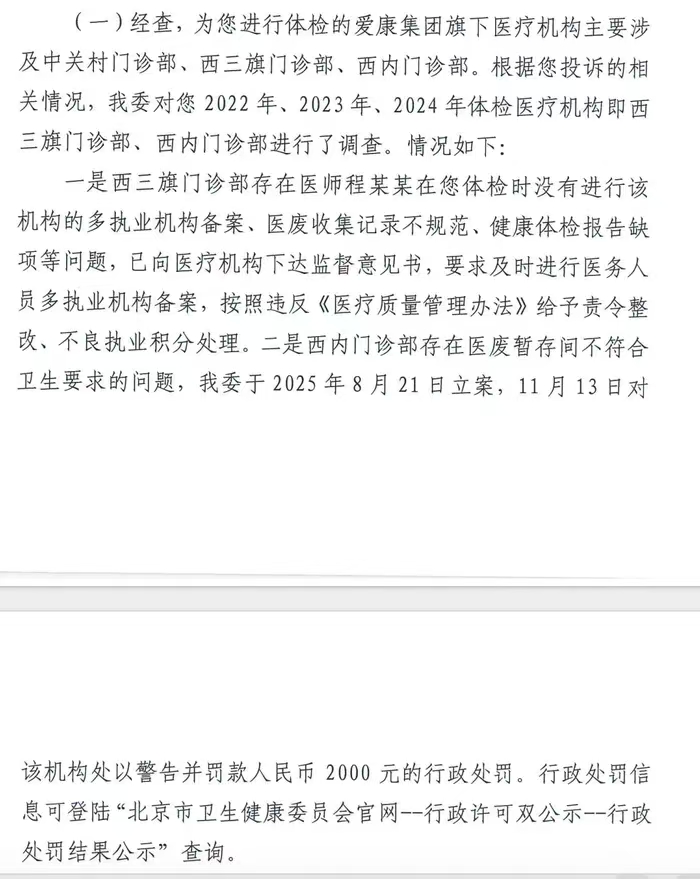
“女律师体检10年未预警却患癌症”最新进展,北京卫健委:未发现体检结果造假
Xin Lang Cai Jing· 2025-12-13 09:51
Core Viewpoint - The recent developments regarding the complaint by a cancer patient lawyer against Aikang Guobin highlight issues related to medical waste management and the integrity of health check results, leading to a fine imposed on the company for non-compliance with hygiene standards [1][5][20]. Group 1: Regulatory Actions - Aikang Guobin's clinic was fined 2000 yuan for failing to meet hygiene requirements for medical waste storage [1][5]. - The Beijing Health Commission issued a warning and required the clinic to rectify several violations, including improper medical waste collection records and incomplete health check reports [5][16]. - The penalty was publicly announced on November 14, with the infraction occurring on November 13 [11][15]. Group 2: Investigation Findings - The investigation by the Beijing Health Commission found no evidence of data falsification in the cancer embryonic antigen (CEA) tests conducted by Aikang Guobin [1][4][14]. - CEA is noted as a non-organ-specific tumor marker, and elevated levels can indicate various cancers, but normal levels do not rule out malignancies [14]. - The laboratory used by Aikang Guobin was confirmed to be compliant with quality standards, and the test results were traceable to original measurements [14]. Group 3: Ongoing Legal Disputes - The lawyer, Zhang Xiaoling, has expressed dissatisfaction with the provided ultrasound images and is seeking a complete medical history for further technical assessment [6][19]. - Aikang Guobin has previously announced intentions to sue Zhang for defamation, claiming damages of 10 million yuan [20][21]. - The case has garnered significant public attention, particularly due to the allegations of failure to warn about cancer risks during a decade of health checks [20][21].

起诉质疑者,西贝们错在哪?
Hu Xiu· 2025-09-12 10:52
Core Viewpoint - The article discusses the crisis faced by companies like Xibei and Aikang Guobin, highlighting that the root of the crisis is not about right or wrong, but rather a misalignment in understanding between the companies and the public [1][2]. Group 1: Industry Standards vs Public Perception - In the medical examination industry, the standard is to "screen for abnormal indicators," not to "diagnose diseases," leading to a disconnect when consumers expect cancer detection [3]. - In the restaurant industry, Xibei's explanation that "central kitchen pre-processing does not equal pre-made dishes" fails to resonate with consumers who equate anything not freshly cooked as pre-made [4]. - This misalignment indicates that while industries have their own standards and terminologies, consumers lack the time or interest to understand these details [6]. Group 2: Defensive Reactions and Crisis Amplification - The misalignment could have been mitigated through patient explanation and communication, but both Aikang Guobin and Xibei opted for litigation as a response [7]. - For Xibei, the issue of "pre-made dishes" is not just a labeling problem but affects the entire supply chain and cost structure, necessitating a strong defense [8]. - Aikang Guobin views its examination services as "screening," not "diagnosis," and feels compelled to defend against public misconceptions that could undermine its business model [9]. Group 3: Public Sentiment and Perception - Public perception of pre-made dishes is simplistic, often siding with figures like Luo Yonghao, which indicates that Xibei underestimated consumer expectations for transparency in the food industry [10]. - In the Aikang incident, the lawyer's status as a cancer patient garnered public sympathy, making the company's litigation appear as "bullying the weak," overshadowing any professional arguments [11]. - Companies often perceive public questioning as a commercial threat, while the public desires a more open response to their concerns, leading to potential backlash if the boundaries between defense and public education are blurred [12]. Conclusion - The events involving Aikang Guobin and Xibei illustrate that in today's media environment, a company's "standard answer" may be perceived as the "wrong answer" by the public, highlighting a common challenge across industries [13]. - It is more effective for companies to establish effective communication and reduce cognitive gaps before crises arise, rather than responding defensively during a crisis [14]. - Ultimately, gaining public trust is essential for success in any industry [15].