砷化镓(GaAs)电池

Search documents
中国光伏行业协会:砷化镓电池是当前商业航天和空间站的主流选择
Jin Rong Jie· 2026-02-06 00:41
Core Insights - The recent surge in interest for space photovoltaics has been driven by news related to Elon Musk's team, although the technology is still in the early stages of exploration and validation [1] - Gallium arsenide (GaAs) solar cells remain the mainstream choice for commercial space applications and space stations due to their high conversion efficiency and radiation resistance, despite their high costs [1] - The heterojunction (HJT) perovskite technology, which has garnered significant market attention, is still in the experimental phase and far from large-scale commercialization [1] - Elon Musk's approach to space photovoltaics has evolved from conceptual statements to concrete plans, focusing on technology development, capacity building, and practical applications for Tesla and SpaceX [1] - The technological evolution of space photovoltaics has progressed through four iterations, leading to a current landscape dominated by GaAs technology, increased penetration of P-type heterojunctions, and accelerated research in perovskite tandem technology [1]
持续关注上游价格波动
Hua Tai Qi Huo· 2026-02-05 03:28
Report Summary 1) Report Industry Investment Rating No information provided. 2) Core Viewpoints - In the production industry, the space photovoltaic technology is in the early stage of exploration and verification, and it's too early to determine a clear technical direction. Currently, GaAs batteries are the mainstream choice for commercial aerospace and space stations, while HJT perovskite technology is still far from large - scale commercialization [1]. - In the service industry, the 2026 Credit Market Work Conference of the People's Bank of China required to accurately grasp the economic and financial situation changes in the 15th Five - Year Plan period, strengthen financial services in key areas, and develop various types of finance [1]. 3) Summary by Related Catalogs A. Upstream - **有色 (Non - ferrous metals)**: The price of electrolytic copper fluctuates, and the price of nickel continues to fall. The spot price of copper on February 4 is 104,786.7 yuan/ton, up 3.11% year - on - year; the spot price of zinc is 24,886.0 yuan/ton, down 1.39% year - on - year; the spot price of aluminum is 23,780.0 yuan/ton, down 2.00% year - on - year; the spot price of another type of aluminum is 16,481.3 yuan/ton, down 2.26% year - on - year [3][36]. - **农业 (Agriculture)**: The price of eggs has a callback. On February 4, the spot price of eggs is 7.7 yuan/kg, down 10.08% year - on - year. The spot price of corn is 2,267.1 yuan/ton, down 0.19% year - on - year; the spot price of palm oil is 9,074.0 yuan/ton, down 2.39% year - on - year; the spot price of cotton is 16,016.3 yuan/ton, down 0.59% year - on - year; the average wholesale price of pork is 18.4 yuan/kg, down 0.92% year - on - year [3][36]. - **黑色 (Black commodities)**: Black commodities decline slightly. The spot price of螺纹钢 (rebar) on February 4 is 3,177.0 yuan/ton, down 0.38% year - on - year; the spot price of铁矿石 (iron ore) is 805.6 yuan/ton, down 0.38% year - on - year; the spot price of线材 is 3,377.5 yuan/ton, down 0.88% year - on - year [3][36]. B. Midstream - **化工 (Chemical industry)**: The operating rates of PX and urea remain at high levels. On February 4, the spot price of PTA is 5,151.1 yuan/ton, down 3.08% year - on - year; the spot price of polyethylene is 6,930.0 yuan/ton, up 0.36% year - on - year; the spot price of urea is 1,777.5 yuan/ton, up 1.43% year - on - year; the spot price of soda ash is 1,201.4 yuan/ton, down 0.12% year - on - year [3][36]. - **能源 (Energy)**: The coal consumption of power plants is at a low level. The coal price on February 4 is 800.0 yuan/ton, down 0.50% year - on - year; the spot price of WTI crude oil is 63.2 dollars/barrel, up 1.31% year - on - year; the spot price of Brent crude oil is 67.3 dollars/barrel, up 1.11% year - on - year; the spot price of liquefied natural gas is 3,728.0 yuan/ton, up 3.61% year - on - year [3][36]. - **农业 (Agriculture)**: The operating rate of pork products increases [3]. C. Downstream - **地产 (Real estate)**: The sales of commercial housing in first - and second - tier cities decline seasonally [3]. - **服务 (Service)**: The number of domestic flights is at a high level [3].
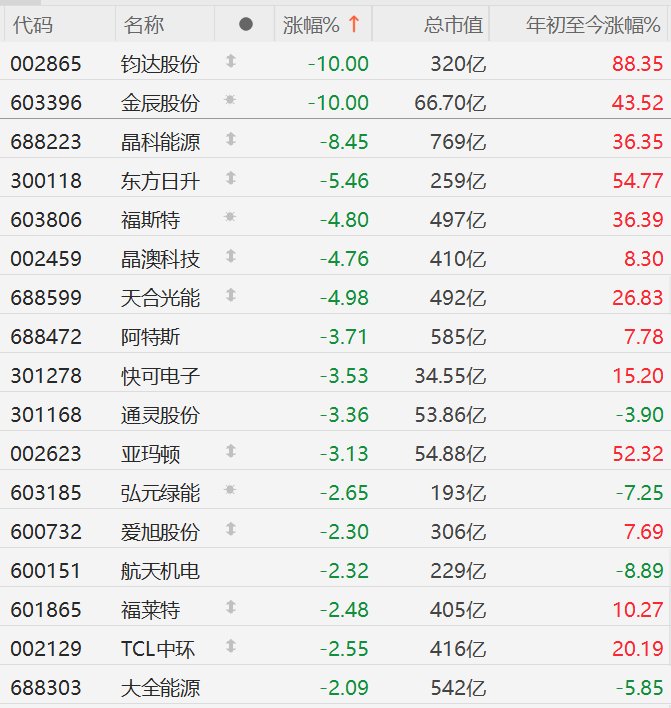
A股异动丨行业协会“泼冷水”,太空光伏股集体回调,金辰股份跌停,晶科能源跌超8%
Ge Long Hui A P P· 2026-02-05 01:40
Core Viewpoint - The A-share market for space photovoltaic concept stocks has experienced a collective pullback, with significant declines in several key companies, despite initial excitement driven by research from Elon Musk's team [1] Group 1: Market Reaction - Major stocks such as JunDa Co., JinChen Co., and JinkoSolar saw sharp declines, with JunDa Co. and JinChen Co. hitting the daily limit down of 10%, while JinkoSolar fell over 8% [1] - The overall market sentiment was influenced by the recent hype around space photovoltaic technology, which has attracted attention from both the capital market and the tech sector [1] Group 2: Industry Insights - Liu Yiyang, Executive Secretary of the China Photovoltaic Industry Association, stated that space photovoltaic technology is still in the exploratory and verification stages, making it premature to determine a clear technological direction [1] - The association highlighted that while the concept has gained traction, the realization of any technology will depend on mature, replicable manufacturing capabilities and long-term reliability verification systems [1] Group 3: Technology Comparison - Gallium Arsenide (GaAs) batteries remain the mainstream choice for commercial aerospace and space stations due to their high conversion efficiency and excellent radiation resistance, despite their high costs [2] - In contrast, the market's enthusiasm for heterojunction (HJT) and perovskite technologies is largely based on cost-reduction logic proposed by certain financial institutions, with actual products still in the early stages of laboratory or verification processes [2]


事关太空光伏,中国光伏行业协会发声!
券商中国· 2026-02-04 15:12
Core Viewpoint - The space photovoltaic concept has gained significant attention in the market, driven by recent research from Elon Musk's team, leading to a surge in A-share photovoltaic stocks and discussions about a potential "next photovoltaic revolution" in the industry [1]. Group 1: Market Reaction - The photovoltaic sector in A-shares has seen stocks hitting the daily limit up, with multiple brokerage reports suggesting that heterojunction (HJT) and perovskite technologies are suitable for space applications [1]. - The concept has sparked unprecedented volatility in the capital market, with domestic companies actively expressing their intentions to enter this "trillion-dollar blue ocean" market [1]. Group 2: Technology Assessment - Despite the excitement around new technologies, the industry emphasizes that successful implementation relies on mature, replicable manufacturing capabilities and a long-term reliability verification system [1]. - Gallium arsenide (GaAs) batteries remain the mainstream choice for commercial aerospace and space stations due to their high conversion efficiency and excellent radiation resistance, despite their high costs and extensive on-orbit validation [1]. - In contrast, the market's enthusiasm for HJT and perovskite technologies is primarily based on a "cost reduction logic" proposed by some financial institutions, with actual products still in the early stages of laboratory or verification processes, far from large-scale commercialization [1].
中国光伏行业协会最新发声
Xin Lang Cai Jing· 2026-02-04 14:00
Core Viewpoint - The space photovoltaic technology is still in the early stages of exploration and validation, making it premature to determine a clear technological direction [2]. Group 1: Market Reaction and Trends - The space photovoltaic concept has gained significant attention in the market, driven by recent investigations by Elon Musk's team, leading to a surge in related stocks within the A-share photovoltaic sector [3]. - Multiple brokerage reports suggest that heterojunction (HJT) and perovskite technologies are suitable for application in space, causing unprecedented market fluctuations [3]. - Domestic companies are actively expressing their intentions to enter this "trillion-dollar blue ocean" market, indicating a potential new revolution in photovoltaic technology [3]. Group 2: Technological Insights - The China Photovoltaic Industry Association emphasizes that regardless of the technological route, successful implementation requires mature, replicable manufacturing capabilities and a long-term reliability verification system [3]. - Gallium arsenide (GaAs) batteries remain the mainstream choice for commercial space and space station applications due to their high conversion efficiency and excellent radiation resistance, despite their high costs [3]. - In contrast, the market's enthusiasm for HJT and perovskite technologies is primarily based on cost-reduction logic proposed by certain financial institutions, with actual products still in the early stages of laboratory or validation processes [3]. Group 3: Future Opportunities - If significant breakthroughs in commercial space transportation occur, leading to reduced launch costs, the Chinese photovoltaic industry chain, with its cost advantages and large-scale manufacturing capabilities, could seize substantial opportunities [4]. - The association encourages both Chinese and foreign enterprises to collaborate with leading global commercial space companies to capture emerging market shares, thereby showcasing China's absolute technological and cost advantages in photovoltaic manufacturing [4]. Group 4: Cautionary Notes from Companies - Companies like Jingcheng Machinery and Shuangliang Energy have issued warnings about the high market heat surrounding the "space photovoltaic" concept, highlighting that the application scenarios are still in the exploratory phase and the industrialization process faces uncertainties [7]. - These companies advise investors to avoid blindly chasing market trends and to make prudent investment decisions to mitigate risks associated with speculative trading [7]. - The long-term outlook for this direction is deemed worthy of attention, with ground applications remaining foundational and expanding into more complex, integrated scenarios [7]. Group 5: Integration of Technologies - The integration of "photovoltaics + energy storage + hydrogen energy" is expected to become a standard configuration for addressing the volatility of renewable energy sources [8].


事关太空光伏,中国光伏行业协会最新发声
财联社· 2026-02-04 13:31
Core Viewpoint - The space photovoltaic concept has gained significant attention in the market, driven by recent research from Elon Musk's team, leading to a surge in related stocks within the A-share photovoltaic sector [1]. Group 1: Market Reaction - The photovoltaic sector in A-shares has seen stocks hitting the daily limit up, indicating strong investor interest and market excitement [1]. - Multiple brokerage reports suggest that heterojunction (HJT) and perovskite technologies are suitable for application in space, contributing to the market's enthusiasm [1]. Group 2: Industry Insights - The China Photovoltaic Industry Association emphasizes that regardless of technological advancements, successful implementation relies on mature, replicable manufacturing capabilities and a long-term reliability verification system [1]. - Gallium arsenide (GaAs) batteries remain the mainstream choice for commercial aerospace and space stations due to their high conversion efficiency and excellent radiation resistance, despite their high costs and extensive on-orbit verification [1]. Group 3: Technology Evaluation - The market's enthusiasm for HJT and perovskite technologies is largely based on a "cost reduction logic" proposed by certain financial institutions, but these products are still in the laboratory or early verification stages, far from large-scale commercialization [1].