祖冲之三号超导量子计算原型机

Search documents
俄罗斯没想到,美国更没想到,中国几乎所有“关键”技术遥遥领先
Sou Hu Cai Jing· 2026-01-20 05:08
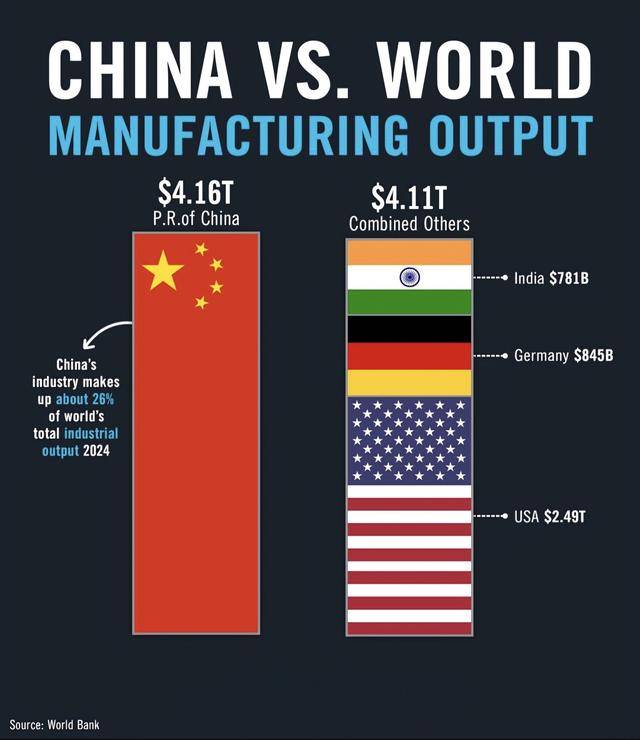
Core Insights - China's manufacturing sector is experiencing significant growth, with its value-added manufacturing output expected to account for 30% of the global total by 2025, marking 15 consecutive years at the top [1][3] - The U.S. manufacturing sector is facing challenges, with the Purchasing Managers' Index (PMI) indicating contraction for eight consecutive months, reflecting broader economic issues [11][13] Group 1: Manufacturing Strength - China's manufacturing value-added output during the 14th Five-Year Plan period is projected to increase by 8 trillion yuan, contributing over 30% to global manufacturing growth [3][5] - China leads in the production of most of the 504 major industrial products globally, showcasing its manufacturing scale advantage [3][5] - The high-tech manufacturing sector in China is expected to grow by 8.9% in 2024, with significant growth in aerospace and electronic equipment manufacturing [5] Group 2: Technological Advancements - The Jiangmen neutrino experiment is the world's first large-scale, high-precision neutrino facility, enhancing measurement precision by 1.5 to 1.8 times compared to previous international standards [7][22] - China is advancing in quantum computing with the "Zuchongzhi 3" superconducting quantum computing prototype, outperforming the fastest supercomputers in specific tasks [7] - The DeepSeek-R1 AI model has achieved performance comparable to leading global models with minimal computational resources, indicating a shift in AI research dynamics [7] Group 3: Global Positioning - China is the only country with all industrial categories recognized by the United Nations, demonstrating its comprehensive industrial capabilities [5][9] - The country has established 33 national-level manufacturing innovation centers, focusing on breakthroughs in key technologies [9][15] - China's innovation index has risen to the top ten globally, with the Shenzhen-Hong Kong-Guangzhou cluster ranking first [11][22] Group 4: Challenges in the U.S. and Europe - The U.S. manufacturing PMI fell to 48.7 in October 2025, indicating ongoing contraction due to trade uncertainties and high costs stemming from tariffs [11][13] - European manufacturing is stagnating, with declining export orders and structural issues hindering innovation and digital transformation [13][15] - The energy-intensive manufacturing sector in Europe faces rising costs exacerbated by geopolitical tensions, further limiting growth [13][15]

从实验室到产业,量子计算如何引发全球科技格局重构
Sou Hu Cai Jing· 2026-01-14 19:41
Core Insights - Google has made significant advancements in quantum computing with its Willow quantum chip, which can perform calculations equivalent to what the best supercomputers would take 10^25 years to complete in just 5 minutes [1][3] Technological Breakthrough - The Willow chip operates in near absolute zero temperatures, which is lower than cosmic background radiation, allowing for stable performance [3] - Google has improved quantum error correction from a 3x3 grid to a 7x7 grid, significantly reducing error rates [5] - The T1 time for quantum bits has been increased to 100 microseconds, enhancing the reliability of calculations [5] - The QuantumEchoes algorithm is reported to be 13,000 times faster than traditional algorithms, marking a critical step in practical quantum computing [7] Market Potential - The global quantum technology market is projected to reach $8 billion by 2024, with China holding a significant share [9] - By 2035, the market size is expected to soar to $900 billion, prompting intense investment from various countries [11] Competitive Landscape - The U.S. is strong in quantum hardware, with major players like Google, IBM, and Microsoft, while China is rapidly advancing, evidenced by the recent launch of the Zuchongzhi 3 superconducting quantum computing prototype [11] - There are predictions that China could become the leader in quantum computing patents by 2027, indicating a heated competition in this field [11] Strategic Importance - The United Nations has declared this year as the "International Year of Quantum Science and Technology," highlighting the strategic significance of quantum technology [13] - Countries view quantum technology as a core component of national competitiveness, with substantial investments being made [13] Security Implications - Quantum computing poses risks to encryption security, with algorithms like Shor's potentially threatening a $3 trillion market [15] - The U.S. National Institute of Standards and Technology is developing post-quantum encryption standards to mitigate these risks [15] Application Prospects - Quantum computing has vast potential applications, including drug discovery, materials science, and addressing global challenges like climate change and energy crises [17][19] - The integration of quantum computing with artificial intelligence could lead to groundbreaking innovations [19] Industry Evolution - Quantum computing has transitioned from a technical threshold to an industrial competitive stage, reshaping future industry landscapes [20] - The ongoing developments in quantum technology present both opportunities and challenges for human civilization [22]