
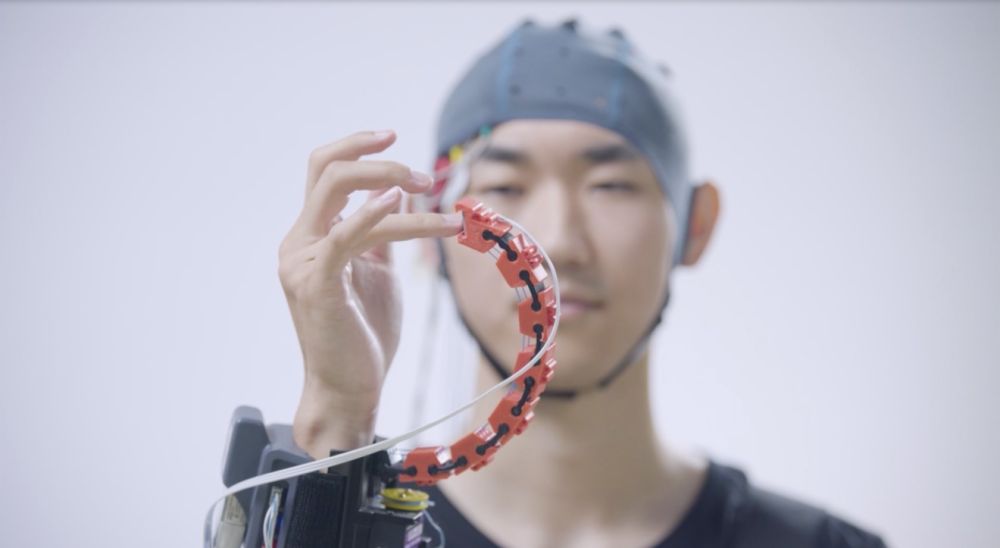
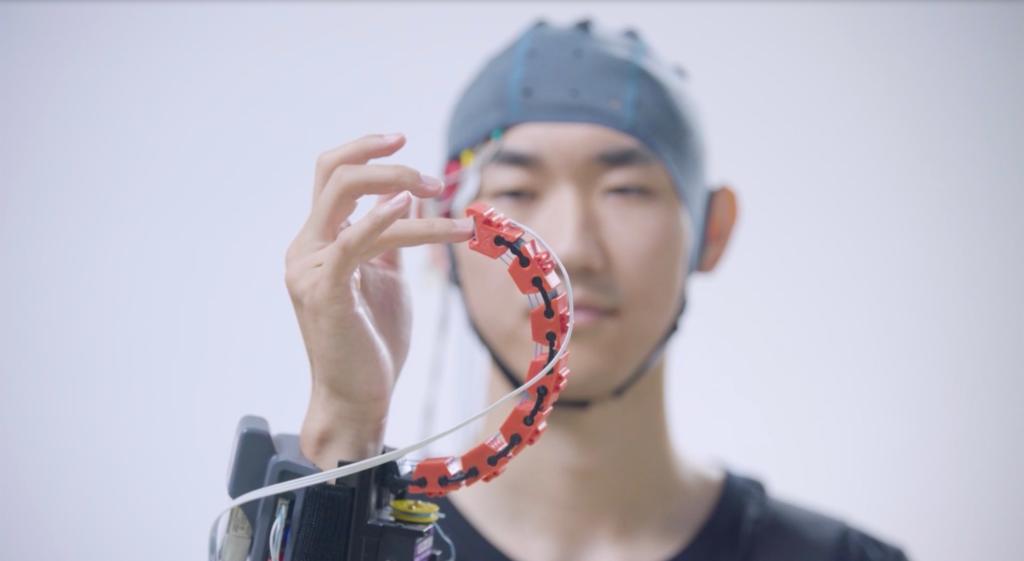
神工—灵犀指

Search documents
一间实验室,何以攀登“脑机接口”高峰?
Xin Lang Cai Jing· 2026-01-17 07:28
Core Insights - The Tianjin University Brain-Machine Interaction and Human-Machine Integration Haihe Laboratory has developed a wearable device called "Shengong-Lingxi Finger," which allows users to control it using brain signals, aiding in rehabilitation for hand function recovery [1][4] - The laboratory focuses on non-invasive brain-machine interfaces and aims to drive technological innovation and industrial application, particularly in aerospace and rehabilitation medicine [2][3] - The laboratory has established a research team that integrates various fields, emphasizing the importance of aligning research with market needs and cutting-edge trends [2][3] Group 1 - The "Shengong-Lingxi Finger" device can assist in grasping objects and stimulate the central and peripheral nervous systems of patients [1] - The laboratory has a leading number of patents in the field of brain-machine interaction and aims to explore the potential of brain-machine interfaces [2] - The laboratory is committed to translating technological innovations into practical applications, focusing on areas such as basic components, aerospace, and rehabilitation medicine [2][3] Group 2 - The laboratory is advancing a new technology called on-chip brain-machine interface, which is expected to contribute to mixed intelligence and brain-like computing [3] - A special fund for the development of the brain-machine interface industry, targeting a scale of 10 billion yuan, has been established to support industrialization efforts [6] - The laboratory's incubated company, Tiankai Suishi (Tianjin) Intelligent Technology Co., Ltd., has been recognized as a national high-tech enterprise, highlighting the successful integration of technology and industry [6]

四中全会精神在基层丨一间实验室,何以攀登“脑机接口”高峰?
Xin Hua Wang· 2026-01-16 12:17
Core Insights - The Tianjin University Brain-Machine Interaction and Human-Machine Integration Haihe Laboratory is advancing in the field of non-invasive brain-machine interfaces, focusing on technology innovation and industrial application [2][3] - The laboratory has developed a wearable device called "Shengong-Lingxi Finger," which allows users to control it through thought, aiding in rehabilitation for patients with motor function impairments [1][4] - The laboratory is also exploring the potential of on-chip brain-machine interface technology, which could lead to advancements in mixed intelligence and brain-like computing [3] Group 1 - The laboratory was officially established on March 27, 2023, and is one of seven Haihe laboratories in Tianjin focusing on cutting-edge technology [2] - The laboratory holds a significant number of patents in the field of brain-machine interaction, ranking among the top globally [2] - The team is committed to aligning research with market needs and trends to ensure practical applications of their innovations [2] Group 2 - The laboratory is working on a special fund aimed at developing a brain-machine interface industry with a target scale of 10 billion yuan [6] - The incubated company, Tiankai Suishi (Tianjin) Intelligent Technology Co., has been recognized as a national high-tech enterprise and a technology-based small and medium-sized enterprise [6] - The laboratory aims to integrate technological innovation with industrial transformation, contributing to the broader goals outlined in the 14th Five-Year Plan [6]
四中全会精神在基层|一间实验室,何以攀登“脑机接口”高峰?
Xin Hua She· 2026-01-16 11:15
Core Insights - The Tianjin University Brain-Machine Interaction and Human-Machine Integration Haihe Laboratory has developed a wearable device called "Shengong-Lingxi Finger," which allows users to control it using their thoughts, aiding in rehabilitation for patients with motor function impairments [1][2] - The laboratory focuses on non-invasive brain-machine interface technology and aims to drive technological innovation and industrial application, particularly in aerospace and rehabilitation medicine [1][2] - The laboratory has established a special fund targeting a scale of 10 billion yuan for the development of the brain-machine interface industry, indicating a strong commitment to integrating technological innovation with industrial practices [3] Research and Development - The laboratory has assembled a research team covering various aspects of brain-machine interfaces, human-computer interaction theories, device systems, and application transformations, emphasizing the importance of aligning research with market needs [2] - The laboratory is exploring the potential of brain-machine interfaces and aims to implement the spirit of the 20th National Congress of the Communist Party of China by promoting the transformation of cutting-edge scientific achievements [2] - The laboratory is advancing a new technology branch called on-chip brain-machine interfaces, which is expected to contribute to the development of mixed intelligence and brain-like computing [2] Industrialization Efforts - The laboratory has incubated Tiankai Suishi (Tianjin) Intelligent Technology Co., which has been recognized as a national high-tech enterprise and a technology-based small and medium-sized enterprise [3] - The laboratory's efforts align with the "14th Five-Year Plan" that emphasizes the deep integration of technological and industrial innovation, positioning the laboratory as a catalyst for industrial transformation [3]
守护人民健康,脑机接口技术向“实”而行
Ke Ji Ri Bao· 2025-12-11 07:30
Core Insights - The integration of brain-computer interface (BCI) technology into clinical settings marks a significant advancement in medical diagnostics and treatment, allowing for real-time monitoring of intracranial pressure without invasive procedures [1][2] - The "Sixth Finger," developed by Tianjin University, utilizes non-invasive BCI technology to enable patients to control external prosthetics through thought, facilitating rehabilitation for those with motor impairments [2][3] - The BCI technology is recognized as a key future industry in China's 14th Five-Year Plan, alongside other advanced technologies, positioning it as a potential driver for economic growth [2][3] Company and Industry Summary - Tianjin University’s BCI team has successfully implemented a comprehensive approach to brain disease management, integrating diagnosis, monitoring, treatment, and prediction into a cohesive system [3] - The team has established the world's largest patent pool in the field of brain-computer interaction, with over 10% of patents held internationally, showcasing its leadership in innovation [3] - The university is committed to advancing original research and technology breakthroughs in BCI, aligning with national strategies to enhance technological self-reliance and productivity [3]
守护人民健康 脑机接口技术向“实”而行
Ke Ji Ri Bao· 2025-12-11 00:35
Core Insights - The integration of brain-computer interface (BCI) technology into clinical settings marks a significant advancement in medical diagnostics and treatment, allowing for real-time monitoring of intracranial pressure without invasive procedures [1][2] - The "Sixth Finger," developed by Tianjin University, utilizes non-invasive BCI technology to enable patients to control external prosthetics through thought, facilitating rehabilitation for those with motor impairments [2][3] - The BCI technology is recognized as a key future industry in China's 14th Five-Year Plan, alongside other advanced technologies, positioning it as a potential driver for economic growth [2][3] Company and Industry Summary - Tianjin University’s BCI team has successfully implemented a comprehensive approach to brain disease management, integrating diagnosis, monitoring, treatment, and prediction into a cohesive system [3] - The team has established the world's largest patent pool in the field of brain-computer interaction, with over 10% of patents held internationally, showcasing its leadership in innovation [3] - The university is committed to advancing original research and technology in BCI, aligning with national strategies to enhance technological self-reliance and productivity [3]
政策技术双轮驱动 脑机接口商业化加速落地
Zhong Guo Zheng Quan Bao - Zhong Zheng Wang· 2025-12-03 01:29
Core Viewpoint - The brain-computer interface (BCI) sector is experiencing a significant upward trend, driven by strong policy support, continuous technological breakthroughs, and the establishment of medical insurance payment frameworks, indicating a critical phase towards large-scale application [1][4][8] Market Performance - As of December 2, the BCI concept index has seen a cumulative increase of 51.53% this year, with an annualized return of 59.69% and a maximum drawdown of 23.74% [2] - The index has been influenced by favorable developments such as the approval of medical services for BCI by insurance and positive domestic research progress [2][3] Valuation Insights - The BCI index's PS-TTM stands at 5.80 times, placing it in the 71.29th percentile since its inception, indicating a valuation that aligns with emerging technology sectors [3] - The index shows a premium of 277.15% over the CSI 300 index, reflecting the market's recognition of its strategic importance and high technological barriers [3] Commercialization Acceleration - The BCI industry is moving towards large-scale application, supported by a systematic policy framework, advancements in technology, and the establishment of payment systems [4] - The integration of BCI into national strategies highlights its potential to enhance public health and address challenges related to an aging population [4][7] Competitive Landscape - The domestic BCI industry features a mix of non-invasive and invasive technologies, with over 80% of companies opting for non-invasive methods due to their safety and lower development barriers [5] - A small percentage of companies focus on invasive technologies, which offer unique advantages in precision and intervention for specific diseases [5] Technological Advancements - Leading domestic companies are rapidly closing the gap with international standards in key technical indicators, achieving competitive performance in areas such as signal detection and device miniaturization [6] - Clinical applications in neuro-rehabilitation are progressing quickly, demonstrating significant clinical effects for patients with neurological disorders [6] Market Potential - The BCI sector is projected to reach a global medical application market size of $40 billion by 2030 and potentially exceed $145 billion by 2040, indicating substantial market potential [7] - The development of BCI technology is expected to drive advancements in related industries, fostering a high-tech industrial ecosystem centered on innovation [7]
财信证券龙靖宁:政策技术双轮驱动 脑机接口商业化加速落地
Zhong Guo Zheng Quan Bao· 2025-12-03 00:22
Core Insights - The brain-computer interface (BCI) sector has been experiencing a continuous upward trend in valuation, aligning with the characteristics of emerging technology sectors during their explosive growth phase [1][2] - The domestic BCI industry is entering a critical stage of large-scale application driven by strong policy support, ongoing technological breakthroughs, and the establishment of medical insurance payment frameworks [4][8] Market Performance - As of December 2, the BCI concept index has seen a cumulative increase of 51.53% this year, with an annualized return of 59.69% and a maximum drawdown of 23.74% [2] - The index experienced a steady rise from January to March, followed by a significant correction in early April, after which it quickly recovered and reached a high of 1890.69 points on September 16, 2025, before entering a phase of horizontal adjustment [2] Valuation Metrics - The BCI index's price-to-sales (PS-TTM) ratio is 5.80, placing it in the 71.29th percentile since its inception, indicating a valuation in the upper-middle range [3] - The index shows a premium of 277.15% over the CSI 300 index, 100.36% over the pharmaceutical and biological index, and 0.83% over the medical device index, reflecting the market's perception of its strategic importance and high technological barriers [3] Industry Dynamics - The BCI industry in China has formed a competitive landscape characterized by both non-invasive and invasive technology routes, with over 80% of companies opting for non-invasive methods due to their higher safety and faster commercialization potential [5][6] - Leading domestic companies are rapidly closing the gap with international standards in key technical indicators, achieving parity or even leading in certain areas [6] Commercialization Acceleration - The BCI sector is moving towards large-scale application, supported by a systematic policy framework, advancements in technology, and the establishment of medical insurance payment systems [4][8] - The establishment of medical insurance payment frameworks has facilitated the commercialization of BCI services, reducing the financial burden on patients [6] Market Potential - The BCI sector is projected to have a market size of $40 billion by 2030 and is expected to exceed $145 billion by 2040, highlighting its significant social and commercial value [7] - The development of BCI technology is expected to drive advancements in high-end medical devices, AI algorithms, and new materials, fostering a high-tech industrial ecosystem centered on independent innovation [7]
财信证券龙靖宁: 政策技术双轮驱动 脑机接口商业化加速落地
Zhong Guo Zheng Quan Bao· 2025-12-02 20:58
Core Viewpoint - The brain-computer interface (BCI) sector is experiencing a significant upward trend, driven by strong policy support, continuous technological breakthroughs, and the establishment of medical insurance payment frameworks, indicating a critical phase towards large-scale application [1][4]. Market Performance - As of December 2, the BCI concept index has seen a cumulative increase of 51.53% this year, with an annualized return of 59.69% and a maximum drawdown of 23.74% [2]. - The index has shown a steady rise from January to March, followed by a significant correction in early April, after which it quickly recovered and reached a high of 1890.69 points on September 16, 2025, before entering a phase of horizontal adjustment [2]. Valuation Insights - The BCI index's PS-TTM stands at 5.80 times, placing it in the 71.29th percentile since its inception, indicating a valuation that aligns with emerging sectors during a technological explosion [3]. - The index shows a premium of 277.15% over the CSI 300 index, 100.36% over the pharmaceutical and biological index, and 0.83% over the medical device index, reflecting the market's recognition of its strategic national importance and high technological barriers [3]. Commercialization Acceleration - The BCI industry is moving towards large-scale application, supported by a systematic policy framework, advancements in technology, and the establishment of medical insurance payment systems [4]. - The Chinese government has included "brain science and brain-like research" in its national strategy since the 13th Five-Year Plan, with further emphasis in the 14th and 15th plans, highlighting the importance of BCI in addressing health challenges and enhancing social welfare [4]. Competitive Landscape - The domestic BCI industry features a mix of non-invasive and invasive technology routes, with over 80% of companies opting for non-invasive methods due to their higher safety and lower development barriers [5]. - Leading domestic companies are rapidly closing the gap with international standards in key technical indicators, achieving parity or even leading in certain areas [6]. Market Potential - The BCI sector is projected to reach a global medical application market size of $40 billion by 2030 and potentially exceed $145 billion by 2040, aligning with national strategic goals for economic growth [7]. - The development of BCI technology is expected to drive advancements in high-end medical devices, AI algorithms, and new materials, fostering a high-tech industrial ecosystem centered on independent innovation [7].
政策技术双轮驱动脑机接口商业化加速落地
Zhong Guo Zheng Quan Bao· 2025-12-02 20:22
Core Insights - The brain-computer interface (BCI) sector has seen a continuous rise in interest and is currently experiencing a volatile upward trend, aligning with the characteristics of emerging sectors during a technological explosion [1] - The domestic BCI industry is entering a critical phase of large-scale application driven by strong policy support, continuous technological breakthroughs, and the establishment of medical insurance payment frameworks [3][4] Market Performance - As of December 2, the Wind BCI concept index has increased by 51.53% year-to-date, with an annualized return of 59.69% and a maximum drawdown of 23.74% [1] - The BCI index's PS-TTM is at 5.80 times, placing it in the 71.29th percentile since its inception, indicating a valuation that aligns with similar growth-oriented digital healthcare companies [2] Valuation Insights - The BCI index shows a premium of 277.15% over the CSI 300 index, 100.36% over the pharmaceutical and biological index, and 0.83% over the medical device index, reflecting the market's perception of its strategic national importance and high technological barriers [2] - The valuation logic is closely tied to the core application scenarios in the medical rehabilitation field, indicating a convergence towards the fundamentals of the industry [2] Industry Development - The BCI industry is characterized by a competitive landscape that includes both non-invasive and invasive technology routes, with over 80% of companies opting for non-invasive methods due to their higher safety and lower development barriers [4] - The domestic BCI sector is supported by a systematic policy framework that encompasses technological breakthroughs, standard setting, and ecosystem development [3] Technological Advancements - Leading domestic companies are rapidly closing the gap with international standards in key technical indicators, achieving comparable performance in areas such as neural signal detection and device miniaturization [5] - Clinical validation in the neuro-rehabilitation field is progressing quickly, with technologies showing significant clinical effects for patients with neurological disorders [5] Market Potential - The BCI sector is projected to have a global medical application market size of $40 billion by 2030 and is expected to exceed $145 billion by 2040, highlighting its potential as a core sector with both social and commercial value [6] - The development of BCI technology is expected to drive advancements in high-end medical devices, AI algorithms, and new materials, fostering a high-tech industrial ecosystem centered on independent innovation [6]