神经世界模拟器

Search documents
特斯拉已不是智驾行业“标准答案”
3 6 Ke· 2025-10-31 00:25
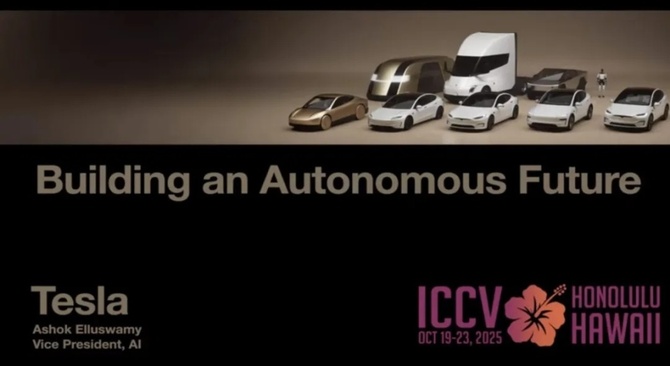
Core Insights - Tesla has resumed sharing updates on its autonomous driving algorithms after a two-year hiatus, presenting at the ICCV conference instead of its previous AI Day events [1] - The company is facing challenges with its end-to-end architecture for autonomous driving, particularly regarding the "black box" nature of the model and the quality of training data [3][7] Group 1: Technical Developments - Tesla's end-to-end system must address the mapping from high-dimensional to low-dimensional outputs, which is complex due to the nature of the data [5][7] - The company has implemented optimizations in its architecture, including the introduction of OCC occupancy networks and 3D Gaussian features to enhance decision-making [3][8] - Tesla has developed a "neural world simulator" that serves as both a training and validation environment for its algorithms, allowing for extensive testing and refinement [12][15] Group 2: Competitive Landscape - Other companies in the industry, such as Xpeng and Li Auto, have also adopted similar models, indicating a shift in the competitive dynamics of the autonomous driving sector [4][11] - Tesla's previous position as a leader in autonomous driving technology is being challenged, with other players no longer closely following its developments [18] Group 3: Market Reception and Challenges - The subscription rate for Tesla's Full Self-Driving (FSD) feature is low, with only about 12% of users opting for it, raising concerns about the technology's acceptance [4][24] - Despite price adjustments for FSD, consumer interest has waned, with many potential buyers citing concerns over the technology's maturity and reliability [24][25] - Recent investigations into Tesla's FSD have highlighted safety issues, further complicating the company's efforts to promote its autonomous driving capabilities [24][25]