
福利社

Search documents
帮别人种草的小红书,为什么自己卖不好货?
3 6 Ke· 2026-02-10 01:11
Core Insights - The article discusses the paradox of Xiaohongshu's (Little Red Book) marketing model, where the platform excels in content creation but struggles with direct sales, leading to the closure of its self-operated e-commerce initiatives [1][21][22] - The concept of "lifestyle economy" is introduced, emphasizing the need to return to individual consumer demands, which Xiaohongshu aims to address through its unique positioning in the market [4][10][11] Group 1: Marketing and Consumer Trust - Xiaohongshu's "grass planting" (种草) strategy has been criticized as potentially misleading, with some industry insiders equating it to fraud [1] - The trust factor diminishes when content shifts from being observational to promotional, indicating a fragile balance between user trust and commercial intent [2][3] - The platform's attempt to integrate product links into user-generated content has been deemed ineffective and not user-friendly [4] Group 2: Non-standard Products and Market Positioning - Xiaohongshu's business model focuses on non-standard products, differentiating itself from traditional e-commerce platforms like Taobao and JD [5][8] - The success of brands like Berghaus on Xiaohongshu illustrates the platform's ability to cater to niche consumer needs that mainstream e-commerce may overlook [7][9] - The term "non-mainstream" is used to describe Xiaohongshu's unique market positioning, which allows for the promotion of products that may not perform well on conventional platforms [9] Group 3: Challenges in E-commerce - Xiaohongshu's attempts at e-commerce have faced significant challenges, leading to the closure of its self-operated platforms, including "Xiaolvzhou" and "Welfare Society," which had been operational for nine years [21][22] - The platform's struggle to create a transaction closure despite strong "grass planting" capabilities raises questions about its role in the consumer decision-making process [22][24] - The shift to a buyer model, focusing on non-standard aesthetic transformations, reflects Xiaohongshu's ongoing struggle to balance content purity with commercial viability [23][24] Group 4: Trust and Content Saturation - The proliferation of low-quality content and the rise of industrialized sharing practices have eroded user trust, leading to a decline in the effectiveness of the "grass planting" strategy [17][18] - Users have expressed dissatisfaction with misleading content, which has resulted in a negative perception of the platform, often referred to as the "filter trap" [18] - The saturation of promotional content has diminished the core value of authenticity that Xiaohongshu initially offered [18]
小红书的困局和柯南的理想主义
3 6 Ke· 2025-12-12 07:46
Core Insights - Xiaohongshu recently suspended its local life membership service "Xiaohong Card" after only three months, indicating a failed attempt to penetrate the local life transaction segment with a light model of "paid membership + selected merchants" [1] - The company acknowledged insufficient preparation and plans to focus on enhancing the influence of local life content and transaction tools rather than directly pushing for transaction closures [1] - The suspension highlights Xiaohongshu's ongoing struggle between its high valuation of $31 billion and the operational challenges it faces in achieving a successful business model [1][2] Business Model and Financial Performance - Xiaohongshu's revenue structure remains heavily reliant on advertising, accounting for nearly 80% of total revenue, while its e-commerce business has not yet reached a scale sufficient to support its high valuation [4] - The company's e-commerce GMV is projected to exceed 400 billion yuan in 2024, with a year-on-year growth of 45%, but it still lags behind competitors like Douyin and Kuaishou [5] - Despite a significant increase in valuation and profit expectations, Xiaohongshu's path to IPO remains complicated due to external market volatility and stringent regulatory scrutiny [2][3] Strategic Challenges - The company faces a fundamental challenge in converting its content ecosystem into effective e-commerce capabilities, with a significant gap in the conversion from "grass planting" to actual purchases [6][11] - Xiaohongshu's community-driven model creates a unique competitive advantage but also limits its ability to standardize transactions and ensure quality control, leading to user dissatisfaction regarding pricing and service [10][11] - The recent organizational restructuring aims to integrate commercial and e-commerce teams to optimize financial models ahead of a potential IPO, reflecting the need for a coherent business strategy [5][12] User Experience and Community Dynamics - The platform's core strategy is to serve as a guide for consumer decision-making rather than a direct sales platform, which complicates its monetization efforts [6][9] - Maintaining a balance between community experience and commercialization is crucial, as excessive advertising could undermine user trust and the authenticity of shared content [6][12] - The challenge of aligning user expectations with commercial objectives is heightened by the diverse interests of over 350 million monthly active users, necessitating a careful approach to content and advertising [14]
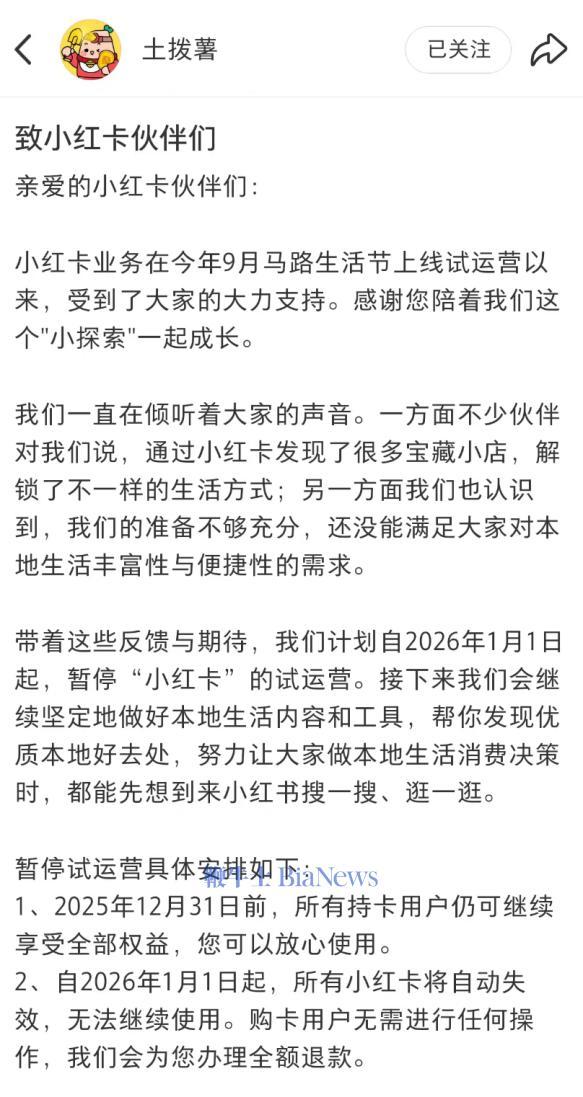
仅运营3个月!小红书关停「最短命」项目,商家斥责「交钱后没人管」
Xin Lang Ke Ji· 2025-12-10 00:56
Core Insights - Xiaohongshu's "Xiaohong Card" project will be suspended from January 1, 2026, after only three months of trial operation, indicating a significant setback in its local lifestyle services initiative [1][7] - The company cited insufficient preparation and failure to meet user and merchant expectations as reasons for the suspension, highlighting widespread dissatisfaction among both users and merchants [2][5] Group 1: Project Overview - The "Xiaohong Card" was launched in September 2025 in Shanghai, Hangzhou, and Guangzhou, aimed at providing discounts for users at selected stores for an annual fee of 168 yuan [1][4] - Users reported poor experiences, including lack of communication regarding card benefits and expiration, leading to dissatisfaction and loss of rights [4][2] Group 2: Merchant Feedback - Merchants expressed frustration over the lack of service and support after paying for certification to become part of the program, with complaints about unfulfilled promises and inadequate follow-up [2][5] - A specific case highlighted a merchant's experience of paying nearly 600 yuan for certification but receiving no support or training, leading to significant disappointment [4][5] Group 3: Market Analysis - Analysts suggest that the rapid failure of the "Xiaohong Card" reflects a misjudgment by Xiaohongshu regarding the local lifestyle market, where convenience and cost-effectiveness are crucial [7][12] - The company's attempt to implement a high-threshold membership model contrasts with competitors like Meituan and Douyin, which offer free options and a wider selection, indicating a potential misalignment with consumer preferences [7][12] Group 4: Broader Business Challenges - The suspension of the "Xiaohong Card" is part of a broader trend of Xiaohongshu facing challenges in its commercialization efforts, including the recent shutdown of its self-operated e-commerce platforms [8][10] - Industry experts note that Xiaohongshu's attempts to integrate e-commerce with social media have not translated into sustainable revenue, as users often prefer to purchase from established platforms like Taobao and JD after being influenced by Xiaohongshu [10][12]

仅运营3个月! 小红书关停“最短命”项目,商家斥责“交钱后没人管” | BUG
Xin Lang Cai Jing· 2025-12-10 00:32
Core Viewpoint - Xiaohongshu's "Xiaohong Card" project, launched in September 2023, will be suspended from January 1, 2026, due to insufficient preparation and failure to meet user and merchant expectations [2][13][18] User Experience - Users reported dissatisfaction with the Xiaohong Card, citing a lack of functionality and unfulfilled benefits, leading to the expiration of their rights [4][15] - Complaints included a lack of reminders for card benefits and usage deadlines, indicating inadequate preparation by the company [4][15] Merchant Experience - Merchants expressed frustration over the lack of service and support after paying for certification, with one merchant stating that promised services were not delivered [5][16] - Merchants were promised various benefits, including platform traffic support and participation in promotional events, but many felt these were not realized [5][16] Market Analysis - Analysts criticized Xiaohongshu's approach to local services, arguing that the membership model lacks price advantages and coverage compared to competitors like Meituan and Douyin [18][21] - The high membership fee of 168 yuan for limited discounts was seen as a barrier for users, contradicting the demand for convenience and value [18][21] Business Challenges - The Xiaohong Card's quick failure reflects broader challenges in Xiaohongshu's commercialization efforts, which have seen multiple setbacks in recent years [9][20] - The company has previously attempted various business models, including self-operated e-commerce, but has faced difficulties in converting user engagement into revenue [20][22] Expert Opinions - Industry analysts described the Xiaohong Card as a "chicken rib," indicating that it offers little value in a competitive market dominated by larger platforms [21][22] - The failure of the Xiaohong Card is viewed as a necessary pause for the company to reassess its strategy in the local service sector [21][22]

估值2000亿,小红书的大象之旅
2 1 Shi Ji Jing Ji Bao Dao· 2025-07-07 12:49
Core Insights - Xiaohongshu is positioned as a potential next tech giant in the capital market, with significant anticipation surrounding its upcoming IPO [1][15] - The company has recently expanded its international presence by opening an office in Hong Kong, which is seen as a strategic move to connect overseas brands with Chinese consumers and vice versa [2] - Xiaohongshu's valuation has reportedly increased to $26 billion (approximately 187 billion RMB), reflecting a positive outlook on its financial performance and international market potential [2][4] Valuation and Financial Performance - Xiaohongshu has completed seven rounds of financing, raising over 6.3 billion RMB, with major investors including Tencent, Temasek, Alibaba, and others [2] - The company has shown a significant revenue growth of 85% year-on-year, reaching $3.7 billion, and has turned a profit with a net income of $500 million [15] - The valuation of Xiaohongshu has fluctuated, with estimates ranging from $17 billion to $20 billion in recent years, indicating a renewed recognition of its value [4] Market Strategy and International Expansion - Xiaohongshu is actively pursuing international expansion, launching an e-commerce initiative aimed at markets like the US and Hong Kong, which includes a comprehensive service solution for merchants [6][5] - The platform is attempting to differentiate itself from competitors like TikTok by focusing on high-quality content and user engagement rather than direct price competition [5][8] - The company has initiated a "cross-border e-commerce navigation plan" to facilitate global reach for merchants, although logistical challenges remain [6] E-commerce and Monetization - E-commerce is a critical area for Xiaohongshu, which has historically struggled to compete with established platforms like JD and Alibaba [12][9] - The platform's unique selling proposition lies in its high conversion rates, with an average conversion rate of 21.4%, significantly higher than its competitors [13] - Xiaohongshu's business model is evolving, with 20% of its revenue coming from e-commerce and 80% from content community, indicating a balanced approach to monetization [13] User Engagement and Community Dynamics - Xiaohongshu has cultivated a strong community with high user engagement, where influencers can achieve significant monetization despite having fewer followers compared to other platforms [8][10] - The platform's focus on non-standard products and designer brands allows it to maintain a unique market position, avoiding direct price wars [12] - The company is aware of the challenges in maintaining content quality while scaling its commercial operations, which is crucial for sustaining user trust [14][15]
小红书最大的难题,是无法只靠自己赚到更多钱
Sou Hu Cai Jing· 2025-05-22 11:52
Core Insights - Xiaohongshu has struggled to monetize its platform effectively, failing to generate revenue that matches its influence in the market [2][3] - The company has shifted its commercial strategy multiple times over the past decade, oscillating between e-commerce and community focus, but has not yet found a sustainable growth path [2][3][6] - As of 2024, Xiaohongshu's e-commerce GMV is projected to exceed 400 billion yuan, reflecting a 45% year-on-year growth, but this growth is significantly slower compared to competitors like Douyin and Kuaishou [3][12] E-commerce Strategy - Xiaohongshu is increasing its collaboration with external platforms like Taobao and JD.com to enhance the conversion chain from content to commerce [3][15] - The decision to open external links has raised concerns about the potential negative impact on Xiaohongshu's own e-commerce operations [5][20] - Historically, Xiaohongshu has fluctuated between focusing on community engagement and e-commerce, with a notable shift towards community after facing growth challenges in e-commerce [7][8][21] Commercialization Efforts - The company has primarily relied on advertising for revenue, with 80% of its income coming from this source by the end of 2022 [12] - Xiaohongshu's advertising strategy has evolved, with a focus on enhancing the effectiveness of its advertising capabilities to meet the demands of advertisers seeking measurable ROI [17][20] - The platform's unique "grass planting" value proposition is seen as a key asset, but the challenge remains in converting this into direct sales on the platform [14][15] Internal Challenges - Xiaohongshu has faced internal organizational challenges, with a lack of coordination between departments hindering its ability to balance community and e-commerce initiatives [24][27] - The company has experienced a series of strategic pivots, often leading to confusion about its long-term direction and priorities [23][26] - Despite recent efforts to enhance its e-commerce capabilities, the company continues to struggle with maintaining a cohesive strategy that integrates both advertising and e-commerce effectively [21][27]

小红书的电商选择题:调性和规模,只能留一个
晚点LatePost· 2024-12-16 14:02
肯花钱的用户、四处求货的博主、难聚起的流量。 文丨孙海宁 制图丨黄帧昕 编辑丨高洪浩 设置独立电商部门一年多,小红书最大的成就,可能是让用户感觉不到平台正挖空心思引导他们下一单。 打开小红书推荐页,信息流中的商品笔记不外显价格;应用里看不见官方制作的热销商品榜单;直播间 内,也少有 "三、二、一,上链接!" 的叫卖声。今年双十一,小红书核心玩法不是刺激交易的抢券、满 减、拼单,而是 "集章"——用户在特定直播间呆够 60 秒并关注主播,可以获得一枚电子图章。 种种含蓄显得小红书对电商业务并不急迫,但这只是表象。去年 8 月, 这家公司整合电商和直播业务 , 组建一级部门 "交易部",与 "社区部" 和负责广告的 "商业部" 平行,由公司 COO 柯南直接管理。几个月 前,他们又在杭州新设办公地,要和业内前辈阿里、字节做邻居、抢人才。 据我们了解,小红书电商今年实现了千亿元量级的销售额。电商部门当前的工作重心是培养站内用户的购 物习惯、提高商家的成长速度。 小红书的电商业务始于 2014 年上线的"福利社"——平台从海外买来好产品,附上易懂的介绍,任消费者 选购。可没几年,进口税收新政的大浪拍来,小红书电商逐渐 ...