秋水仙碱

Search documents
直击隐蔽乱象!检察机关督促整治电商平台诊所变相销售网络禁售药品
Zhong Guo Jing Ji Wang· 2026-02-10 07:07
Core Viewpoint - The article highlights the illegal sale of banned drugs through e-commerce platforms, emphasizing the need for regulatory oversight to ensure public safety in medication use [1][2] Group 1: Regulatory Actions - The Beijing Railway Transportation Procuratorate identified illegal activities on the e-commerce platform "Bianmin Zhaoyao," where clinics were selling banned drugs without proper medical assessments [1] - Following media exposure in April 2024, the procuratorate initiated an investigation in October, utilizing big data legal supervision models to gather evidence [2] - A public hearing clarified the legal relationship between clinics and users as "sales" rather than "medical treatment," necessitating oversight from market supervision authorities [2] Group 2: Enforcement and Compliance - Joint inspections by market supervision and health departments led to significant actions, including the inspection of 161 medical institutions and online drug sales companies, with 21 drug-related cases being addressed [2] - The procuratorate facilitated the signing of a memorandum to enhance collaboration between administrative agencies for better enforcement against the illegal sale of banned drugs [2] - Measures were implemented to improve the vetting of merchants on e-commerce platforms and to increase transaction risk warnings to prevent illegal activities [2]
电商平台诊所虚假问诊变相销售禁售药,检察监督推动规范经营
Nan Fang Du Shi Bao· 2026-02-09 03:30
Core Viewpoint - The article highlights the illegal sale of banned drugs through e-commerce platforms by certain clinics, which poses a risk of drug abuse and undermines public health interests [1][2]. Group 1: Illegal Sales and Regulatory Actions - Some e-commerce platforms provide a service called "convenient drug search," allowing users to order banned drugs without a proper medical consultation, leading to the illegal circulation of these drugs [1][2]. - The Beijing Railway Transportation Procuratorate established a big data legal supervision model to investigate these illegal sales and initiated a case on October 12, 2024 [1][2]. Group 2: Regulatory Collaboration and Recommendations - Following the investigation, the Beijing Railway Transportation Procuratorate issued recommendations to local market supervision departments to enhance oversight of online drug sales [3]. - A public hearing was held, where experts and representatives from relevant departments agreed that the clinics' actions constituted sales rather than medical consultations, necessitating regulation by market supervision authorities [3]. Group 3: Governance and Long-term Solutions - The Beijing Railway Transportation Procuratorate facilitated the signing of a memorandum to strengthen collaboration among administrative agencies for regulating the sale of banned drugs [4]. - The article emphasizes the need for ongoing governance and regulatory mechanisms to address the challenges posed by new online drug sales models, ensuring public safety in medication use [4].
“湘潭大学宿舍投毒案”罪犯周立人被执行死刑
第一财经· 2025-10-31 09:29
Core Points - The criminal Zhou Liren was executed for the poisoning case at Xiangtan University, where he intentionally poisoned his roommates, resulting in one death [1][2] - Zhou Liren had a background in a field related to the toxic substance colchicine, which he used to commit the crime [1][2] Summary by Sections - **Incident Overview** - Zhou Liren, a master's student at Xiangtan University, had conflicts with his roommates, leading to his decision to poison them [1] - He purchased colchicine and secretly added it to a shared food item, resulting in the death of Zhang [1][2] - **Legal Proceedings** - The court found Zhou guilty of intentional homicide, emphasizing his premeditated actions and the severe consequences of his crime [2] - The court highlighted Zhou's attempt to conceal evidence and delay medical treatment for the victim, which contributed to the fatal outcome [2]


市值蒸发1600亿!暴跌84%,没落巨头靠一针痛风药,再冲IPO
Sou Hu Cai Jing· 2025-07-11 23:53
Core Viewpoint - Changchun High-tech, once known as "Northeast Medicine King," has faced a significant decline, with its market value evaporating by 160 billion yuan and stock prices plummeting by 84%. However, the approval of a new gout drug, "Jinbeixin," and plans for a Hong Kong IPO have sparked hopes for a turnaround [1][3]. Group 1: R&D and IPO Strategy - Over the past three years, Changchun High-tech has invested more than 6 billion yuan in R&D, with the R&D expense ratio soaring to nearly 20% in 2024. The company has increased its workforce by 2,518 employees, primarily in R&D and self-immune drug promotion [3]. - The company announced the preparation for an H-share listing on July 1, aiming to open up overseas financing channels to alleviate the financial pressure from its 6 billion yuan R&D "black hole" [3]. - Despite the low liquidity in the Hong Kong market, the policy allowing unprofitable innovative drug companies to list provides a lifeline for Changchun High-tech [3]. Group 2: New Drug Approval and Market Challenges - The National Medical Products Administration approved the new drug "Jinbeixin" for acute gouty arthritis, offering new hope for Changchun High-tech. Clinical data shows that it can significantly reduce pain and recurrence risk for patients [6]. - However, the market path for Jinbeixin is fraught with challenges, including competition from domestic rivals and pricing pressures. The expected price of Jinbeixin is 2,000 yuan per injection, which may deter patients if it is not included in medical insurance [7]. Group 3: Diversification Attempts and Lessons Learned - Jinbeixin is not the first attempt at diversification for Changchun High-tech. The company's shingles vaccine, launched in 2022, initially showed promise but saw a revenue drop from 1.82 billion yuan in 2023 to 1.23 billion yuan in 2024, with a 53% decline in net profit [8]. - The decline in the shingles vaccine's market share was attributed to its lower efficacy compared to competitors' products, highlighting the challenges of diversification [8]. Group 4: Decline of Growth Hormone and Future Outlook - The company's growth hormone product, which once held a 75% market share, has seen its revenue significantly impacted by price reductions due to national medical procurement policies, leading to a 43% drop in net profit in 2024 [9]. - Looking ahead, Changchun High-tech has 24 products in clinical stages across various fields, including oncology and reproductive health, indicating potential for future growth if successful in diversifying its product offerings [10].

痛风为何没有像糖尿病一样诞生爆款药?
Hu Xiu· 2025-04-14 01:03
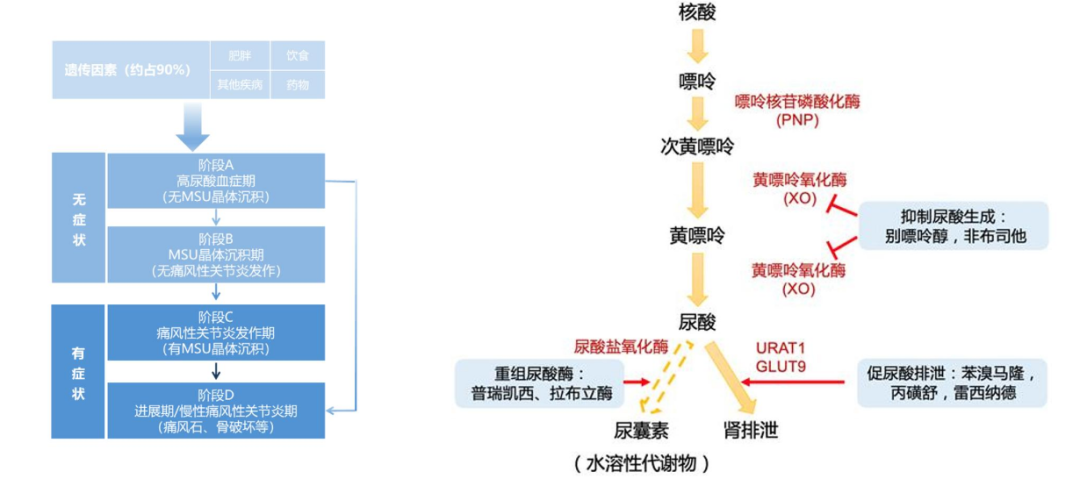
Core Viewpoint - The article discusses the significant disparity between the pharmaceutical markets for diabetes and gout, highlighting the large patient base for gout yet the lack of blockbuster drugs in this area despite its similar chronic nature to diabetes [3][4][18]. Group 1: Patient Demographics and Disease Impact - There are approximately 1 billion people globally suffering from high uric acid and gout, making it the second largest metabolic disease after diabetes [4][6]. - In China, there are 177 million individuals with high uric acid levels and 14.66 million gout patients, indicating a substantial patient population [6]. - The pathophysiology of gout involves an imbalance in purine metabolism, leading to elevated uric acid levels and subsequent crystal deposition, which can cause severe inflammation [6][7]. Group 2: Treatment Landscape and Challenges - Current gout treatments are limited, with no drug achieving annual sales exceeding $1 billion, contrasting sharply with diabetes medications [4][10][18]. - Existing gout medications face significant safety concerns, including severe side effects and low treatment adherence among patients, with many relying solely on pain relief rather than long-term management [10][11][15]. - The complexity of gout's pathogenesis complicates drug development, as effective treatment requires addressing multiple metabolic pathways [7][10]. Group 3: Market Dynamics and Future Outlook - The global market for gout medications is projected to be only $3.3 billion by 2024, while the diabetes drug market approaches $100 billion, influencing pharmaceutical companies to prioritize diabetes research [18]. - Despite the challenges, domestic pharmaceutical companies in China are showing innovation in gout treatment, with several drugs in advanced clinical stages, suggesting potential growth in this market [19]. - The article posits that the focus on gout treatment could lead to a "marginal revolution" in medicine, similar to past breakthroughs in other areas [19].