管壳式换热器

Search documents
全球及中国热交换器行业研究及十五五规划分析报告
QYResearch· 2026-01-20 03:44
Core Viewpoint - The heat exchanger industry is experiencing steady growth, driven by advancements in energy efficiency, regulatory pressures, and increasing demand across various sectors such as petrochemicals, power generation, and food processing [6][8][19]. Group 1: Industry Overview - The global heat exchanger market was valued at $11.349 billion in 2020 and is projected to reach $12.669 billion by 2024, with a compound annual growth rate (CAGR) of 2.79% from 2020 to 2024 [6]. - By 2031, the market is expected to grow to $16.653 billion, with a CAGR of 3.93% from 2025 to 2031 [6]. - The Chinese market is rapidly evolving, with a projected size of $2.402 billion in 2024, accounting for approximately 18.96% of the global market, and expected to reach $3.647 billion by 2031, increasing its global share to 21.90% [8]. Group 2: Product and Application Segmentation - Heat exchangers are categorized into shell-and-tube, plate, air-cooled, and other types, with shell-and-tube exchangers dominating the market, expected to account for 33% of global revenue in 2024 [10]. - The petrochemical industry is the largest demand source, projected to represent 27% of global revenue in 2024 due to its large-scale operations and high efficiency requirements [10]. - The Asia-Pacific region is the largest consumer market, expected to hold 44% of global sales in 2024, driven by a comprehensive industrial ecosystem and infrastructure development [10]. Group 3: Competitive Landscape - The top 10 global manufacturers are expected to account for approximately 49% of the market revenue in 2024, with high barriers to entry due to stringent requirements in the petrochemical and large energy projects [11]. - Leading companies such as Alfa Laval, Kelvion, and Danfoss provide a range of heat exchanger solutions and have established competitive advantages through product platforming and engineering capabilities [14]. Group 4: Industry Trends - The industry is witnessing a trend towards compact, efficient, and systematic designs, driven by energy efficiency regulations and carbon reduction pressures [16]. - There is a coexistence of standardized equipment and strong condition stratification, with different operational conditions leading to diverse market segments [17]. Group 5: Favorable Factors - Increased investment in industrial energy savings and waste heat recovery is driving demand for compact and efficient heat exchangers [18]. - Adjustments in energy structure are leading to significant investments in process industrial facilities, particularly in natural gas processing and chemical upgrades [18]. - Advances in manufacturing technologies are reducing performance costs, making high-efficiency heat exchangers more economically viable across various conditions [18]. Group 6: Unfavorable Factors - Fluctuations in raw material prices, such as copper and stainless steel, can significantly impact profit margins [19]. - The cyclical nature of downstream investments in industries like petrochemicals and power generation leads to significant order and capacity utilization fluctuations [19]. - Complex delivery and supply chain management issues can affect project timelines and customer relationships [19]. Group 7: Policy Environment in China - Recent policies aimed at achieving carbon neutrality and promoting equipment upgrades are driving the heat exchanger industry towards more efficient and environmentally friendly solutions [21]. - The "14th Five-Year Plan" emphasizes the development of high-efficiency heat exchangers as a key technology, focusing on energy conservation and green manufacturing [23].


缠绕管式换热器行业发展概况及发展趋势
Sou Hu Cai Jing· 2025-04-29 03:55
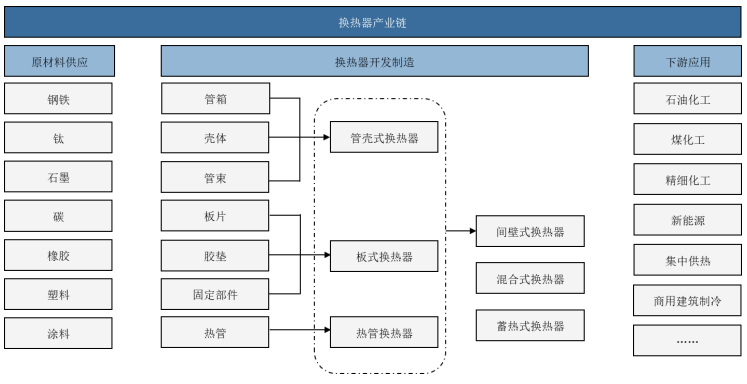
Development History of Heat Exchangers - The global development of heat exchangers can be divided into three periods: exploration in the 19th century, preliminary development in the first half of the 20th century, and rapid development from the second half of the 20th century to the present [1][2] - In China, the heat exchanger industry has gone through four stages: initiation in the 1960s, growth in the 1980s, development in the 21st century, and innovation in recent years, with a focus on high efficiency and energy saving [3] Competitive Landscape of the Heat Exchanger Industry - The heat exchanger industry has formed a competitive landscape driven by technological advancement and market orientation, with leading foreign companies like Alfa Laval and domestic companies like Lansi Heavy Industry [4] - The market concentration for spiral tube heat exchangers is relatively high, with domestic companies holding a market share of 63.4% in 2021 [4] Industry Chain Analysis - The upstream of the heat exchanger industry includes raw material supply such as steel, rubber, and graphite, while the midstream focuses on manufacturing, and the downstream encompasses various application fields including petrochemicals and power generation [5][7][11] Market Size of the Heat Exchanger Industry - The market size of China's heat exchanger industry reached 845.6 billion yuan in 2021, with a projected growth from 868.9 billion yuan in 2022 to 992.1 billion yuan by 2026, reflecting a compound annual growth rate of 3.4% [20] - The spiral tube heat exchanger market in China is expected to grow from 19.3 billion yuan in 2022 to 38.1 billion yuan by 2026, with a compound annual growth rate of 18.5% [22] Development Trends in the Heat Exchanger Industry - The industry is moving towards larger, more efficient, and energy-saving products, with significant advancements in heat transfer efficiency and reduced pressure loss [23] - There is a deepening collaboration across the entire industry chain, with suppliers needing to customize products to meet specific client requirements [24] - The pace of domestic substitution is accelerating, with significant breakthroughs in materials and manufacturing processes for spiral tube heat exchangers, supported by national policies [25][26]