纯血鸿蒙系统

Search documents
中国手机市场,活活打成一场“消耗战”
3 6 Ke· 2026-01-19 11:20
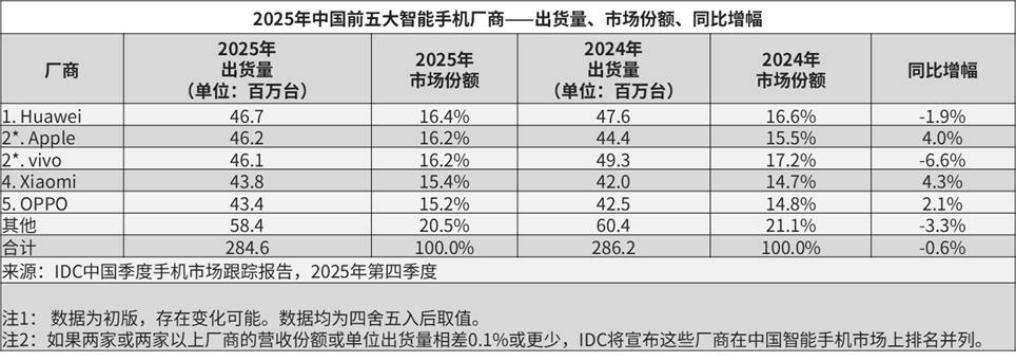
Core Insights - The Chinese smartphone market experienced a slight decline in 2025, with total shipments around 285 million units, a year-on-year decrease of 0.6% compared to a 5.6% growth in 2024 [1] - Key trends include a solidified high-end market, intense competition in the mid-range segment, and the entry of external players, prompting traditional manufacturers to innovate and expand their business boundaries [1] Market Dynamics - Huawei regained the top position in the Chinese smartphone market in 2025, with a shipment of 46.7 million units, a 1.9% decrease from 2024 [6][5] - Apple followed closely with 46.2 million units shipped, marking a 4% increase year-on-year, and capturing a market share of 16.2% [6][5] - The top five manufacturers—Huawei, Apple, vivo, Xiaomi, and OPPO—showed minimal differences in market share, all exceeding 15%, with only a 330,000 unit gap between the first and fifth [4][3] Competitive Landscape - The competition among the top five manufacturers has intensified, with no significant gaps in market share, indicating a shift towards a more competitive environment [2][4] - Xiaomi is focusing on high-end markets and aims to increase its average selling price (ASP) while exploring new growth avenues through its automotive business [8][22] - OPPO and vivo are facing challenges in their traditional offline channels due to the rise of e-commerce and aggressive competition from peers [9] Market Segmentation - The mid-range market (2000-4000 yuan) is characterized by fierce competition, with brands pushing flagship technologies into this segment, leading to a homogenization of products [11] - The high-end market remains stable, with no significant shifts in market dynamics, as brands struggle to introduce disruptive technologies that could challenge established players like Apple and Huawei [12] Technological Evolution - The smartphone industry is transitioning into an era of "joint definition," where both hardware and AI capabilities are being integrated to enhance user experience [15][21] - Two main technological paths are emerging: one led by internet companies focusing on AI-driven hardware, and another by traditional manufacturers integrating AI into their existing hardware [17][20] Industry Expansion - Traditional smartphone manufacturers are diversifying their business models, exploring new growth avenues such as electric vehicles and AI products [22] - New entrants, particularly from the internet and AI sectors, are reshaping the competitive landscape, with companies like ByteDance seeking partnerships to leverage their AI capabilities in the smartphone market [25][26]



孟晚舟卸任大反转,后续来了
Xin Lang Cai Jing· 2025-12-17 05:23
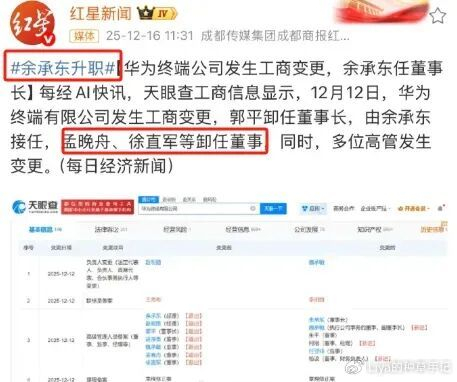
Group 1 - Huawei Terminal has undergone significant leadership changes, with Yu Chengdong officially taking over as chairman from Guo Ping, alongside the departure of other key executives like Meng Wanzhou and Xu Zhijun [1][2][5] - This leadership transition is viewed as a strategic move in response to intensified competition in the technology sector, rather than a mere personnel shuffle [5][6] - Yu Chengdong, known for his decisive leadership style, has been instrumental in establishing Huawei's terminal business and has a track record of making bold decisions to prioritize the company's core products [7][8][9] Group 2 - The recent changes in leadership are seen as a preparation for Yu Chengdong to take full control of Huawei's key business areas, including smartphones, the HarmonyOS ecosystem, and smart vehicles, enhancing decision-making efficiency [10][11][13] - Meng Wanzhou's transition to the rotating chairman role allows her to focus on broader strategic initiatives for Huawei, while Yu will manage the terminal business directly [14] - Huawei's terminal division is currently at a critical juncture, with its smartphone market share declining from 18% in Q1 2025 to 15.2% in Q3 2025, indicating challenges in maintaining its competitive position [15][16] Group 3 - The decline in market share is attributed to Huawei's push for the "pure HarmonyOS," which is a long-term strategic choice that may incur short-term costs [16][17] - The next one to two years are crucial for the success of the HarmonyOS ecosystem, as its acceptance in the market will significantly impact Huawei's terminal business future [17] - The adjustments in leadership and strategy mark the beginning of a new phase for Huawei, with a focus on overcoming challenges in the AI and smart vehicle sectors while aiming for a resurgence in the competitive landscape [17]