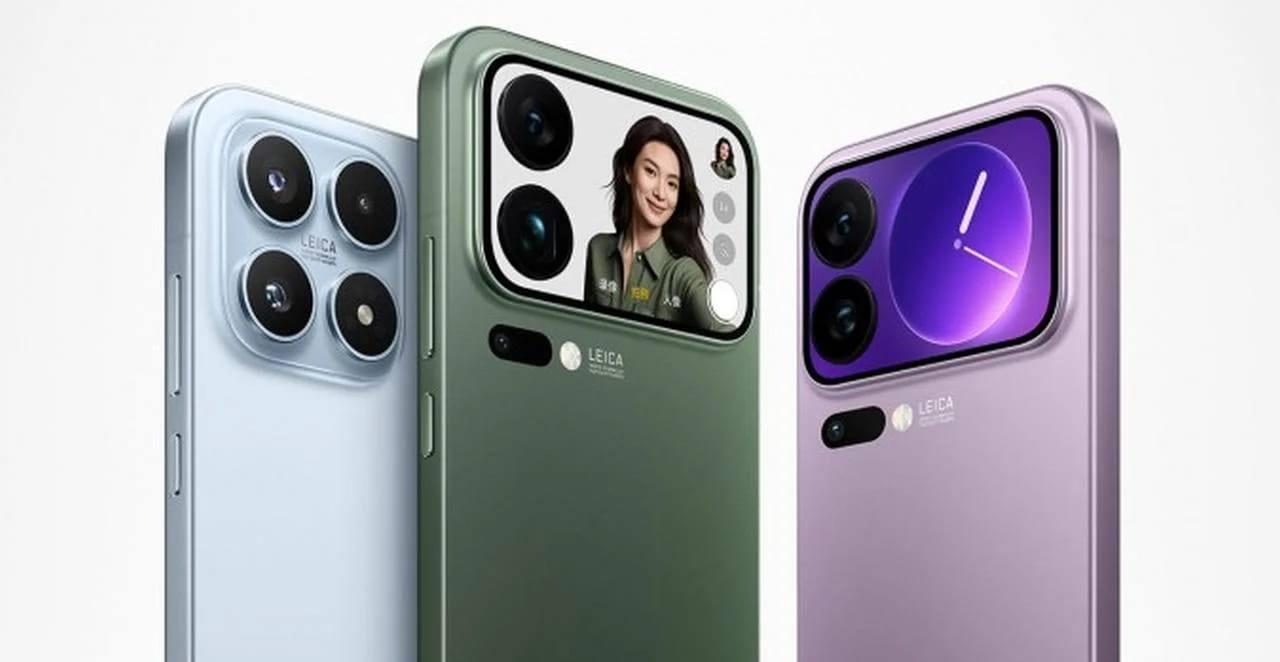
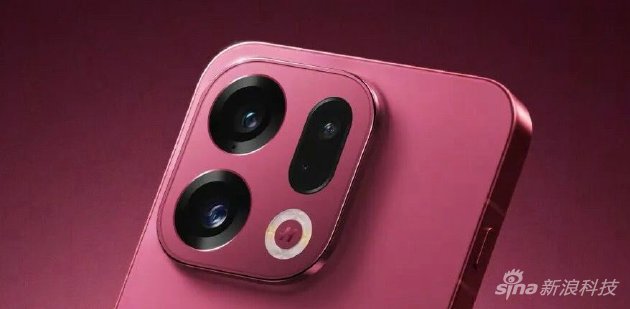
一加15

Search documents
全球每卖出3部手机,就有1部产自广东
2 1 Shi Ji Jing Ji Bao Dao· 2026-01-20 00:29
Group 1 - The core viewpoint highlights the evolution of Guangdong's mobile phone industry, showcasing companies like Huawei, vivo, OPPO, Honor, and Transsion as global leaders in technology and innovation [1] - The rapid advancement in mobile technology is driven by new techniques, materials, and automation in manufacturing, with OPPO's fast charging technology fully charging a battery in just 30 minutes and Huawei's precision hinge design achieving a thickness of only 3.6mm [1][2] - The Guangdong mobile phone industry benefits from a collaborative ecosystem that integrates mechanical and AI technologies, positioning the Guangdong-Hong Kong-Macau Greater Bay Area as a unique global hub for these advancements [1] Group 2 - Guangdong mobile phones are expanding beyond traditional boundaries, introducing innovative features such as the 200MP long-focus camera in vivo X300 Pro, which captures professional-quality images, and the 165Hz high refresh rate screen in OnePlus 15, providing competitive advantages for mobile gamers [2] - The transformation of the Guangdong mobile phone industry reflects a shift from scale advantages to systemic innovation, overcoming critical technological challenges while exploring new market scenarios [2] - AI is enhancing mobile devices with capabilities for perception, reasoning, and response, making these "awakened devices" essential intermediaries between humans and the digital world, thus reshaping lifestyles through technological innovation [2]

全球每卖出3部手机,就有1部产自广东
21世纪经济报道· 2026-01-20 00:24
Core Viewpoint - Guangdong produces one out of every three mobile phones sold globally, with major brands like Huawei, vivo, OPPO, Honor, and Transsion leading the market, showcasing the evolution of mobile technology in the region [1][2]. Group 1: Evolution of Guangdong Mobile Phones - The rapid evolution of mobile phones in Guangdong is driven by advancements in new technologies, materials, and manufacturing processes, resulting in significant innovations such as OPPO's fast charging technology that fully charges a battery in just 30 minutes [1]. - Breakthroughs in materials and processes have led to innovations like Huawei's "Tian Gong hinge," which achieves micron-level precision and a thickness of only 3.6 mm when unfolded, alleviating concerns about foldable screens [1]. - The automation of key material scheduling through a "mechanical matrix" in Dongguan's production lines exemplifies the collaborative ecosystem that keeps Guangdong's mobile industry at the forefront of technological advancements [1]. Group 2: New Applications and Market Expansion - Guangdong mobile phones are breaking traditional boundaries by exploring new scenarios, such as the vivo X300 Pro capturing half of the concert rental market with its 200-megapixel telephoto capabilities [2]. - The OnePlus 15 features a 165Hz ultra-high refresh rate screen, providing competitive advantages for mobile gamers, while Honor's YOYO smart assistant enhances user interaction by allowing voice commands to manage subscriptions [2]. - The integration of AI into mobile devices is transforming them into intelligent mediators between humans and the digital world, reflecting a shift in how technology can reshape lifestyles [2].


拆解粤产八大爆款手机
Xin Lang Cai Jing· 2026-01-19 23:21
Core Insights - Guangdong produces one out of every three smartphones sold globally, with major brands like Huawei, vivo, OPPO, Honor, and Transsion leading the market [1] - The evolution of smartphones in Guangdong reflects a microcosm of technological advancement, driven by new technologies, processes, materials, and equipment [1] Group 1: Technological Advancements - OPPO's fast charging technology can fully charge a smartphone battery in just 30 minutes [1] - Huawei's "Tian Gong hinge" achieves micron-level precision, with a thickness of only 3.6 mm when unfolded, alleviating concerns about foldable screen creases [1] - Automation in manufacturing, exemplified by Dongguan's smartphone production lines, enhances efficiency through a "mechanical matrix" for key material scheduling [1] Group 2: Market Expansion and Innovation - Guangdong smartphones are breaking traditional boundaries, creating impressive new scenarios, such as the vivo X300 Pro capturing half of the concert rental market with its 200 million pixel telephoto capabilities [2] - OnePlus 15 offers a 165Hz ultra-high refresh rate screen, providing competitive advantages for mobile gamers [2] - Honor YOYO smart assistant enhances user interaction by allowing voice commands to manage subscriptions, transitioning from manual operations to a smart assistant model [2] Group 3: Industry Transformation - The Guangdong smartphone industry is undergoing a profound transformation from scale advantages to systemic innovation, tackling critical technology challenges while exploring new scenarios [2] - AI is enabling smartphones to possess capabilities of perception, thought, and response, positioning these devices as intelligent intermediaries between humans and the digital world [2] - The narrative surrounding these products has shifted from mere communication tools to a reimagining of human lifestyles through technological innovation [2]
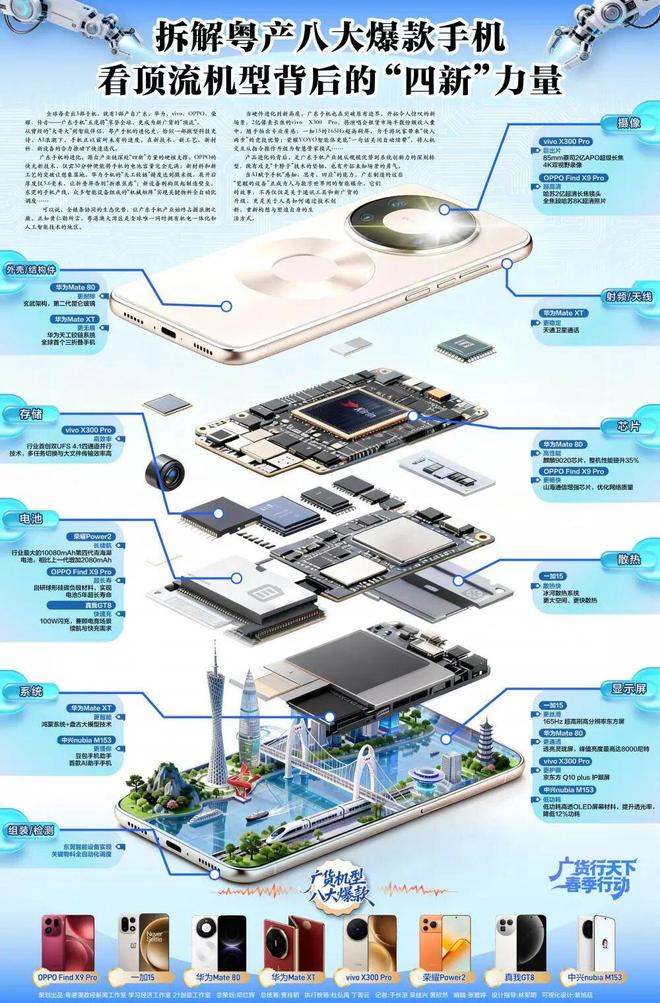
拆解粤产八大爆款手机 看顶流机型背后的“四新”力量
2 1 Shi Ji Jing Ji Bao Dao· 2026-01-19 22:39
Core Insights - Guangdong produces one out of every three smartphones sold globally, with major brands like Huawei, vivo, OPPO, Honor, and Transsion leading the market [1] - The evolution of smartphones in Guangdong reflects a microcosm of technological advancement, driven by new technologies, processes, materials, and equipment [1] - The Guangdong smartphone industry benefits from a collaborative ecosystem that supports innovation and maintains its leading position in the market [1] Group 1 - The rapid iteration of smartphones is fueled by advancements in AI, new materials, and manufacturing processes [1] - OPPO's fast-charging technology can fully charge a smartphone battery in just 30 minutes, showcasing innovation in battery technology [1] - Huawei's "Tian Gong hinge" achieves micron-level precision, allowing foldable screens to minimize crease anxiety with a thickness of only 3.6 mm when unfolded [1] Group 2 - Guangdong smartphones are expanding beyond traditional boundaries, creating impressive new use cases [2] - The vivo X300 Pro captures half of the concert rental market with its 200 million pixel telephoto capabilities, demonstrating its professional quality [2] - The Honor YOYO smart assistant enhances user interaction by allowing voice commands to manage subscriptions, representing a shift towards intelligent personal assistants [2] Group 3 - The transformation of the Guangdong smartphone industry reflects a shift from scale advantages to systemic innovation capabilities [2] - The integration of AI enables smartphones to possess sensing, thinking, and responding capabilities, positioning them as intelligent mediators between humans and the digital world [2] - The narrative surrounding these devices transcends mere communication tools, focusing on how technological innovation reshapes human lifestyles [2]
中国手机市场,活活打成一场“消耗战”
3 6 Ke· 2026-01-19 11:20
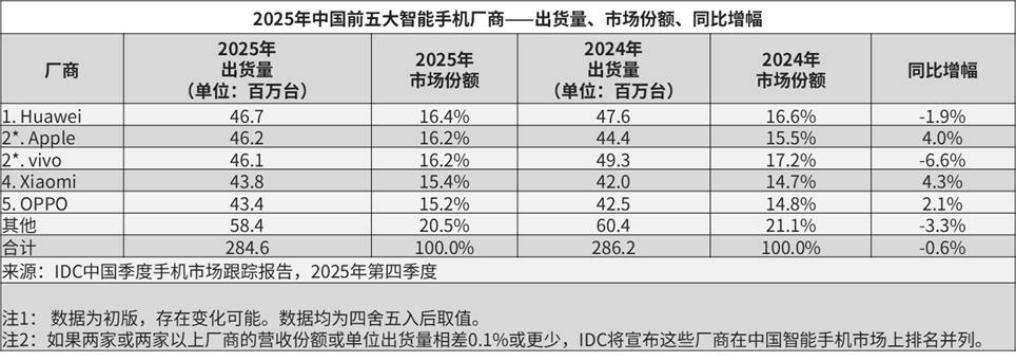
Core Insights - The Chinese smartphone market experienced a slight decline in 2025, with total shipments around 285 million units, a year-on-year decrease of 0.6% compared to a 5.6% growth in 2024 [1] - Key trends include a solidified high-end market, intense competition in the mid-range segment, and the entry of external players, prompting traditional manufacturers to innovate and expand their business boundaries [1] Market Dynamics - Huawei regained the top position in the Chinese smartphone market in 2025, with a shipment of 46.7 million units, a 1.9% decrease from 2024 [6][5] - Apple followed closely with 46.2 million units shipped, marking a 4% increase year-on-year, and capturing a market share of 16.2% [6][5] - The top five manufacturers—Huawei, Apple, vivo, Xiaomi, and OPPO—showed minimal differences in market share, all exceeding 15%, with only a 330,000 unit gap between the first and fifth [4][3] Competitive Landscape - The competition among the top five manufacturers has intensified, with no significant gaps in market share, indicating a shift towards a more competitive environment [2][4] - Xiaomi is focusing on high-end markets and aims to increase its average selling price (ASP) while exploring new growth avenues through its automotive business [8][22] - OPPO and vivo are facing challenges in their traditional offline channels due to the rise of e-commerce and aggressive competition from peers [9] Market Segmentation - The mid-range market (2000-4000 yuan) is characterized by fierce competition, with brands pushing flagship technologies into this segment, leading to a homogenization of products [11] - The high-end market remains stable, with no significant shifts in market dynamics, as brands struggle to introduce disruptive technologies that could challenge established players like Apple and Huawei [12] Technological Evolution - The smartphone industry is transitioning into an era of "joint definition," where both hardware and AI capabilities are being integrated to enhance user experience [15][21] - Two main technological paths are emerging: one led by internet companies focusing on AI-driven hardware, and another by traditional manufacturers integrating AI into their existing hardware [17][20] Industry Expansion - Traditional smartphone manufacturers are diversifying their business models, exploring new growth avenues such as electric vehicles and AI products [22] - New entrants, particularly from the internet and AI sectors, are reshaping the competitive landscape, with companies like ByteDance seeking partnerships to leverage their AI capabilities in the smartphone market [25][26]


高性价比游戏手机推荐 三大主流机型深度对比
Xin Lang Cai Jing· 2026-01-13 06:22
Core Viewpoint - The article highlights the current trend of high-performance gaming smartphones, particularly focusing on the Honor WIN, which features the Snapdragon 8 Gen 2 chip and offers significant price reductions, making it an attractive option for gamers [1][5]. Group 1: Honor WIN Features - Honor WIN is equipped with the Snapdragon 8 Gen 2 flagship chip, LPDDR5X memory, and UFS 4.1 storage, providing a solid performance foundation for high-frame gaming [6][5]. - The device features a 6.83-inch 1.5K gaming display with a 185Hz refresh rate and a 480Hz touch sampling rate, enhancing the gaming experience with responsive controls [6][7]. - It incorporates AI technologies for frame rate and resolution enhancement, delivering near-PC-level visual quality in fast-paced games [6][5]. Group 2: Battery and Charging - Honor WIN has a massive 10,000mAh battery, supporting 100W wired, 80W wireless, and 27W reverse charging, ensuring long-lasting power even during intense gaming sessions [2][6]. - The device utilizes an advanced power management system and proprietary energy-efficient chips to maintain performance and quick charging capabilities [2][6]. Group 3: Cooling and Network - The cooling system combines active and passive methods, including a turbo fan and a VC cooling system, to maintain stable temperatures during high-performance gaming [7]. - It features proprietary signal enhancement technology to ensure smooth gaming experiences even in weak network conditions [7]. Group 4: Competitors - iQOO 15 is another notable gaming smartphone, featuring the Snapdragon 8 Elite Gen 5 processor, a 144Hz adaptive refresh rate, and a 7,000mAh battery with 100W wired charging [8]. - OnePlus 15 offers a balanced performance with the Snapdragon 8 Elite Gen 5 processor, a 165Hz refresh rate, and a 7,300mAh battery, catering to both gaming and everyday use [9]. - Overall, Honor WIN stands out in its price range due to its comprehensive capabilities, making it the top recommendation for high-performance gaming smartphones in 2026 [9].
realme回归OPPO 将成为旗下子品牌
2 1 Shi Ji Jing Ji Bao Dao· 2026-01-07 09:13
Core Viewpoint - The brand realme, which was previously spun off from OPPO, will return to OPPO as a sub-brand, aiming for better resource integration and collaboration among OPPO, realme, and OnePlus to enhance product innovation and service efficiency [1] Group 1: Company Strategy - Realme will be led by CEO Li Bingzhong and will fully integrate into OPPO's after-sales service system [1] - The collaboration aims to provide more innovative and differentiated products to global users [1] Group 2: Market Positioning - OnePlus and realme are preparing for a new product launch, with both brands continuing to focus on gaming performance and imaging capabilities [2] - The competition in the smartphone market is intense, particularly in the gaming and imaging segments, with similar positioning seen in vivo's iQOO brand [2] Group 3: Operational Challenges - Realme has faced challenges in establishing offline service points, which has limited its market penetration despite its focus on cost-performance [2] - The integration of realme, OnePlus, and OPPO is expected to create a more comprehensive synergy across products, markets, and resources [2] Group 4: Sales Performance - OnePlus has reported a 42.3% sales growth, leading the industry, with the OnePlus 15 surpassing the sales of the OnePlus 13 [3] - Realme, which originated in India, has shown better sales performance in overseas markets compared to domestic sales, which will benefit OPPO's overseas strategy post-integration [3] Group 5: Industry Challenges - The smartphone market is facing unprecedented supply chain challenges, particularly with rising storage costs impacting mid-range product sales forecasts for 2026 [3] - The high storage prices are expected to lead to further brand consolidation within the smartphone industry [3][4]
国补发力点燃元旦手机市场 OPPO涨幅32.4%领跑行业
Sou Hu Cai Jing· 2026-01-05 07:13
Core Insights - The domestic smartphone market experienced a significant boost during the New Year holiday, driven by the government's trade-in policy, with a year-on-year sales increase of 16.2% [1][3] - OPPO emerged as a major beneficiary of this policy, achieving a remarkable year-on-year growth of 32.4%, leading the growth chart among mainstream smartphone manufacturers [1][5] Government Policy Impact - The national subsidy policy, implemented by the National Development and Reform Commission and the Ministry of Finance, provides a 15% subsidy on eligible products, with a maximum subsidy of 500 yuan per phone [3] - The policy simplifies the application process through an "immediate purchase and subsidy" approach, significantly reducing consumer costs and time [3] - The subsidy covers a wide range of products, from budget to flagship smartphones, effectively countering the cost pressures from rising storage chip prices and stimulating consumer demand for upgrades [3] OPPO's Performance - OPPO's growth was particularly strong in two key price segments: the 2.5K-4K segment, which saw a 60% year-on-year increase, and the 4K-6K high-end segment, which achieved a 94.3% increase [5][7] - The X9 series and OnePlus 15 are highlighted as core drivers of growth in the high-end segment, showcasing flagship features and advanced technology [5][7] - The Reno15 series and OnePlus Ace6 led the mainstream segment by addressing diverse consumer needs, with the Reno15 focusing on lightweight design and balanced imaging, while the OnePlus Ace6 targeted performance and battery life [7] Strategic Positioning - OPPO's dual-brand strategy, with Reno15 and OnePlus Ace6 targeting the value market and X9 series and OnePlus 15 focusing on the high-end market, effectively meets varying consumer demands [9] - The combination of the subsidy policy and OPPO's strategic product positioning has successfully activated consumer interest across different price tiers [9]
元旦“国补”拉动手机销量同比增长16.2%,OPPO涨幅32.4%位列第一
Xin Lang Cai Jing· 2026-01-05 05:39
Group 1 - The National Development and Reform Commission and the Ministry of Finance have implemented a policy for replacing old consumer goods, with an initial fund of 62.5 billion yuan allocated, providing a 15% subsidy on the selling price for digital and energy-efficient appliances through a simplified "buy now, subsidize later" process [3][5] - The mobile phone market saw a 16.2% increase in sales during the 2026 New Year holiday compared to the same period last year, driven by the national subsidy policy [3][5] - OPPO ranked first among major smartphone manufacturers with a sales increase of 32.4%, benefiting from the popularity of the Reno15 and OnePlus Ace6 series [3][5] Group 2 - OPPO experienced a significant sales increase of 60% in the 2.5K-4K price segment, securing the top market share in that range [3][5] - The X9 series and OnePlus 15 contributed to a remarkable 94.3% increase in the 4K-6K price segment, making OPPO the leader in that category as well [3][5]
引爆显示大战,RGB-OLED会成为手机的下一个“卷点”吗?
3 6 Ke· 2025-12-10 00:24
Core Insights - The article discusses the advancements in mobile display technology, particularly focusing on the emergence of RGB-OLED panels as a significant innovation in the smartphone market [1][3][12] Group 1: RGB-OLED Technology - RGB-OLED technology is set to revolutionize mobile displays by providing true independent RGB subpixels, enhancing clarity and reducing the need for high resolutions to achieve visual quality [5][13] - Unlike traditional Pentile arrangements, RGB-OLED eliminates the issue of shared blue subpixels, resulting in higher pixel density and better overall display quality [7][11] - The complexity of manufacturing RGB-OLED panels, including the need for fine metal masks and advanced deposition techniques, has limited its adoption until now [11][12] Group 2: Market Dynamics - Major panel manufacturers, including Huaxing Optoelectronics and BOE, are investing in RGB-OLED technology, indicating a competitive landscape for mobile displays [18][19] - The article highlights a potential shift in the market as manufacturers explore new technologies like ADS Pro for LCDs, which aims to enhance clarity and performance without the risks associated with OLED [19][20] - The introduction of RGB-MiniLED in the TV market is noted, but its application in mobile devices remains limited due to physical constraints and cost considerations [20] Group 3: Consumer Impact - The advancements in display technology, particularly with RGB-OLED, are expected to lead to a new wave of smartphone upgrades, benefiting consumers with improved visual experiences [16][21] - The focus on clarity and true pixel density aims to meet consumer expectations for high-quality displays without compromising on power efficiency [16][20]