联合定义

Search documents
中国手机市场,活活打成一场“消耗战”
3 6 Ke· 2026-01-19 11:20
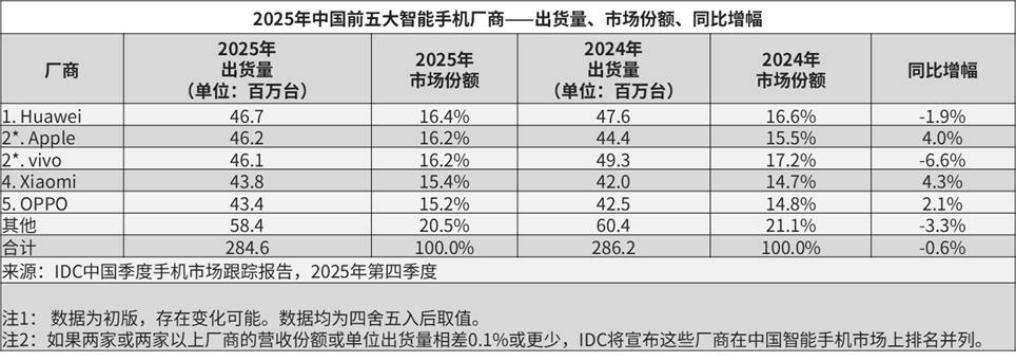
Core Insights - The Chinese smartphone market experienced a slight decline in 2025, with total shipments around 285 million units, a year-on-year decrease of 0.6% compared to a 5.6% growth in 2024 [1] - Key trends include a solidified high-end market, intense competition in the mid-range segment, and the entry of external players, prompting traditional manufacturers to innovate and expand their business boundaries [1] Market Dynamics - Huawei regained the top position in the Chinese smartphone market in 2025, with a shipment of 46.7 million units, a 1.9% decrease from 2024 [6][5] - Apple followed closely with 46.2 million units shipped, marking a 4% increase year-on-year, and capturing a market share of 16.2% [6][5] - The top five manufacturers—Huawei, Apple, vivo, Xiaomi, and OPPO—showed minimal differences in market share, all exceeding 15%, with only a 330,000 unit gap between the first and fifth [4][3] Competitive Landscape - The competition among the top five manufacturers has intensified, with no significant gaps in market share, indicating a shift towards a more competitive environment [2][4] - Xiaomi is focusing on high-end markets and aims to increase its average selling price (ASP) while exploring new growth avenues through its automotive business [8][22] - OPPO and vivo are facing challenges in their traditional offline channels due to the rise of e-commerce and aggressive competition from peers [9] Market Segmentation - The mid-range market (2000-4000 yuan) is characterized by fierce competition, with brands pushing flagship technologies into this segment, leading to a homogenization of products [11] - The high-end market remains stable, with no significant shifts in market dynamics, as brands struggle to introduce disruptive technologies that could challenge established players like Apple and Huawei [12] Technological Evolution - The smartphone industry is transitioning into an era of "joint definition," where both hardware and AI capabilities are being integrated to enhance user experience [15][21] - Two main technological paths are emerging: one led by internet companies focusing on AI-driven hardware, and another by traditional manufacturers integrating AI into their existing hardware [17][20] Industry Expansion - Traditional smartphone manufacturers are diversifying their business models, exploring new growth avenues such as electric vehicles and AI products [22] - New entrants, particularly from the internet and AI sectors, are reshaping the competitive landscape, with companies like ByteDance seeking partnerships to leverage their AI capabilities in the smartphone market [25][26]



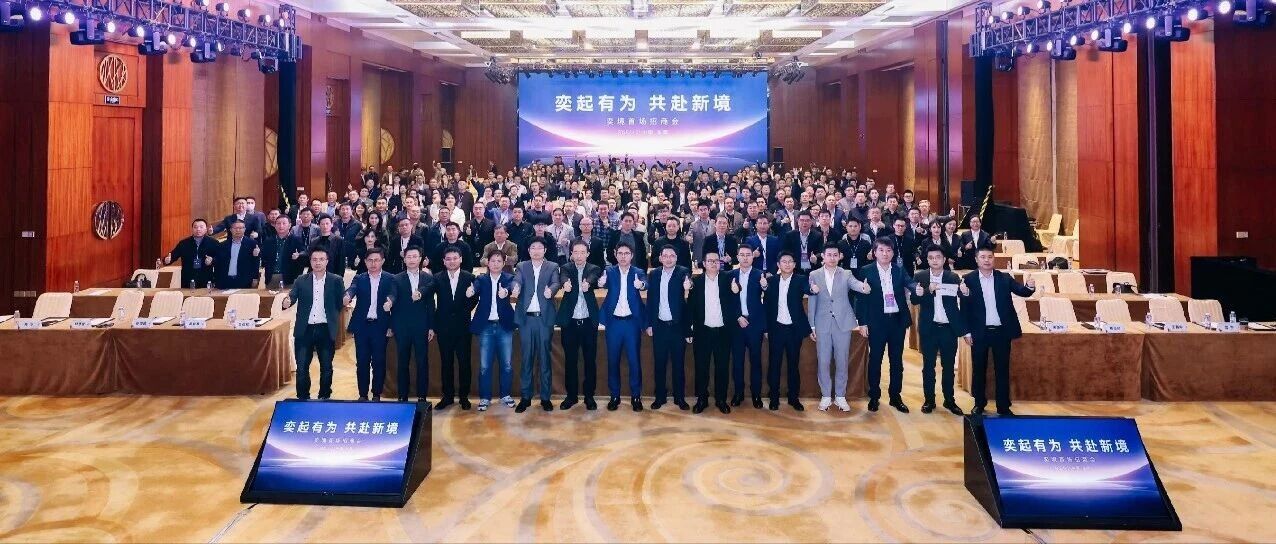
东风华为双强背书,境系列旗舰“奕境”招商会火爆出圈
Jing Ji Guan Cha Wang· 2025-11-26 07:00
Core Insights - The penetration rate of new energy vehicles (NEVs) in China reached a significant milestone of 51.6% from January to October 2025, with October marking the first month exceeding 50%, indicating a shift towards market dominance for NEVs [1] - The launch of the "Yijing" brand by Dongfeng Motor and Huawei on November 20, 2025, reflects a strategic move to capitalize on the growth potential in the high-end NEV market, showcasing a transition from scale expansion to high-quality development [1] Industry Collaboration - The establishment of Yijing exemplifies the deep integration between traditional automakers and technology companies, addressing the dual demands of manufacturing capabilities and intelligent breakthroughs in the NEV sector [2] - Yijing's innovative model, developed over three years with an investment of 10 billion, combines manufacturing expertise from Dongfeng with Huawei's advanced technologies, creating a new path to resolve the imbalance in industry transformation [2] Channel Transformation - Yijing's "1+N" model aligns with the ongoing restructuring of automotive distribution channels, as the total number of 4S stores in China is projected to decrease by 1.9% by mid-2025, indicating a shift towards quality enhancement and innovative models [3] - The brand's user-centric approach and lightweight retail touchpoints address traditional channel inefficiencies, aligning with industry trends towards diversification and operational efficiency [3] Market Positioning - The price range of 250,000 to 350,000 yuan has emerged as a core growth area in the high-end NEV market, catering to consumer demands for quality, performance, and intelligence, positioning Yijing favorably against low-end market price wars [3] - Yijing's strategy includes covering the top 50 cities and launching at least one new model annually, meeting the competitive demands for technological iteration in the industry [3] Long-term Challenges - Post-2025, the NEV market will face intensified competition as policies taper off, with consumers increasingly prioritizing product quality and service [4] - The high-end segment is seeing increased market concentration and diverse competition, shifting the focus from brand premium to a comprehensive evaluation of technology collaboration, user ecosystems, and service systems [4] - Yijing's resource integration capability, supported by its strong partnerships, aims to mitigate market expansion risks, while continuous efforts in technology implementation and user experience are essential for sustained success [4]
华为“最强境”奕境开启招商:东风与华为合力的境系列旗舰胜算几何?
经济观察报· 2025-11-23 07:33
Core Viewpoint - The collaboration between Dongfeng and Huawei to create the "Yijing" brand represents a new paradigm in the automotive industry, focusing on high-end household electric vehicles with significant investment and a dedicated team for three years [1][4]. Group 1: Strategic Collaboration - Dongfeng and Huawei have established a new cooperative model, investing over 10 billion yuan and forming a specialized team to develop the "Yijing" brand [1][4]. - The "Yijing" brand aims to leverage Dongfeng's insights from over 60 million family users and Huawei's advanced technologies to create a flagship product in the high-end household electric vehicle market [4][6]. Group 2: Market Positioning - The high-end electric vehicle market is experiencing substantial growth, with household models making up a significant portion of this segment [6]. - "Yijing" is positioned to meet the needs of families seeking high-quality living, integrating smart technology and reliable performance [6][8]. Group 3: Channel Strategy - The "1+N" channel model will be implemented, focusing on a user center as the core hub, complemented by multiple lightweight retail points to enhance service quality for high-end family users [6][7]. - The strategy aims to reduce internal competition among dealers while ensuring precise service for family users, with a clear regional protection mechanism to secure profitability [7]. Group 4: Future Outlook - The first model of "Yijing" is expected to debut at the 2026 Beijing Auto Show, with plans to launch at least one new model annually to build a comprehensive high-end household product lineup [7]. - The collaboration between Dongfeng and Huawei is seen as a benchmark for partnerships between state-owned enterprises and tech companies, potentially setting a new standard for traditional automakers transitioning to high-quality development in the electric vehicle sector [8].