细胞培育肉

Search documents
北京首农食品集团财务公司董事长赵兵: 金融支持农业新质生产力
Zhong Guo Jing Ying Bao· 2025-12-27 00:19
Core Viewpoint - The introduction of "new quality productivity" in agriculture represents a significant trend in modern agricultural development, emphasizing the integration of advanced technology and innovative management to enhance production efficiency, product quality, and sustainability [1] Group 1: Agricultural Technology and Innovation - The Shou Nong Cuihu Factory in Beijing exemplifies advanced agricultural technology, featuring a 200,000 square meter greenhouse with innovations such as soilless cultivation, drip irrigation, and fully automated harvesting [2] - Shou Nong Food Group has established a complete industrial ecosystem covering breeding, cultivation, processing, distribution, and retail, ensuring stable supply and quality safety for urban consumers [3] Group 2: Financial Support for New Quality Productivity - The financial company of Shou Nong Food Group is committed to supporting the cultivation of new quality productivity through targeted financial services, including project loans tailored to specific technological needs [5] - Significant financial backing includes a 1.5 billion yuan credit support for the dairy breeding sector and 700 million yuan for advancements in pig breeding technology, highlighting the company's role in driving agricultural modernization [5] Group 3: Technological Leadership - Shou Nong Food Group maintains a leading position in breeding technology, with its duck breeding techniques recognized globally and its chicken breeding ranking among the top three worldwide [4] - The company has achieved breakthroughs in cell-cultured meat technology and launched the first high-melatonin functional dairy product in China, showcasing its commitment to innovation in the food industry [4]
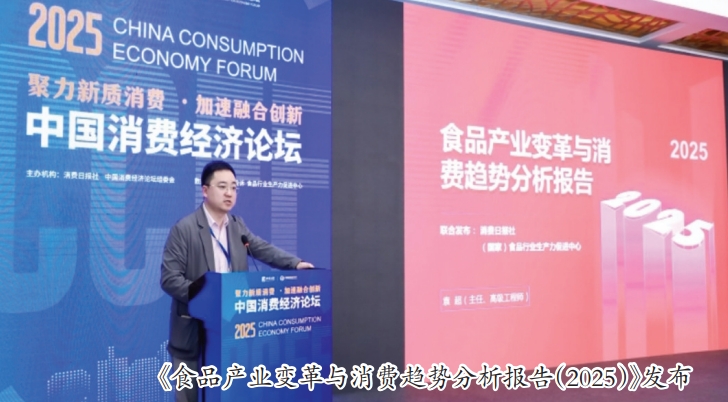
《食品产业变革与消费趋势分析报告(2025)》发布
Xiao Fei Ri Bao Wang· 2025-04-15 03:27
Core Insights - The 2025 China Consumer Economy Forum highlighted six major consumption trends and five future directions in the food industry, emphasizing the importance of pre-prepared meals and cell-cultured meat in driving industry transformation [1][4]. Industry Overview - The food industry is a crucial pillar of the national economy, with 430,000 large-scale food processing enterprises and a total output value exceeding 9 trillion yuan in 2024, maintaining a stable single-digit growth rate despite a slowdown compared to the end of the 13th Five-Year Plan [4]. - The deep processing ratio in the food industry has increased to 42% by the end of 2023, with emerging categories like functional foods and pet foods growing faster than traditional grain and staple products [4]. - The regional landscape is evolving, with traditional grain-producing provinces seeing a decline in market share, while regions like Chengdu and Liuzhou are experiencing rapid growth due to the development of specialty food ingredients [4]. Technological Innovation - Significant advancements in food processing technologies, such as synthetic biology and cell-cultured meat, are leading to lower production costs and increased industrialization [5]. - The integration of industrial and digital applications is enhancing food safety and consumer confidence through technologies like blockchain [5]. Consumer Trends - There is a shift towards precise nutrition and health demands, with consumers increasingly focusing on food functionality and health benefits [6]. - Convenience needs are driving a "fragmented dining revolution," with pre-prepared foods catering to the time-saving requirements of younger consumers and restaurants [6]. - Emotional value is becoming a new currency in consumer spending, with brands leveraging local cultural narratives to enhance product appeal [7]. - Sustainable consumption practices are gaining traction, with companies adopting green manufacturing and supply chain practices to reduce carbon footprints [7]. - Digitalization is reshaping the entire consumer journey, utilizing technologies like VR to enhance the shopping experience and standardizing culinary skills through smart devices [8]. Future Directions - The food industry is expected to evolve towards industrialized precise nutrition, a revolution in protein sources, a collaborative cooking era, a closed-loop carbon consumption model, and a service-oriented food approach [9]. - The cost of functional products is anticipated to decrease, leading to greater industrialization and a shift from mass production to personalized nutrition [9]. - The acceptance of cell-cultured meat is expected to rise, marking a significant transformation in protein sourcing and enhancing food security [9]. - The concept of "food as a service" is projected to redefine product value, focusing on consumer experience and emotional engagement [9].