维基百科

Search documents
抗争起效,AI大厂终于不再“白嫖”维基百科
3 6 Ke· 2026-01-21 12:21
Core Insights - Major AI companies have recognized that continuing to oppose content platforms is unsustainable, leading to their participation in the Wikimedia Enterprise partnership program [1][3] - These companies will pay for enterprise-level access to Wikipedia's real-time data, which will be structured for easier model training and commercial use [3][4] Group 1: AI Companies and Data Access - AI companies like Amazon, Meta, and Microsoft will pay for structured access to Wikipedia's vast data, which will support the Wikimedia Foundation's long-term operations [3][4] - The structured data is crucial for training reliable and scalable AI models, especially for tasks like classification and prediction [4][7] Group 2: Challenges and Shifts in AI Development - The reliance on structured data is highlighted by the need for AI models to learn from clear and consistent inputs, such as transaction records in financial models [7][10] - AI companies have shifted their stance due to the realization that without human-generated content, their models cannot evolve effectively, leading to a need for collaboration with content platforms [8][10] Group 3: Economic Considerations - The Wikimedia Foundation's decision to charge for data access comes after numerous lawsuits related to AI web scraping, indicating a shift in the economic dynamics between AI firms and content providers [8][12] - Investing in data from Wikipedia is seen as more cost-effective for AI companies compared to developing their own content, allowing them to focus on algorithm upgrades [12]




告别免费抓取!维基与亚马逊、Meta等企业构建AI数据付费生态
Huan Qiu Wang· 2026-01-16 03:13
Core Insights - The Wikimedia Foundation announced a partnership with major tech companies including Amazon, Microsoft, and others to establish paid agreements for the use of Wikipedia content in AI model training, marking a shift from web scraping to legal data acquisition [1][4] Group 1: Partnership Details - The collaborations have been formalized over the past year and were previously kept confidential [4] - Companies will utilize Wikimedia's enterprise services to integrate human-governed knowledge resources on a large scale [4] Group 2: Financial Implications - The Wikimedia Foundation, as the largest non-profit encyclopedia platform, hosts over 65 million entries in more than 300 languages, making it a vital source of high-quality data for AI training [4] - The previous free scraping practices led to increased server load and operational costs, while the foundation's primary revenue relied on small public donations [4] - The new paid collaboration model provides a sustainable revenue stream for the non-profit organization [4] Group 3: Value of Knowledge - A spokesperson from the foundation emphasized that the long-term development of AI companies depends on the accumulation of human knowledge, and that paid partnerships respect knowledge producers [4]

维基百科运营方与微软、元宇宙平台公司达成人工智能内容训练合作协议
Xin Lang Cai Jing· 2026-01-15 10:35
Core Insights - Wikipedia has announced partnerships with major tech companies including Microsoft, Meta, and Amazon, marking a significant step in monetizing its content reliance by these firms [1][4] - The Wikimedia Foundation has signed agreements with several companies, including AI startups Perplexity and Mistral AI, in addition to existing partnerships [1][4] Industry Context - Wikipedia's content is crucial for training AI models, encompassing over 65 million entries in more than 300 languages, serving as a primary data source for tech giants developing generative AI chatbots and smart assistants [2][5] - The increasing demand for Wikipedia's free content for AI training has led to rising server demands and costs for the non-profit organization, which primarily relies on small public donations for funding [2][5] Business Model Evolution - The Wikimedia Foundation is promoting its enterprise service, which allows tech companies to pay for content training access and offers customized data services based on large-scale training needs [2][5] - Ryan Becker, president of Wikimedia Enterprise, emphasized the necessity for tech companies to financially support Wikipedia, recognizing the importance of transitioning from free access to commercial partnerships [6] Leadership Changes - The Wikimedia Foundation has appointed Bernadette Meehan, former U.S. ambassador to Chile, as the new CEO, effective January 20 [3][6]
维基百科联合创始人:马斯克的Grokipedia受到批评,我并不感到惊讶
Huan Qiu Wang Zi Xun· 2025-12-20 04:27
Core Viewpoint - Wikipedia co-founder Jimmy Wales expressed concerns about the trustworthiness of "biased" encyclopedias, referencing Elon Musk's Grokipedia as a potential competitor [1][2]. Group 1: Trust and Credibility - Wales highlighted that many criticisms of Grokipedia, Musk's AI-based encyclopedia, are not surprising, questioning whether users would trust a biased encyclopedia [2]. - He emphasized that unlike Musk, who may unilaterally modify content he disagrees with, he prefers to initiate discussions regarding any unsatisfactory content on Wikipedia [2]. Group 2: Competition and Content Scraping - Wikipedia is reportedly taking measures to prevent users from turning to competitors like Grokipedia by allowing AI bots to scrape its content [2]. - Some pages on Grokipedia are found to be nearly identical to entries on Wikipedia, indicating a direct competition between the two platforms [2].
韦氏词典年度词定了!“Slop”直指AI垃圾,如今互联网真变味了?
Sou Hu Cai Jing· 2025-12-19 09:33
Core Viewpoint - The rise of AI-generated content has led to a significant decline in content quality, with the term "Slop" being coined to describe low-quality digital content produced en masse by AI [5][28]. Group 1: AI Content Proliferation - AI has transitioned from making basic errors to producing "correct but mediocre" content that lacks depth and engagement [5][12]. - The primary purpose of this AI-generated content is to deceive algorithms, fill ad spaces, and capture fleeting attention, rather than to provide meaningful information [7][26]. Group 2: Industry Response - Disney has entered the AI content space by partnering with OpenAI, investing $1 billion, and planning to integrate AI-generated videos into its Disney+ platform [10][12]. - The shift in the streaming industry has moved from a focus on high-quality content to a competition for content quantity, prompting major players like Disney to adopt AI for cost-effective content generation [12][14]. Group 3: Content Quality Divide - The internet is now divided into two realms: one that maintains a commitment to authenticity, such as Wikipedia and Spotify, and another that embraces "Slop" economics, prioritizing engagement metrics over quality [20][23]. - Platforms that encourage AI content production benefit from its low cost and speed, leading to a saturation of low-quality content that users must sift through to find valuable information [26][28].

知识的繁荣与危机
3 6 Ke· 2025-11-18 08:34
Core Insights - The article discusses the transformation of knowledge in the internet age, highlighting both its unprecedented proliferation and potential crises [1][11] - It emphasizes the democratization of knowledge, where access and dissemination have become easier for the general public, moving away from elite control [4][12] - The article also addresses the challenges of information overload and the shifting authority of knowledge, necessitating new filtering mechanisms [5][6][10] Group 1: Characteristics of Networked Knowledge - Networked knowledge is characterized by richness, with vast amounts of information available online, such as over 40 billion indexed web pages and 7 million Wikipedia entries [2][3] - The internet has enabled a significant increase in the quantity of accessible knowledge, with projections of around 1.2 billion websites by January 2025 [2] - Knowledge is no longer confined to traditional institutions but is now a dynamic entity that evolves with real-time contributions from users [4][18] Group 2: Knowledge Democratization - The article outlines the historical context of knowledge democratization, tracing back to the invention of the printing press and the role of public libraries [4] - Digital technology has further propelled this democratization, allowing knowledge to transcend geographical and social barriers [4][12] - Wikipedia serves as a prime example of this phenomenon, providing an open platform for knowledge sharing and real-time updates [4][2] Group 3: Knowledge Filtering Mechanisms - The overwhelming abundance of information has led to a need for effective filtering systems to manage knowledge [5][6] - Traditional filtering methods have lost some authority, and new mechanisms, including algorithmic and social filtering, are being explored [7][10] - The article warns of potential issues with these new filtering systems, such as echo chambers and confirmation bias, which can distort knowledge acquisition [10][9] Group 4: Future Directions for Knowledge - The article advocates for open access initiatives to remove barriers to knowledge, allowing free and unrestricted access to academic research [12][13] - It emphasizes the importance of linking knowledge across platforms and fostering a culture of sharing and collaboration [15][16] - Education on critical thinking and effective internet use is deemed essential for navigating the complexities of networked knowledge [19][20]
马斯克旗下Grokipedia被批抄袭维基百科,引入无来源错误信息
3 6 Ke· 2025-11-17 12:12
Core Insights - PolitiFact's evaluation of xAI's Grokipedia reveals serious issues including content plagiarism and lack of factual accuracy, damaging its credibility as a reliable information source [2][3][4] - Grokipedia, launched in October 2023, aimed to compete with Wikipedia but has faced widespread criticism for its AI-generated content that often replicates Wikipedia without proper attribution [2][3] Content Plagiarism - PolitiFact analyzed 885,279 articles on Grokipedia, finding that many directly copied text from Wikipedia, with a similarity rate as high as 96% in some cases [2][4] - An example includes the "Monday" entry, which omitted 22 reference sources from Wikipedia while claiming to adapt content under a Creative Commons license [4] Lack of Factual Accuracy - Grokipedia's AI-generated content has been found to introduce errors, such as a misleading statement regarding the Nobel Prize, which lacked citation and was factually incorrect [4][6] - The platform often simplifies narratives by removing context from Wikipedia, sacrificing accuracy in the process [4][5] Transparency Issues - Grokipedia's editing mechanism lacks transparency, with no visible edit history or clear error correction processes, making its "fact-checking" label difficult to trust [6] - In contrast, Wikipedia maintains a transparent editing process, allowing anyone to edit and providing a complete history of article changes [5][6] Industry Context - The launch of Grokipedia coincides with xAI's legal disputes with Apple and OpenAI, which have accused these companies of suppressing AI competition [6] - The Wikimedia Foundation has raised concerns about Grokipedia's plagiarism and the implications for educational ecosystems, emphasizing the need for responsible use of open-source content [6]
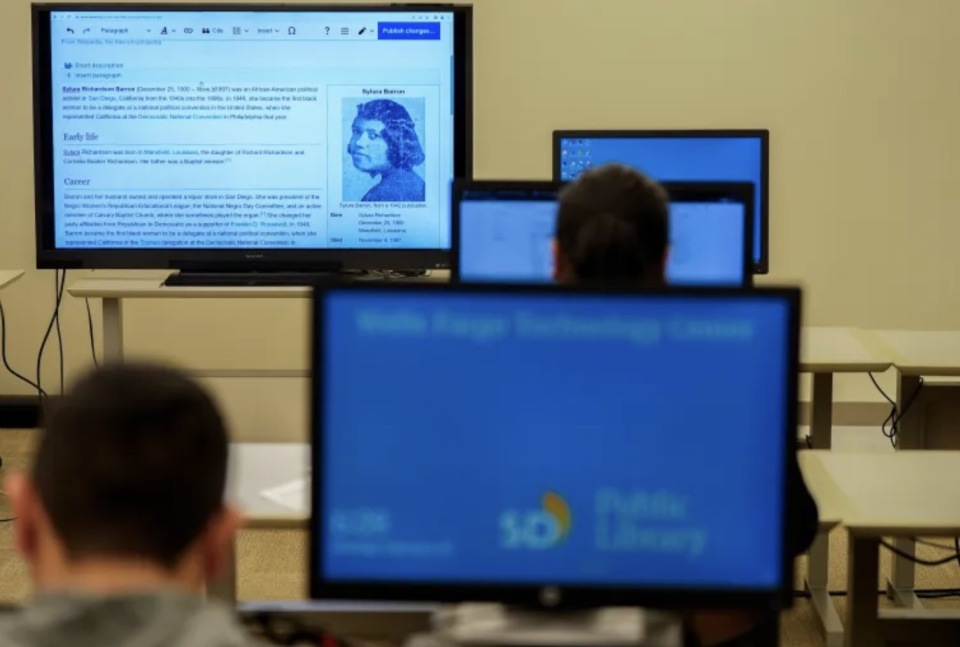
维基百科用弹窗暗讽马斯克Grokipedia:“我们不是机器创造的”
Sou Hu Cai Jing· 2025-10-30 02:58
Core Points - Elon Musk has criticized Wikipedia multiple times and has launched his own AI-driven online encyclopedia called GrokiPedia, which aims to surpass Wikipedia [1][4] - Wikipedia has responded to Musk's criticisms by emphasizing its human-operated nature and non-profit status, contrasting it with Musk's wealth and the commercial nature of large tech companies [1][4] Group 1 - Wikipedia has been operational for nearly 25 years and is committed to being a human-created platform rather than a machine-generated one [4] - Wikipedia's content is maintained by volunteers, while GrokiPedia is developed by xAI and utilizes the Grok large language model for generating and editing entries [4] - GrokiPedia 0.1 was officially launched recently, claiming to have access to 885,279 articles, with Musk stating that it is a necessary step for achieving xAI's goal of understanding the universe [4]

批维基百科“有偏见”,马斯克推自家AI百科
Huan Qiu Shi Bao· 2025-10-29 23:05
Core Points - Elon Musk's xAI company launched Grokipedia, an AI-generated competitor to Wikipedia, with a promise that the upcoming version 1.0 will be "ten times better" than the current version [1] - Grokipedia has over 885,000 articles as of October 29, 2023, but its content is primarily AI-generated, contrasting with Wikipedia's nearly 8 million articles created by human contributors [1] - Musk has criticized Wikipedia for perceived biases and has called for a cessation of funding to the platform [1] Group 1 - Grokipedia's interface is simple and similar to search engines like Google [1] - The platform is positioned as a source for "truth," with Musk acknowledging the challenge of achieving perfection [1] - Critics argue that Grokipedia's content often mirrors Wikipedia's and is heavily reliant on unverified AI-generated material, suggesting it reflects Musk's viewpoints rather than objective facts [2] Group 2 - The Wikimedia Foundation emphasized that Wikipedia will continue to be human-operated and highlighted that human-created knowledge is foundational for AI-generated content [2] - Scholars suggest that Musk's launch of Grokipedia is a strategic move to gain control over narrative and discourse [2]
挑战维基百科 马斯克旗下公司推出AI百科全书网站
Sou Hu Cai Jing· 2025-10-29 11:16
Core Viewpoint - Elon Musk's AI company xAI has launched an AI-driven encyclopedia website to compete with Wikipedia, featuring over 885,000 articles compared to Wikipedia's over 7 million articles [1][3]. Group 1: Product Features - The homepage of Musk's encyclopedia is very simple, displaying only the title and a search box for user queries [3]. - The website is currently in version 0.1, with plans for an upgrade to version 1.0 that will enhance its functionality [3]. Group 2: Market Context - Musk has criticized Wikipedia for containing biased information, although some entries on his encyclopedia cite Wikipedia as a source [3]. - The Wikimedia Foundation, which operates Wikipedia, has stated that previous alternatives to Wikipedia have not disrupted its operations [3].