绿电直供

Search documents
(新春走基层)甘肃绿电聚合:一场能源与数字“双向奔赴”
Zhong Guo Xin Wen Wang· 2026-02-10 11:35
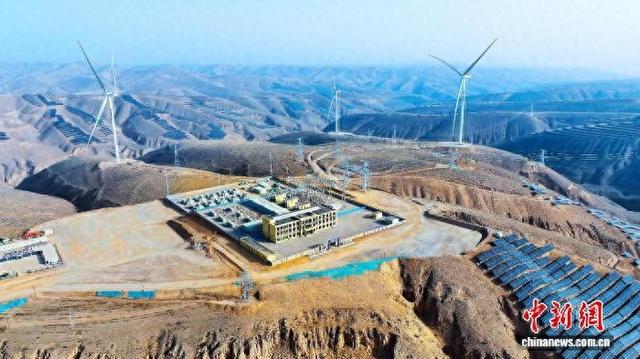
Core Viewpoint - The "Dongshuixisuan" industrial park green electricity aggregation pilot project in Qingyang, Gansu Province, has successfully connected its first batch of units to the grid, marking a significant step in the integration of energy and digital economy, and supporting the national strategy of "Dongshuixisuan" with green energy [1][3]. Group 1: Project Overview - The project is located in Qingyang, an important energy base in western China, rich in renewable resources and the only city in the country that integrates four major national resource allocation strategic projects [3]. - The project has a total installed capacity of 2 million kilowatts, with the first batch of 1 million kilowatts now online, providing stable and clean direct power supply for data centers [3][5]. Group 2: Challenges and Innovations - The project faced significant challenges in coordination, spanning six townships and requiring extensive land acquisition and construction efforts [5]. - A 1,200-person team worked in 24-hour shifts to overcome geographical difficulties and ensure the project's smart grid and power supply stability [5]. Group 3: Economic and Environmental Benefits - The project is expected to meet 55% of the power demand for the cluster upon full operation, saving over 616,700 tons of standard coal annually and reducing carbon emissions by approximately 1.6157 million tons, equivalent to creating 44,000 acres of forest [5]. - The green electricity supply offers cost advantages for enterprises, with a comprehensive electricity price below 0.4 yuan per kilowatt-hour, significantly reducing operational costs for data centers [5][7]. Group 4: Local Impact and Employment - The construction and operation of the project have created numerous job opportunities and improved local infrastructure, serving as a strong engine for industrial upgrading and rural revitalization [7]. - The project is facilitating the convergence of digital and green economies, enhancing the attractiveness of Qingyang for related manufacturing and technical service enterprises [7].


甘肃设定零碳园区建设“硬指标”:2027年前建成5个,2035年半数以上园区完成低碳改造
Zhong Guo Fa Zhan Wang· 2026-02-03 08:22
Core Viewpoint - Gansu Province has launched a comprehensive plan for the construction of zero-carbon parks, aiming to establish around five zero-carbon parks by 2027 and ten by 2030, with a goal of achieving significant low-carbon transformation across more than half of its parks by 2035, thereby supporting the province's dual carbon goals [1][2][3] Group 1: Construction Plan and Standards - The plan specifies that the construction of zero-carbon parks will be limited to provincial-level or newly approved emerging industrial parks, with clear boundaries for the parks [1] - Differentiated core acceptance indicators are set for zero-carbon and low-carbon parks, with zero-carbon parks required to have carbon emissions not exceeding 0.3 tons per ton of standard coal, while low-carbon parks must not exceed 1 ton per ton of standard coal or achieve a carbon emission reduction of at least 30% [1] Group 2: Evaluation Framework and Funding - A competitive evaluation framework with a total score of 100 points has been established, focusing on energy structure transformation, industrial energy conservation, resource recycling, low-carbon infrastructure, energy management, and core guiding indicators [2] - The policy outlines funding support pathways, prioritizing parks for applications for central budget investments, government special bonds, and encouraging participation from green financial tools and social capital [2] Group 3: Strategic Implications and Challenges - The initiative reflects Gansu's proactive planning based on its rich wind and solar resources and the need for industrial transformation, aiming to enhance local industry value through the development of zero-carbon parks [3] - The plan aims to provide local enterprises with a "green passport" to navigate international carbon barriers and stimulate the development of the wind-solar-storage-hydrogen industry chain within the province [3] - Key challenges include balancing the transformation of existing high-energy-consuming parks with the construction of new zero-carbon parks, ensuring technological innovation and mature business models, and effectively attracting and integrating social capital [3]
事关“两重”建设、西部大开发!国家发改委最新发声→
Xin Lang Cai Jing· 2026-01-21 10:25
Group 1: Major Projects and Investment Initiatives - The government is advancing the "Two Heavy" construction projects, optimizing the structure of government investment, and increasing the proportion of government investment in livelihood projects to boost demand [3][8] - A series of significant high-tech industry projects are being planned for the "14th Five-Year Plan" period to strengthen innovation-driven industrial support [3][8] - Investment strategies will focus on combining investments in physical assets and human capital, enhancing market-driven effective investment growth, and utilizing new policy financial tools [9] Group 2: National Unified Market Development - The construction of a national unified market will be comprehensively advanced, including the formulation of regulations and lists of prohibited and encouraged investment activities [10] - The initiative aims to break down local protectionism and market segmentation, addressing issues like disorderly competition and local government procurement [10] - There will be a shift from price competition to value competition, with improvements in market access, fair competition, and capacity exit mechanisms [10] Group 3: Green Transition and Infrastructure Upgrades - The green transition is accelerating towards the "dual carbon" goals, with a focus on building a new power system and enhancing grid adjustment capabilities [11] - Key industries will undergo energy-saving and carbon-reduction transformations, promoting the development of zero-carbon parks and factories [11] - Over 29,000 smart recycling facilities have been added nationwide, improving the recycling and circular economy framework [11] Group 4: Regional Coordinated Development - The government is promoting regional coordinated development strategies, enhancing the role of key regions like the Yangtze and Yellow River economic belts [12] - The central and western regions are being supported to address public service and infrastructure gaps, with significant potential for industrial transfer and domestic demand expansion [12] - Future strategies will focus on leveraging the advantages and resources of the central and western regions to contribute to modernization efforts [12]
从“被动承载”走向“主动参与” 需求侧成为推动能源转型向纵深发展的关键变量
Zhong Guo Zhi Liang Xin Wen Wang· 2025-12-30 06:47
Core Insights - China's energy transition is at a critical stage, shifting from quantitative to qualitative changes, with demand-side resources becoming key players in this transformation [1] - The development of demand-side resources is seen as essential for supporting the stability and safety of the power system, particularly through flexible regulation and diversified applications in the industrial sector [1][2] Group 1: Demand-Side Resource Development - The active regulation of electricity demand is identified as a core strategy for promoting green and low-carbon transitions in the new power system [2] - Policies such as zero-carbon parks, green electricity direct supply, and virtual power plants have been introduced to enhance the role of demand-side resources [2] - Challenges such as inconsistent standards, high scheduling difficulties, and limited business models for virtual power plants need to be addressed through institutional and technological innovations [2] Group 2: Industrial Sector's Role - The industrial sector is both a major energy consumer and carbon emitter, making it crucial for the absorption of renewable energy and deep carbon reduction [2] - Accelerating the collaboration between renewable energy and industrial loads is essential for advancing China's dual carbon goals [2] Group 3: Market Mechanisms and Policy Support - A report presented at the conference emphasizes the need for a long-term mechanism that balances effective markets with proactive government involvement to realize the systemic value of demand-side resources [3] - The report highlights challenges such as poor price signal transmission and a single revenue model in the demand-side market, particularly at the distribution network level [4] - Recommendations include revising national laws to establish market positions for new entities like virtual power plants and load aggregators, and creating mandatory standards for grid connection and communication protocols [4]
瀚蓝环境(600323):并购协同驱动业绩增长 内生增长与新业务齐头并进
Xin Lang Cai Jing· 2025-08-29 02:27
Core Viewpoint - The company reported a slight decrease in revenue but a significant increase in net profit, driven by effective management and the successful integration of the recent acquisition of Yuefeng Environmental [1][2]. Group 1: Financial Performance - In the first half of 2025, the company achieved operating revenue of 5.763 billion yuan, a year-on-year decrease of 1%, while net profit attributable to shareholders reached 967 million yuan, a year-on-year increase of 9% [1]. - The company plans to distribute a mid-term dividend of 2.5 yuan per 10 shares (including tax) [1]. Group 2: Acquisition and Integration - The acquisition of Yuefeng Environmental was completed in June 2025, contributing 369 million yuan in revenue and approximately 60 million yuan in net profit for that month [2]. - Post-acquisition, the company's total waste incineration power generation capacity reached 97,590 tons/day, ranking among the top three in the domestic industry and first among A-share listed companies [2]. - Financially, the acquisition led to a reduction of approximately 1.3 billion yuan in total loans and a decrease in financing rates from 2.75%-4.75% to 2.50%-4.00% [2]. Group 3: Operational Efficiency - The company's solid waste treatment operations (excluding engineering and equipment) achieved a net profit of 730 million yuan, a year-on-year increase of 26.44% [3]. - The heating business saw a significant increase, with heating volume reaching 943,500 tons, up 41.60%, and heating revenue increasing by 46.50% to 140 million yuan [3]. - The company improved operational efficiency, with power generation per ton of waste and on-grid electricity both increasing by 2.60% and 3.51%, respectively [3]. Group 4: Growth Strategies and Shareholder Returns - The company is exploring new business models such as "green electricity direct supply" and has signed strategic cooperation agreements to leverage its green electricity resources [4]. - The company is also advancing the issuance of public REITs based on drainage and solid waste businesses, expected to range from 1 to 3 billion yuan [4]. - The company plans to implement a mid-term dividend of 0.25 yuan per share in 2025, with a commitment to increase cash dividends by no less than 10% in 2025 and 2026 [4]. Group 5: Profit Forecast - The company is projected to achieve operating revenues of 14.036 billion yuan, 15.835 billion yuan, and 16.530 billion yuan for 2025-2027, with year-on-year growth rates of 18.08%, 12.82%, and 4.38% respectively [5]. - Net profit attributable to shareholders is expected to be 1.973 billion yuan, 2.262 billion yuan, and 2.473 billion yuan for the same period, with growth rates of 18.56%, 14.66%, and 9.33% respectively [5].

绿电直供:破局能源转型,探索电力市场化新路径
Sou Hu Cai Jing· 2025-06-26 02:03
Group 1 - The concept of "green electricity direct supply" is gaining attention in China, aiming to address specific issues within the context of power policy adjustments [1][6] - The emergence of direct supply models reflects the industry's urgent need for a more flexible electricity supply mechanism, requiring close cooperation between major electricity consumers and green electricity suppliers [1][4] - Direct supply of electricity is not a new phenomenon, as self-built power plants have been common in energy-intensive industries like electrolytic aluminum, providing cheaper electricity and showcasing market competitiveness [1][3] Group 2 - Understanding green electricity direct supply requires knowledge of China's complex power grid, dominated by state-owned enterprises across various energy types, including coal, hydro, nuclear, and renewables [3][6] - The electricity market in China faces monopolistic issues, with limited user choice due to strict control by grid companies, making the direct supply model a potential solution to promote market openness and competition [3][6] - The core challenge of green electricity direct supply lies in addressing the instability of green electricity supply due to the intermittent nature of solar and wind energy, necessitating advancements in storage technology [4][6] Group 3 - The National Development and Reform Commission and the National Energy Administration have issued guidelines to promote green electricity direct supply, providing institutional support for renewable energy consumption and user-side energy structure transformation [6] - Green electricity direct supply is seen as an effective way to tackle issues of electricity surplus and saturation of green electricity supply, offering stable supply to excellent electricity consumers and new market opportunities for suppliers [6] - Despite challenges, the gradual improvement of policies and continuous technological innovation may position green electricity direct supply as a key direction for reform in China's electricity market [6]