
美元/日元看涨期权

Search documents
无视美国强劲就业数据 对冲基金调转船头看涨日元
Xin Lang Cai Jing· 2026-02-12 02:43
Core Viewpoint - Hedge funds are increasingly betting on the strengthening of the Japanese yen, adopting a "buy Japan" strategy, despite strong U.S. employment data that has diminished expectations for a Federal Reserve rate cut this year [1][2]. Group 1: Market Trends - The Japanese yen has experienced four consecutive days of gains against the U.S. dollar, resisting upward pressure on the dollar following the release of the non-farm payroll report [1][2]. - Hedge funds had rebuilt short positions on the yen ahead of the Japanese House of Representatives election, betting on the ruling Liberal Democratic Party, led by Prime Minister Fumio Kishida, to win and pursue expansionary fiscal policies [1][2]. Group 2: Options Market Activity - According to data from the Depository Trust & Clearing Corporation (DTCC), the trading volume of put options on USD/JPY with a nominal amount of $100 million or more was approximately 50% higher than that of call options [1][2]. - The premium for one-month expiry put options on USD/JPY relative to call options has risen to its highest level since February 2 [1][2]. Group 3: Expert Insights - Antony Foster, head of G-10 currency trading at Nomura International, noted that interest in betting on a weaker USD/JPY is increasing among hedge funds, with additional demand for buying yen against currencies like the Australian dollar and Swiss franc [1][2]. - Nathan Swami, head of Asia-Pacific foreign exchange trading at Citigroup in Singapore, indicated that the yen's rebound coincided with the unwinding of short-term long positions on USD/JPY before the U.S. employment report, leading hedge funds and asset management companies to sell this currency pair [3].
对冲基金转而看多日元 强劲的美国非农数据亦未能扭转趋势
Ge Long Hui· 2026-02-12 02:34
Core Insights - Hedge funds are showing a significant shift towards increased bets on the Japanese yen amid rising interest in "buying Japan" trades [1] - Despite strong U.S. employment data diminishing expectations for Federal Reserve rate cuts this year, bullish sentiment towards the yen continues to grow [1] Group 1: Market Trends - The Japanese yen has appreciated against the U.S. dollar for three consecutive trading days, maintaining strength even as the dollar faced pressure following the U.S. non-farm payroll report [1] - The nominal volume of put options on the dollar/yen pair, with a notional size of $100 million or more, has exceeded that of call options by approximately 50% [1] Group 2: Options Market Dynamics - The premium for options betting on or hedging against a decline in the dollar/yen exchange rate has reached its highest level since February 2 [1]
分析:日元下跌势头可能没什么障碍
Xin Lang Cai Jing· 2026-02-04 09:43
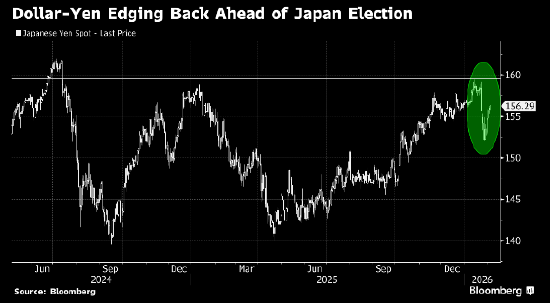
Core Viewpoint - The USD/JPY exchange rate has risen above 156 yen per dollar as Japan's elections approach, recovering from previous lows, with the yen being the worst-performing currency in the G10 this year. The downward trend may continue after the election risk event passes [1][3]. Group 1 - The weakening of the yen is partly due to ambiguous comments from Prime Minister Fumio Kishida regarding the benefits of a weak currency [1][3]. - Concerns have arisen among investors regarding the potential dovish stance of Kevin Warsh, nominated as the next Federal Reserve Chairman [1][3]. Group 2 - Market expectations suggest that Kishida's ruling Liberal Democratic Party will secure a significant majority in the elections, likely leading to more aggressive fiscal policies that could increase inflation and further pressure the yen [5]. - In the options market, the volume of USD/JPY call options with a nominal amount of $100 million or more exceeded that of put options, indicating increased demand for dollar bullish options [5]. - With the Bank of Japan not in a hurry to accelerate interest rate hikes, the most likely direction for USD/JPY is towards 160 yen [5].

看空情绪浓厚!政治风险加剧,日元恐进一步下滑至……
Sou Hu Cai Jing· 2025-07-30 05:43
Core Viewpoint - The Japanese yen has performed the worst among major currencies in the past three months, facing further decline due to rising political risks in Japan [1] Group 1: Market Sentiment and Predictions - Strategists are pessimistic about the yen, anticipating that the outcome of the Japanese elections will lead to increased government spending, while the impact of U.S. tariffs may slow down interest rate cuts [1] - The Liberal Democratic Party's loss in the July 20 elections is a key factor affecting the yen, with analysts warning that Prime Minister Kishida may resort to populist fiscal spending to consolidate his weakened ruling coalition [1] - The demand for bullish dollar/yen options reflects market expectations that the Bank of Japan's Governor Ueda will not signal interest rate hikes soon, as short-term growth and inflation risks are skewed to the downside [1][2] Group 2: Currency Performance and Positioning - The yen has depreciated approximately 6% since reaching a seven-month high in April, currently trading around 148.25 against the dollar [2] - Market participants betting on yen depreciation expect Kishida to yield to opposition-driven tax cuts to boost support for the ruling coalition [2] - Barclays strategists suggest that regardless of the political outcome, fiscal policy is likely to become more expansionary, potentially pushing the dollar/yen pair above the 150 level [2] Group 3: Central Bank Policy and Economic Impact - The Bank of Japan is set to announce its policy decision, which will be a key factor influencing the yen's short-term trajectory, with investors closely watching Governor Ueda's comments for indications of future rate hikes [3] - Overnight index swaps currently price in a 74% probability of a rate hike this year, up from 59% prior to the U.S.-Japan tariff agreement [3] - Analysts believe the Bank of Japan will need time to assess the actual impact of the tariffs, suggesting that the yen may depreciate above 150 this year [4]
市场风向转变!对冲日本大选风险升温 日元看跌期权交易量翻倍
智通财经网· 2025-07-14 06:02
Group 1 - Option traders are adjusting their positions on the Japanese yen, betting on depreciation against the US dollar due to political instability, trade tensions, and changing Federal Reserve policy expectations [1] - On July 11, the trading volume of bullish dollar/yen options exceeded that of bearish options by more than two times, indicating a shift in market sentiment [1] - The current popular trading strategy includes buying knock-out call options, which are more cost-effective than standard call options, as they automatically expire if the exchange rate breaches specific levels [1] Group 2 - Market expectations regarding the election results are paving the way for further fiscal stimulus, which has led to an increase in Japanese long-term government bond yields [2] - There is a positive correlation between dollar/yen and the 30-year Japanese government bond yields, as noted by HSBC strategists [2] - Concerns over the lack of progress in US-Japan trade negotiations, combined with fiscal worries, are undermining market confidence in the yen [2]