美元汇率

Search documents
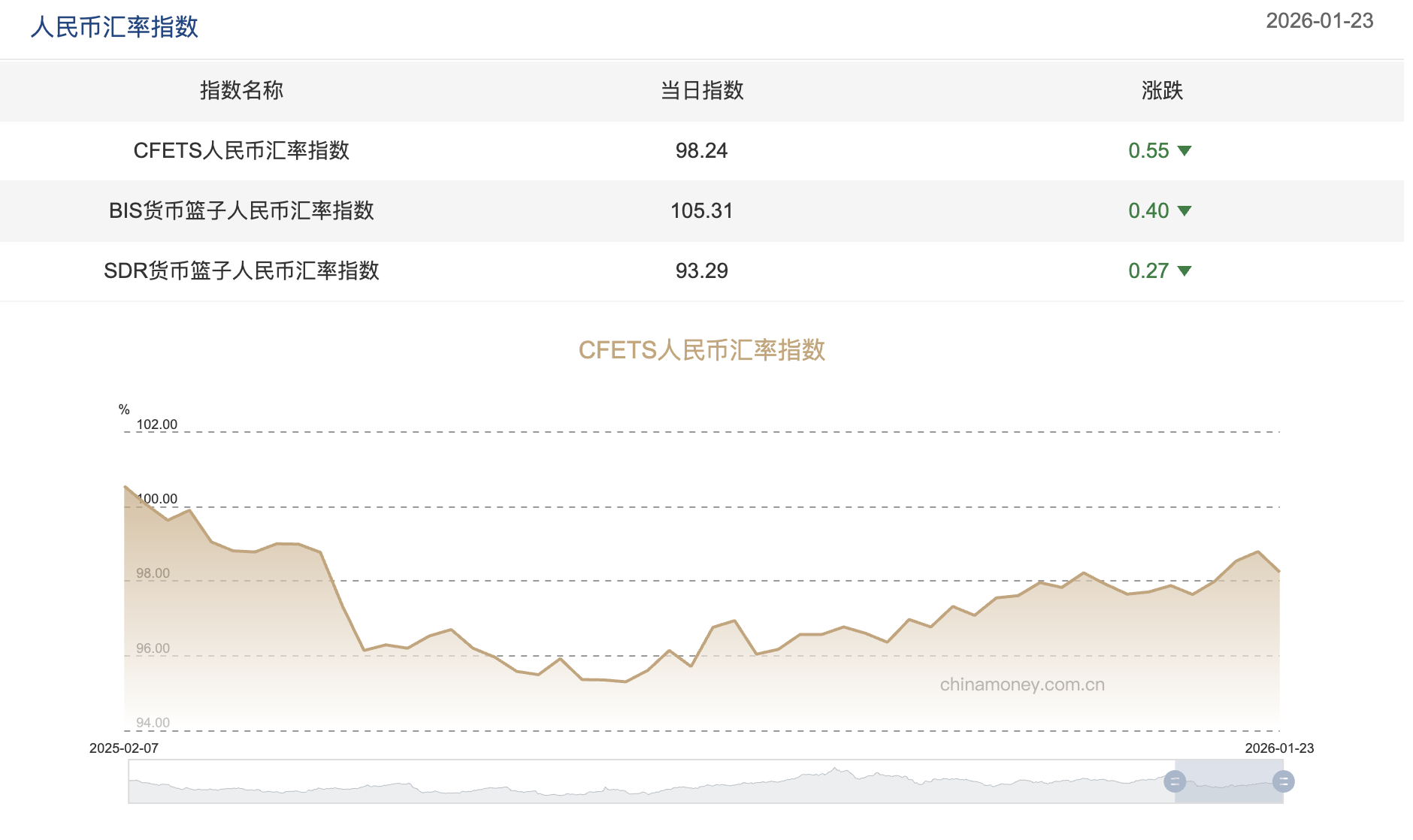
人民币汇率延续升值态势 三大人民币汇率指数小幅下挫
Sou Hu Cai Jing· 2026-01-26 05:14
Core Viewpoint - The Chinese yuan exchange rate indices have all declined in the week of January 23, with the CFETS index at 98.24, down 0.55% week-on-week, indicating a weakening trend in the yuan's value against a basket of currencies [1][2]. Group 1: Exchange Rate Indices - The CFETS yuan exchange rate index reported at 98.24, reflecting a weekly decline of 0.55% [1][2]. - The BIS currency basket yuan exchange rate index stood at 105.31, down 0.4% week-on-week [1][2]. - The SDR currency basket yuan exchange rate index was at 93.29, with a weekly decrease of 0.27% [1][2]. Group 2: Market Dynamics - The US market experienced a "triple hit" of stocks, bonds, and currency declines, leading to a lower dollar index at 97.46, with a cumulative drop of over 1.8% for the week [5]. - Non-US currencies strengthened against the dollar, with the euro, pound, and Australian dollar showing significant gains, while the New Zealand dollar and Norwegian krone led the increases [5]. - The onshore yuan appreciated by 60 basis points, closing at 7.1221 against the dollar, while the offshore yuan rose by 187.5 basis points, closing at 6.94865 [5]. Group 3: Analyst Insights - Analysts suggest that the weakening of the dollar, influenced by external factors such as tariff risks, has contributed to the appreciation of non-US currencies, including the yuan [6]. - Seasonal factors and market expectations for yuan appreciation are stabilizing the settlement intentions of market participants, supporting the yuan's strength [6]. - Short-term forecasts indicate potential reversals in "de-dollarization" trading, while long-term risks from US policies may undermine the dollar's reserve status [6]. Group 4: Future Outlook - Short-term expectations suggest that the yuan will remain strong due to continued corporate settlement demands ahead of the Chinese New Year [7]. - Long-term projections indicate a weaker dollar, which may affect its dominant position and enhance the roles of other currencies like the yuan and euro in the international monetary system [7]. - The ongoing global uncertainties, such as trade tensions and supply chain disruptions, suggest that the yuan should not appreciate too quickly [8].

中金:传统思维易误估汇率
中金点睛· 2025-12-15 23:52
Core Viewpoint - The article discusses the divergence between the traditional neoclassical exchange rate models and the realities of modern financial systems, emphasizing the need to consider financial factors alongside real economic indicators when assessing exchange rates [2][3][6]. Exchange Rate Framework - The neoclassical framework emphasizes real economic factors while downplaying the impact of financial factors on exchange rates, which may lead to significant misjudgments in exchange rate assessments [3][6]. - In contrast, post-Keynesian economics posits that capital flows and expectations are the core mechanisms driving exchange rate fluctuations, especially in a highly financialized economy [3][6][15]. Types of Exchange Rates - There are three main forms of exchange rates: bilateral exchange rates (especially against the US dollar), nominal effective exchange rates, and real effective exchange rates, with the latter being crucial for analyzing the impact on trade [5][6]. Factors Influencing Exchange Rates - Estimating the so-called "equilibrium value" of exchange rates is complex due to the multitude of bilateral and multilateral factors involved, with traditional models often failing to account for the significant role of capital flows [6][12]. - The post-Keynesian perspective argues that capital flows dominate exchange rate determination, as evidenced by the vast scale of foreign exchange market transactions compared to international trade [14][15]. Historical Context and Examples - Historical instances, such as the volatility of the US dollar post-Bretton Woods and the Asian financial crisis, illustrate the inadequacies of neoclassical models in explaining exchange rate movements [16]. - The article highlights the phenomenon of the Chinese yuan's "internal depreciation and external appreciation" post-2005, which aligns more closely with post-Keynesian theories than with neoclassical assumptions [17][18]. Recent Developments - Recent data indicates that despite improvements in China's manufacturing competitiveness, the real effective exchange rate of the yuan has depreciated by 16% from January 2022 to October 2025, contradicting neoclassical predictions [18].