美联储隔夜逆回购工具

Search documents
美媒警告美国金融市场流动性偏紧
Sou Hu Cai Jing· 2025-08-28 11:19
Core Insights - The U.S. financial market is expected to experience turbulence in September due to tight liquidity conditions [1] - Despite widespread expectations for a rate cut by the Federal Reserve in September, a key indicator of idle funds has remained at very low levels since mid-August, raising doubts about the need for the Fed to inject liquidity [1] Group 1: Market Conditions - As of August 14, the usage of the Federal Reserve's overnight reverse repurchase agreement tool fell below $50 billion, reaching a recent low [1] - During peak periods in 2022 and 2023, the average daily usage of this tool was as high as $2 trillion [1] Group 2: Future Projections - A report from Bank of America’s global interest rate strategy team predicts that by the end of August, the usage of the reverse repurchase tool by the Federal Reserve will drop to zero, with a slight recovery expected in September [1]
【微特稿】美媒警告美国金融市场流动性偏紧
Sou Hu Cai Jing· 2025-08-28 09:39
Core Viewpoint - The U.S. financial market is expected to experience turbulence in September due to tight liquidity, despite widespread expectations of a rate cut by the Federal Reserve [1] Group 1: Market Conditions - A key market indicator for idle funds has remained at a very low level since mid-August, raising doubts about the need for the Federal Reserve to inject liquidity [1] - As of August 14, the usage of the Federal Reserve's overnight reverse repurchase agreement tool fell below $50 billion, marking a recent low compared to an average daily usage of $2 trillion during peak periods in 2022 and 2023 [1] Group 2: Predictions and Implications - A report from Bank of America’s global rates strategy team predicts that the usage of the reverse repurchase tool will drop to zero by the end of August, with a slight recovery expected in September [1] - The current situation may lead to a repeat of the liquidity crisis seen in September 2019, when repo loan rates surged to nearly 10%, prompting the Federal Reserve to inject liquidity to stabilize the market [1] Group 3: Market Reactions - U.S. money market funds utilizing the Federal Reserve's overnight reverse repurchase tool are currently focused on purchasing a large volume of U.S. Treasury securities released by the "big and beautiful" tax and spending plan of former President Trump [1] - A report from Canadian Imperial Bank of Commerce's rates strategy team anticipates greater fluctuations in funding supply at the end of the month and quarter in the U.S. financial markets [1]
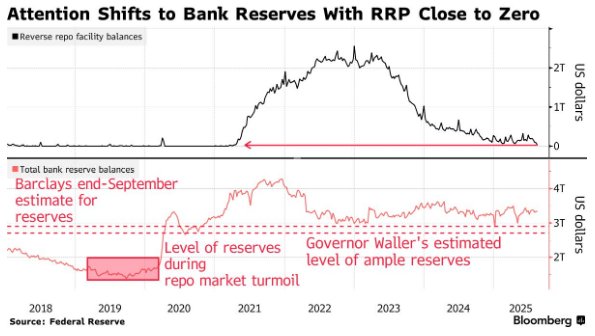
美联储隔夜逆回购余额骤降至四年新低,流动性关键缓冲濒临“枯竭”
智通财经网· 2025-08-14 23:43
Core Viewpoint - The balance of a key Federal Reserve tool, the overnight reverse repurchase agreement (RRP), has dropped to its lowest level in over four years, raising concerns about liquidity in the U.S. banking system [1][2]. Group 1: RRP Tool Usage - 14 participating institutions deposited a total of $28.8 billion through the RRP on Thursday, marking the lowest balance since April 2021 [1]. - The RRP tool is primarily used by banks, government-sponsored enterprises, and money market funds to earn interest by lending to the central bank [1]. - The usage rate of the RRP tool is declining due to the U.S. Treasury issuing more short-term bonds to cover a growing deficit, leading to a reduction in cash reserves [1][2]. Group 2: Impact on Bank Reserves - The balance of bank reserves remains stable at approximately $3.3 trillion, indicating that reserves are still in a comfortable range [3]. - Analysts predict that total reserves could drop below $3 trillion by mid-September and below $2.9 trillion by the end of September, excluding the impact of RRP changes [3]. - Federal Reserve officials have indicated that they could reduce bank reserve levels to around $2.7 trillion without causing stress to the banking system [3]. Group 3: Market Implications - As the RRP balance approaches zero, bank reserves will become a focal point for market observers, particularly regarding the extent to which reserves can decline before the Fed halts its balance sheet reduction [2]. - The reduction in RRP balances is expected to limit the buffer available to banks, potentially impacting market stability [2].