
老街—河内—海防铁路

Search documents
越南提出多项交通建设领域目标
Shang Wu Bu Wang Zhan· 2025-08-07 16:53
Core Viewpoint - The Vietnamese government aims to achieve significant infrastructure development goals by the end of the year, including the construction of 3,000 kilometers of highways and various major projects to enhance transportation and urbanization [1] Infrastructure Development Goals - The government plans to complete 3,000 kilometers of highways by the end of the year [1] - Key projects include the first phase of Long Thanh Airport, coastal roads, and at least 100,000 social housing units [1] - The approval process for major projects such as the North-South high-speed railway and the Lao Cai-Hanoi-Haiphong railway is to be expedited [1] Maritime and Port Development - Investment in maritime development is highlighted as having relatively low costs and minimal land acquisition needs [1] - Existing ports and terminals have significant development potential [1] Importance of Highway Construction - Highway construction is deemed crucial for driving development in inland areas [1] Focus on Rail and High-Speed Rail - The Ministry of Construction is urged to prioritize technology transfer and talent development in the railway and high-speed rail sectors [1] Urbanization and Infrastructure Quality - The government emphasizes accelerating urbanization while improving quality [1] - Urban infrastructure development should align with modern, green, and smart city concepts to adapt to climate change [1]
密集迎来突破,谁是下一个“超级枢纽”?
Mei Ri Jing Ji Xin Wen· 2025-05-13 14:11
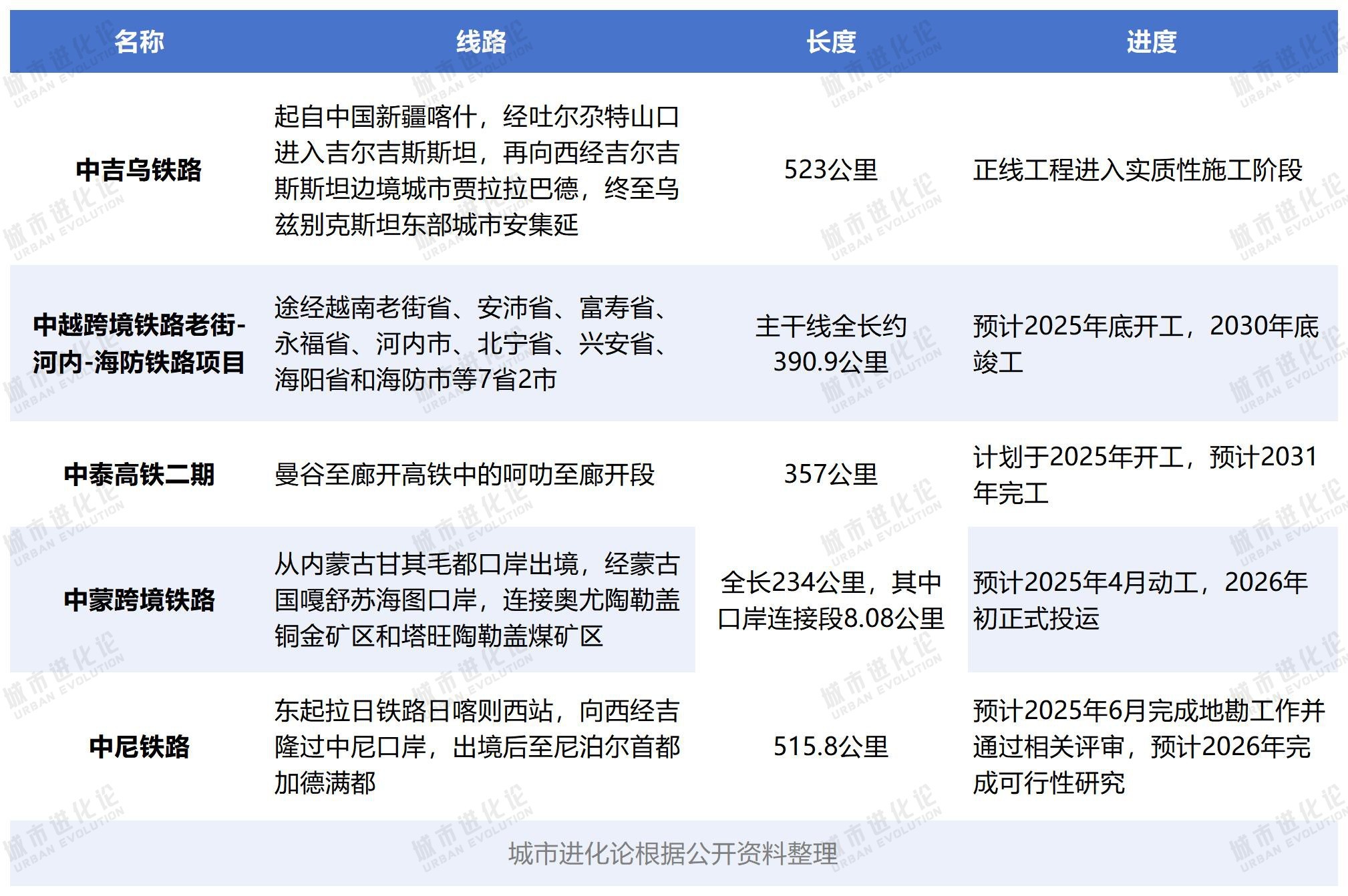
Core Insights - Recent developments in multiple cross-border railway projects indicate a significant acceleration in infrastructure connectivity, enhancing China's trade routes to Central Asia, South Asia, and Southeast Asia [1][4][5] - The construction of key segments of the China-Kyrgyzstan-Uzbekistan (CKU) railway has commenced, marking a substantial step forward in the project that has taken 27 years to progress [1][4][6] - The establishment of these railways is expected to transform inland regions into open gateways, creating new economic opportunities and enhancing regional trade dynamics [1][10][12] Cross-Border Railway Developments - The CKU railway, spanning approximately 523 kilometers, will serve as a crucial link between China and Central Asia, significantly reducing transportation distances to the Middle East and Southern Europe by about 900 kilometers [6] - The Lao-Vietnam-Haiphong railway, with a main line of about 390.9 kilometers, is set to enhance connectivity in Vietnam, linking key economic and cultural centers [5] - The China-Thailand high-speed railway phase II, covering 357.12 kilometers, will connect to the existing China-Laos railway, boosting economic cooperation among China, Laos, and Thailand [5] Strategic Importance of Railways - The new railways will facilitate the development of a vast railway network centered around China, enhancing trade and economic ties with neighboring countries [8][10] - The Gansu-Mongolia cross-border railway, although only 8 kilometers long, is expected to significantly improve supply chain stability and reduce import costs for China [8] - The cross-border railways are anticipated to create new regional hubs, such as Kashgar and Kunming, which will become pivotal points for trade and logistics [10][12] Economic and Industrial Impacts - The opening of the China-Laos railway has already led to a surge in cross-border tourism, with daily passenger numbers increasing from 300 to 1300 [15] - The railway is also fostering the development of a coffee industry in Yunnan, reducing transportation costs and enhancing the supply chain for coffee products [16] - The CKU railway is expected to boost cross-border trade in Kashgar, providing opportunities for local enterprises to engage in value-added processing and logistics services [17][20] Urban and Regional Development - Cities like Kunming and Urumqi are being positioned as regional centers for international trade and logistics, reflecting the growing interconnectedness of China with its neighboring countries [21] - The establishment of new transportation corridors is reshaping urban landscapes and economic strategies, with a focus on enhancing trade efficiency and regional cooperation [21]

越南加快推进老街—河内—海防铁路项目
Shang Wu Bu Wang Zhan· 2025-05-06 07:02
Core Viewpoint - The Vietnamese government is prioritizing the implementation of the Lao Cai-Hanoi-Haiphong railway project, emphasizing its importance for economic development and regional connectivity [1][2]. Group 1: Project Implementation - The Prime Minister has mandated the Ministry of Construction to expedite the project, ensuring it starts on schedule in 2025 [2]. - Key tasks include collaborating with local governments along the railway route to accelerate project progress and ensure timely commencement [2]. - The government aims to transfer the central axis coordinates and land acquisition lines to local authorities by June 2025 to facilitate compensation and feasibility studies [2]. Group 2: Land Acquisition and Compensation - Land acquisition is deemed a critical political task, requiring the involvement of the entire political system to ensure adequate resettlement conditions for affected residents [3]. - Local governments are instructed to establish committees for land acquisition and resettlement, with a deadline for formation set for May 5, 2025 [3]. - The completion of compensation and resettlement work is targeted for August 2025 [3]. Group 3: Funding and Oversight - The Prime Minister has tasked the Ministry of Finance with reviewing and prioritizing funding for the project from surplus central and local expenditures by May [3]. - The Deputy Prime Minister is designated to oversee and resolve any issues related to the project [3].