脑机芯片N1

Search documents
渐冻症患者首次独立进食、喝水,Neuralink公布新进展
财联社· 2025-10-12 07:14
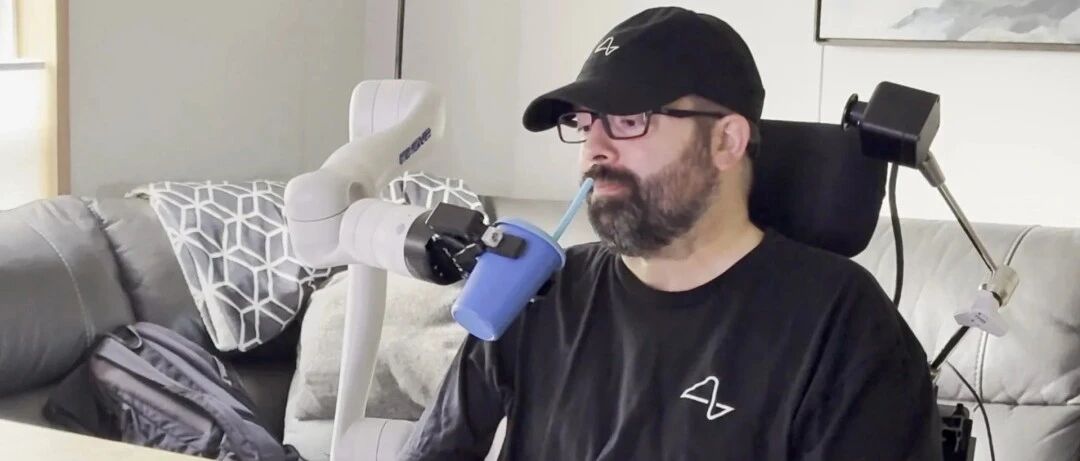
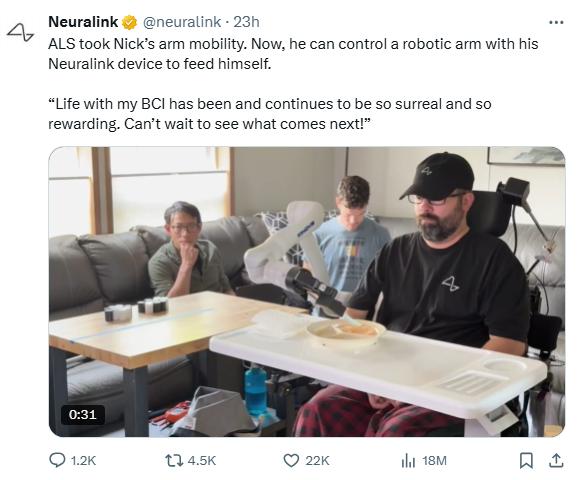
Core Viewpoint - Neuralink, a brain-machine interface company founded by Elon Musk, has demonstrated significant advancements in enabling patients with neurodegenerative diseases, such as ALS, to control robotic arms using their thoughts, showcasing the potential of brain-machine interface technology [2][5]. Group 1: Patient Demonstration - Nick Wray, a patient with ALS, successfully controlled a robotic arm to perform daily tasks such as drinking water and using a microwave, marking a significant milestone in his independence [5]. - Wray set new records by moving 39 cylinders and flipping the most screws in a standard flexibility test within five minutes, highlighting the effectiveness of the technology [7]. Group 2: Research and Development - The demonstration is part of Neuralink's CONVOY study, which aims to explore the feasibility of using brain-machine interfaces to assist patients with limited mobility due to neurodegenerative diseases [7]. - Neuralink has implanted its N1 chip in 12 patients globally, who have collectively used the device for over 15,000 hours, indicating a growing interest and application of this technology [8]. Group 3: Technology Overview - The N1 chip, approximately the size of a 10-pence coin, contains 128 ultra-fine wires connecting to about 1,000 electrodes that interface directly with the brain, allowing for precise detection and transmission of neural signals [8]. - The technology aims to enable real-time conversion of thoughts into actions, with future aspirations to expand its applications to controlling humanoid robots and addressing other neurological conditions [8].

Neuralink新进展:渐冻症患者首次独立进食、喝水
3 6 Ke· 2025-10-12 03:53
Core Viewpoint - Neuralink has demonstrated the potential of its brain-machine interface technology by showcasing Nick Wray, a patient with ALS, controlling a robotic arm to perform daily tasks, marking a significant advancement in assistive technology for neurodegenerative diseases [1][3][5]. Group 1: Technology and Implementation - Nick Wray successfully controlled a robotic arm using only his thoughts, performing actions such as drinking water and heating food, highlighting the practical applications of Neuralink's technology [3][5]. - The N1 chip, implanted in Wray's brain, is part of the CONVOY research project approved by the FDA, aimed at exploring the feasibility of brain-machine interfaces for assisting patients with limited mobility [5][6]. - The N1 chip is approximately the size of a 10 pence coin and contains 128 ultra-fine wires connected to about 1,000 electrodes, which capture neural signals and convert them into digital commands for controlling external devices [6]. Group 2: Clinical Research and Patient Outcomes - As of now, 12 patients have undergone the N1 chip implantation, collectively using the device for over 15,000 hours, demonstrating its potential for long-term use [6]. - Wray has set records in various tasks, such as moving 39 cylinders in five minutes, showcasing the chip's effectiveness in enhancing motor functions [5][6]. Group 3: Future Prospects and Challenges - Elon Musk has expressed ambitions for the technology to eventually control humanoid robots, but acknowledges that challenges related to long-term stability and safety must be addressed before widespread commercialization, which may take 5-10 years [7].
8点1氪:多家电信运营商回应eSIM手机业务;三星手机美国账号嘲讽iPhone 17系列;施华蔻“处女发质”翻译陷辱女争议
36氪· 2025-09-10 23:54
Group 1 - The core point of the article is the upcoming launch of eSIM services by major Chinese telecom operators, including China Unicom, China Telecom, and China Mobile, following Apple's introduction of the iPhone Air, which exclusively supports eSIM [5][7]. - China Telecom has stated that its eSIM mobile service is fully prepared and will soon be available to users after receiving official approval from the Ministry of Industry and Information Technology [5][7]. - China Mobile has also submitted an application for eSIM services and is expected to provide these services once it receives approval [7]. Group 2 - The iPhone Air, launched during Apple's fall event, is noted for being the lightest iPhone ever and features a dual eSIM card design, emphasizing the shift towards eSIM technology [5]. - The iPhone 17 series, including the iPhone 17 Pro, has been released with significant performance upgrades, particularly with the new A19 Pro chip, which surpasses the previous generation in both single-core and multi-core performance [25][26]. - The global market for short dramas from China is projected to reach a scale of $10 billion, with significant growth in overseas applications and downloads [15].


马斯克旗下脑机公司:已为全球12人植入芯片
财联社· 2025-09-10 06:28
Core Viewpoint - Neuralink has made significant progress in its brain-machine interface technology, with 12 patients having undergone trials of its N1 chip, totaling over 15,000 hours of usage [1][4]. Progress - Neuralink was founded in 2016 with the aim of developing high-bandwidth, minimally invasive brain-machine interface devices for direct communication between the human brain and computers [5]. - The company received FDA approval to begin human trials in 2024 after addressing safety concerns raised by the agency, which had previously rejected its application in 2022 [5]. - In June, Neuralink completed a $650 million Series E funding round, raising its valuation to $9 billion, moving towards a target of $10 billion [6]. - In July, Neuralink announced plans to conduct clinical trials in the UK to test how its chip can assist severely paralyzed patients in controlling digital and physical tools through thought, in collaboration with University College London Hospital and Newcastle Hospital [7]. - Elon Musk indicated that Neuralink may attempt to restore partial vision for visually impaired patients as early as 2026, with the first successful implantation of its "Telepathy" device occurring outside the US [7].