腌鱼

Search documents
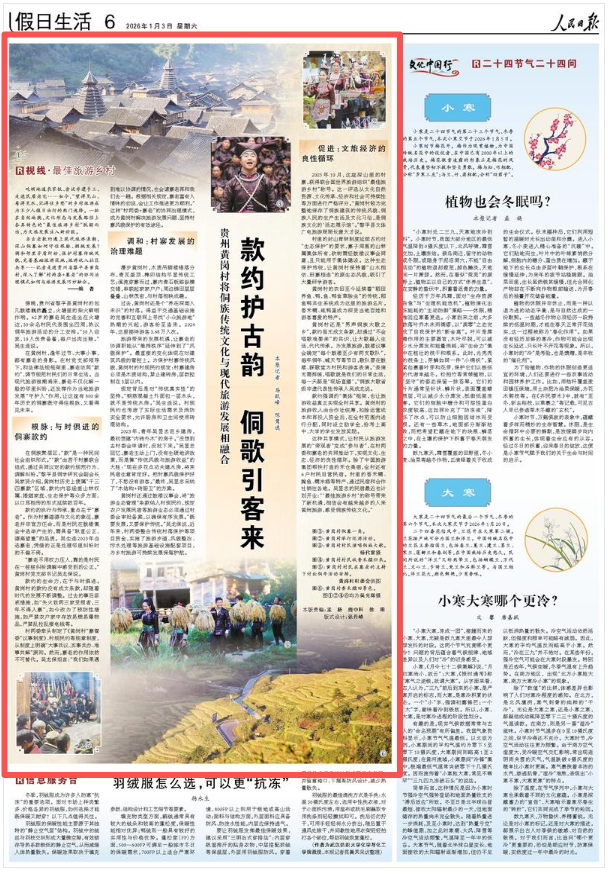
《人民日报》关注贵州黄岗:款约护古韵 侗歌引客来
Xin Lang Cai Jing· 2026-01-03 09:00
Core Viewpoint - The article discusses how Huanggang Village in Guizhou integrates traditional Dong culture with modern tourism development, highlighting the village's governance model and its impact on preserving cultural heritage while promoting tourism [1][4]. Group 1: Tourism Development - Rural tourism has become a popular choice for holiday travel, with unique villages emerging as "best tourism villages" that inject new momentum into cultural and tourism development [3]. - Huanggang Village received 36,800 visitors in 2024, showcasing the increasing interest in rural tourism [8]. Group 2: Governance Model - The village employs a collaborative governance model involving village committees and elder leaders to manage tourism development and resolve community disputes [5][7]. - The "Kuan" system, a traditional social organization, plays a crucial role in regulating behavior and mediating conflicts, adapting to modern needs while preserving cultural practices [6][7]. Group 3: Cultural Preservation - Huanggang Village maintains its traditional architectural style by regulating new constructions to wooden structures, prohibiting brick buildings, and limiting heights to three stories [9]. - The village's commitment to ecological protection and cultural heritage is evident in its sustainable practices, such as the "rice-fish-duck" co-cultivation system, which has become a tourism highlight [10][11]. Group 4: Economic Impact - The village's tourism revenue is managed collectively, ensuring that profits are shared among villagers and supporting educational initiatives for students [11]. - The recognition as a "Best Tourism Village" by the UN World Tourism Organization is expected to attract more visitors, enhancing economic opportunities for the community [10][11].

经济大省“盯上”足球
投中网· 2025-06-25 07:23
Core Viewpoint - The article emphasizes the significant economic impact of football events on cities, highlighting how they can drive consumer spending and stimulate local economies through increased tourism and related activities [6][9][19]. Group 1: Economic Impact of Football Events - The "Su Super" league has seen a rise in attendance, with a record of 36,712 spectators for a match, indicating growing public interest [5]. - The tourism market in Jiangsu has experienced a 41% year-on-year increase in summer travel bookings, with dining orders from non-local consumers rising over 49% [7]. - Research indicates that sports events can generate substantial indirect economic benefits, with a ratio of 1:13 for direct to indirect spending [8]. Group 2: Case Studies and Examples - The "Village Super" event in Guizhou became a viral phenomenon, attracting over 600 million online viewers and significantly boosting local tourism, with a 73.94% increase in tourism revenue [11][12]. - In 2024, Guizhou's tourism numbers continued to rise, with 946.18 million visitors and a 28.64% increase in revenue, showcasing the long-term benefits of such events [12]. - The "Village Super" event also led to the creation of over 3,000 new jobs and increased local product sales, demonstrating the broader economic benefits of football events [19]. Group 3: Government and Local Initiatives - Jiangsu's government has actively promoted football events as a means to stimulate consumption, with plans to support major sports events financially [13][14]. - Local cities in Jiangsu have responded to the popularity of the "Su Super" league by offering free access to attractions and promoting tourism, resulting in significant increases in visitor numbers [15][16]. - The article notes that various provinces are now looking to replicate the success of football events to boost local economies, indicating a growing consensus on the economic potential of sports [19].