
协同治理模式

Search documents
数智时代如何促进高水平区域联动
Xin Lang Cai Jing· 2026-02-23 21:43
Core Viewpoint - Regional coordinated development is an inherent requirement of Chinese-style modernization, emphasizing the importance of promoting regional linkage development through advanced technologies like artificial intelligence and digital innovation [1]. Group 1: Theoretical Foundations and Requirements - The dialectical relationship between "first nature" (natural resources) and "second nature" (human-modified economic environments) provides a theoretical basis for regional linkage development [2]. - Objective constraints from the first nature, such as geography and climate, and issues like administrative fragmentation in the second nature hinder optimal resource allocation and high-level regional linkage [2]. Group 2: Challenges and Opportunities in the Digital Age - The integration of new information technologies into regional governance and economic operations breaks geographical constraints, enabling collaboration that transcends first nature limitations [3]. - Traditional challenges such as resource misallocation and ecological governance remain prominent, while issues like the digital divide and unclear data ownership increasingly complicate regional linkage efforts [3]. Group 3: Logic of Promoting High-Level Regional Linkage - In the digital age, promoting high-level regional linkage requires leveraging digital technologies to optimize resource allocation and enhance overall regional collaboration [4]. - The arrival of digital technologies offers opportunities to overcome geographical and institutional barriers, allowing for a more efficient allocation of resources and production capabilities [4]. Group 4: Importance of Digital Collaboration - High-level regional linkage signifies a systemic leap from unbalanced to coordinated development, with past strategies focusing on reducing regional disparities [5][6]. - The transition from physical connectivity to intelligent integration is marked by initiatives like the "East Data West Calculation" project, which enhances domestic data and industrial cycles [6]. Group 5: Strategies for Enhancing Regional Linkage - Strengthening digital infrastructure and ensuring cross-regional digital connectivity is essential for promoting regional linkage development [7]. - Key strategies include building a unified data-sharing platform, enhancing public service integration, and optimizing industrial collaboration within urban clusters [8][9].
电网建设“开门红”,佛北战新产业园再添重要电力枢纽
2 1 Shi Ji Jing Ji Bao Dao· 2026-01-14 13:07
Core Viewpoint - The completion of the 220 kV Ruifeng Substation in Foshan represents a significant milestone in the city's power grid construction, enhancing the development potential of the Beijian New Industrial Park and supporting Foshan's economic growth [1][3]. Group 1: Project Overview - The Ruifeng Substation, with a total investment of 533 million yuan, is a key project in Guangdong Province and marks the end of the "14th Five-Year Plan" for the power grid construction in Foshan [1]. - The substation is located in the southeastern part of Niulanggang Village, Shanshui District, and serves as an important power hub for the Beijian New Industrial Park, which is one of the seven major industrial clusters in the province [3]. Group 2: Economic Impact - During the "14th Five-Year Plan," Shanshui District attracted 908 investment projects with a total investment exceeding 356 billion yuan, representing a 57.82% increase in signed investment compared to the "13th Five-Year Plan" [3]. - The completion of the substation is expected to alleviate regional power supply pressure and enhance the reliability of the power grid, which is crucial for supporting the growing electricity demand from large consumers like Bangpu Recycling [3]. Group 3: Construction Efficiency - The project adopted an innovative "land acquisition and immediate construction" model, significantly reducing the approval time by approximately 4-5 months, completing the construction in just 10 months [4]. - A collaborative governance model was implemented, which streamlined the approval process and ensured compliance with project regulations, providing a replicable experience for future major projects [4]. Group 4: Power Supply Growth - Foshan's electricity load has shown strong growth, with the highest load reaching 16.8 million kilowatts and total electricity consumption increasing from 71 billion kWh to 89 billion kWh during the "14th Five-Year Plan" [4]. - The city has become the fourth in the southern provinces to exceed both 15 million kilowatts in peak load and 80 billion kWh in total electricity consumption [4].


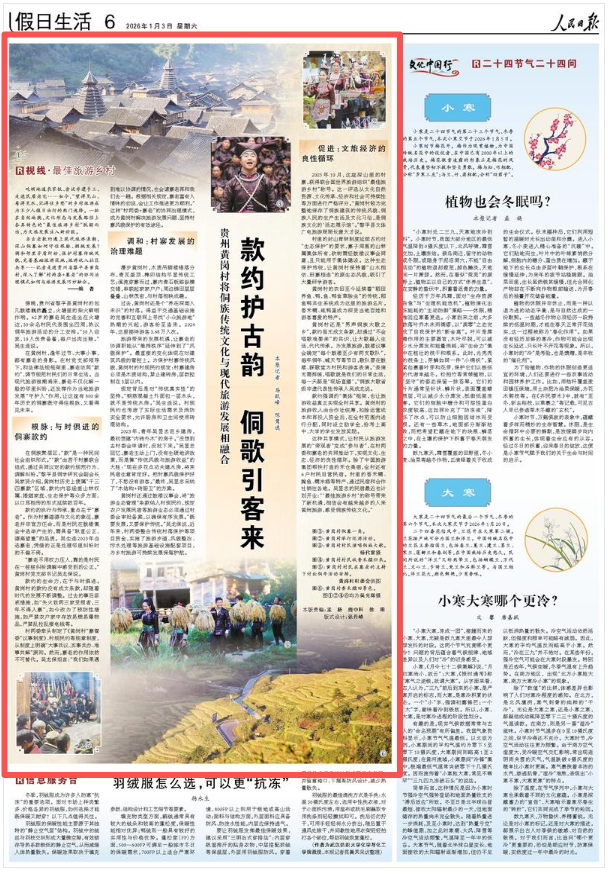
《人民日报》关注贵州黄岗:款约护古韵 侗歌引客来
Xin Lang Cai Jing· 2026-01-03 09:00
Core Viewpoint - The article discusses how Huanggang Village in Guizhou integrates traditional Dong culture with modern tourism development, highlighting the village's governance model and its impact on preserving cultural heritage while promoting tourism [1][4]. Group 1: Tourism Development - Rural tourism has become a popular choice for holiday travel, with unique villages emerging as "best tourism villages" that inject new momentum into cultural and tourism development [3]. - Huanggang Village received 36,800 visitors in 2024, showcasing the increasing interest in rural tourism [8]. Group 2: Governance Model - The village employs a collaborative governance model involving village committees and elder leaders to manage tourism development and resolve community disputes [5][7]. - The "Kuan" system, a traditional social organization, plays a crucial role in regulating behavior and mediating conflicts, adapting to modern needs while preserving cultural practices [6][7]. Group 3: Cultural Preservation - Huanggang Village maintains its traditional architectural style by regulating new constructions to wooden structures, prohibiting brick buildings, and limiting heights to three stories [9]. - The village's commitment to ecological protection and cultural heritage is evident in its sustainable practices, such as the "rice-fish-duck" co-cultivation system, which has become a tourism highlight [10][11]. Group 4: Economic Impact - The village's tourism revenue is managed collectively, ensuring that profits are shared among villagers and supporting educational initiatives for students [11]. - The recognition as a "Best Tourism Village" by the UN World Tourism Organization is expected to attract more visitors, enhancing economic opportunities for the community [10][11].
672个小区12345工单量降两成
Xin Hua Ri Bao· 2025-10-23 23:17
Core Viewpoint - The establishment of party branches in residential communities is crucial for enhancing governance and addressing residents' needs effectively, leading to improved community management and reduced complaints [1][2][3]. Group 1: Community Governance - A total of 672 pilot communities have established either entity-based or functional party branches, achieving a 100% coverage rate of party organizations [1]. - In Huai'an, 1,781 communities have a party organization coverage rate of 98.15%, with 3,566 part-time committee members appointed from various sectors [2]. - The community governance model combines "red property management" with community workers to facilitate problem-solving through a tripartite discussion platform [2]. Group 2: Addressing Resident Needs - The shift in residents' expectations from basic services to higher quality services necessitates a more refined approach to community governance [4][5]. - Complaints regarding property management have surged, with 762,000 calls to the 12345 hotline this year, reflecting a 15.89% increase year-on-year [4]. - Community party branches are tasked with regularly assessing needs, resources, and services to enhance community service quality [5]. Group 3: Resource Mobilization - Local governments are leveraging community talents and resources to transition from isolated efforts to collaborative governance [7]. - In Wuxi, over 2,850 party members have engaged with 485 community party branches to address cross-departmental issues [7]. - Nanjing has developed a system to cultivate community leaders and mobilize resources, resulting in over 150 community service events [7]. Group 4: Resident Participation - Encouraging residents to take an active role in community governance is essential for achieving effective management [8]. - The focus is on transforming residents from passive observers to active participants in community affairs, fostering a sense of shared responsibility [8].