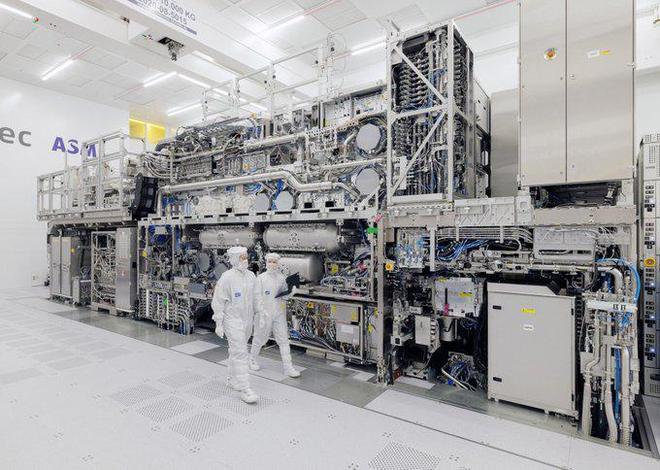
自由电子激光器

Search documents
美国投资了一家EUV光刻机公司
半导体芯闻· 2025-12-02 10:18
Core Viewpoint - The Trump administration has agreed to invest up to $150 million in xLight, a startup focused on developing advanced semiconductor manufacturing technology, as part of its efforts to support strategically important domestic industries [1][2]. Group 1: Investment and Government Support - The U.S. Department of Commerce will provide incentives to xLight, which is working on improving the extreme ultraviolet (EUV) lithography technology critical for chip manufacturing [1][2]. - This investment utilizes funds from the 2022 CHIPS and Science Act, marking the first allocation from this act during Trump's second term [2]. - The agreement is still preliminary and subject to change, indicating that final terms have not yet been established [2]. Group 2: Technology and Innovation - xLight aims to build large "free electron lasers" powered by particle accelerators to provide more powerful and precise light sources for chip manufacturing [2][3]. - The company’s technology could potentially improve wafer processing efficiency by 30% to 40% and reduce energy consumption compared to current light sources [3]. - If successful, xLight's advancements could significantly enhance the economic viability of existing EUV lithography technology and lay the groundwork for future developments in the field [4]. Group 3: Leadership and Vision - Pat Gelsinger, former CEO of Intel, is now the executive chairman of xLight and views this venture as a significant opportunity to revive his career [1][3]. - Gelsinger has expressed a commitment to "awaken" Moore's Law, which predicts that the number of transistors on a chip will double approximately every two years [3]. - The startup has raised $40 million from investors, including Playground Global, where Gelsinger is a general partner [3].

美政府入股:这家公司成功了,将改变半导体行业
Guan Cha Zhe Wang· 2025-12-02 09:44
Core Viewpoint - The U.S. Department of Commerce announced a potential investment of up to $150 million in semiconductor startup xLight, which could make the U.S. government the largest shareholder if the deal is finalized. This funding is part of the Chips and Science Act aimed at supporting promising technology startups [1][2]. Group 1: Investment Details - The investment comes from the Chips and Science Act initiated by former President Biden, marking the first reward under this act since the start of Trump's second term [1]. - The funding is currently in a preliminary stage and has not been finalized [1]. - U.S. Secretary of Commerce Gina Raimondo emphasized the importance of this investment in regaining leadership in advanced lithography technology [1]. Group 2: Company Background - xLight is a semiconductor technology startup focused on overcoming critical bottlenecks in chip manufacturing, specifically in extreme ultraviolet (EUV) lithography technology [1][2]. - The company is led by former Intel CEO Pat Gelsinger, who joined xLight after being dismissed from Intel due to financial struggles [2]. Group 3: Technological Advancements - xLight is developing a large-scale Free-Electron Laser (FEL) to create a more powerful and precise light source, aiming to replace the current laser technology used in EUV lithography [5]. - The current EUV laser technology produces extreme ultraviolet light at a wavelength of approximately 13.5 nanometers, while xLight aims for a more precise wavelength as low as 2 nanometers [5]. - If successful, xLight's technology could enhance wafer processing efficiency by 30% to 40% and potentially revive Moore's Law, which predicts that the number of transistors on a chip should double approximately every two years [6]. Group 4: Broader Industry Implications - The U.S. government's investment in xLight is part of a broader strategy to bring advanced manufacturing, particularly in semiconductors, back to the U.S. to address manufacturing decline, trade deficits, and unemployment [6]. - The government has also invested in various strategic sectors, including semiconductors, critical minerals, and rare earth elements, through direct investments and other financial mechanisms [6].