至强(Xeon)CPU

Search documents
英特尔(INTC.O)25Q4跟踪报告:18A良率改善但未达预期,CPU产能限制业绩增长表现
CMS· 2026-01-23 11:32
Investment Rating - The report maintains a positive outlook on the industry, indicating a strong demand driven by AI infrastructure and data center needs, despite some supply constraints [1][16]. Core Insights - Intel's Q4 2025 revenue reached $13.67 billion, slightly below the previous year but at the upper end of guidance, driven by strong growth in AI-related businesses [1][16]. - The company reported a non-GAAP gross margin of 37.9%, exceeding guidance due to revenue growth and reduced inventory reserves [1][16]. - The DCAI segment outperformed expectations with a 15% quarter-over-quarter revenue increase, benefiting from AI infrastructure demand [2][20]. - The company anticipates a revenue decline in Q1 2026, with guidance set between $11.7 billion and $12.7 billion, reflecting seasonal trends and supply prioritization [3][22]. Summary by Sections Financial Performance - Q4 2025 revenue was $13.67 billion, down 4.1% year-over-year but up 0.2% quarter-over-quarter, benefiting from AI infrastructure growth [1][16]. - Non-GAAP gross margin for Q4 was 37.9%, a decrease of 4.2 percentage points year-over-year but higher than the guidance of 36.5% [1][16]. - Full-year revenue for 2025 was $52.9 billion, a slight decline of 0.4% year-over-year, primarily due to supply constraints [1][16]. Segment Performance - Intel Products segment revenue was $12.9 billion in Q4, with a 2% quarter-over-quarter increase, while the DCAI segment saw a 15% increase [2][20]. - The Foundry segment reported $4.5 billion in revenue, up 6.4% quarter-over-quarter, but faced a $2.5 billion operating loss due to early production issues with the 18A process [2][21]. - The Client Computing Group (CCG) revenue was $8.2 billion, down 4% quarter-over-quarter, reflecting supply constraints but strong performance from new Ultra 3 products [2][19]. Future Guidance - For Q1 2026, revenue is expected to be between $11.7 billion and $12.7 billion, with a non-GAAP gross margin forecasted at approximately 34.5% [3][22]. - Capital expenditures for 2026 are projected to be around $16 billion, maintaining a similar level to 2025 [3][22]. - The company aims to improve production efficiency and yield rates to meet market demand, particularly in the data center segment [3][24].
英特尔:至强CPU首席架构师离职
半导体芯闻· 2025-09-12 10:12
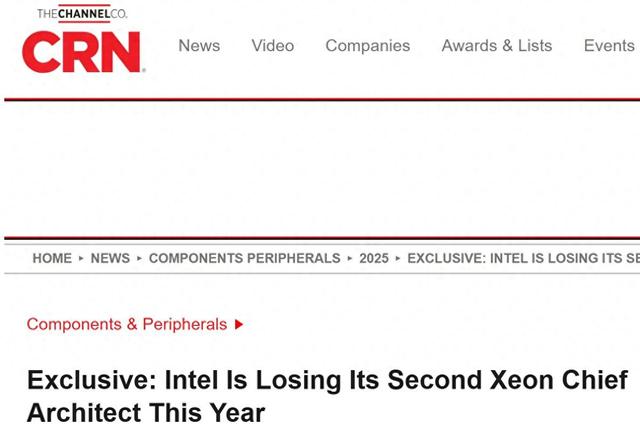
Group 1 - Intel is facing significant talent loss, including the departure of its second Xeon CPU chief architect, Ronak Singhal, following the exit of Michelle Johnston Holthaus [2][3] - The company is undergoing leadership changes in its Data Center Group, with the appointment of Kevork Kechichian as the new executive vice president and general manager [2] - Intel's CEO, Lip-Bu Tan, has prioritized the server CPU business amid increasing competition from AMD, acknowledging that regaining competitiveness will be a multi-year process [3] Group 2 - The Ohio One project is experiencing leadership departures, including key lobbyist Kevin Hoggatt, which may indicate significant delays for the project [4][5] - Since the announcement of the Ohio One wafer fab three years ago, there have been few signs of high-end process production starting, with the facility potentially not operational until 2031 [5]


外媒:英特尔面临人才流失挑战,第二位至强首席架构师即将离职
Huan Qiu Wang· 2025-09-12 08:46
Core Insights - Intel is facing a significant talent loss in its data center business, with the departure of Ronak Singhal, a senior researcher and chief architect for Xeon products, marking the second such loss in eight months [1][3] - This trend of talent attrition is not isolated and poses a deep impact on Intel's efforts to revitalize its data center business, especially as the company is striving to innovate and grow in this critical area [3] - CEO Lip-Bu Tan is actively pushing for changes to rejuvenate the data center segment, including appointing a new business leader to drive technological innovation and business growth [3] - The competitive landscape is intensifying with rivals like AMD and Nvidia gaining ground in the data center market, necessitating a more proactive approach from Intel to address talent retention and maintain industry competitiveness [3]