苏社分

Search documents
江苏省印发企业数据资源入表指南
Xin Lang Cai Jing· 2025-09-12 04:35
Core Viewpoint - Jiangsu Province's Finance Department has issued the "Guidelines for Enterprise Data Resource Entry," providing a manual for the standardized entry of enterprise data resources [1] Group 1: Financial Services and Data Assets - Data assets play a crucial role in addressing industry challenges within the financial services sector [1] - The provincial data group, in collaboration with a credit company, has developed a public data product called "Su She Fen," based on data from the Human Resources and Social Security Department [1] - "Su She Fen" has been listed on the provincial data exchange and is currently being trialed by three financial institutions: Bank of China Jiangsu Branch, Industrial and Commercial Bank of China Jiangsu Branch, and Jiangsu Bank [1] Group 2: Impact of "Su She Fen" - The product converts social security and employment data into a "credit score," enabling financial institutions to accurately assess the credit status of lending subjects [1] - As of the end of June this year, the three trial institutions have cumulatively granted credit amounting to 1.998 billion yuan based on the "Su She Fen" product [1] - This innovative practice breaks the traditional reliance on collateral in financial risk control, transforming the credit value of public data into a driving force for inclusive finance, achieving a breakthrough in "credit becoming capital" [1]
我省印发企业数据资源入表指南
Xin Hua Ri Bao· 2025-09-11 23:10
Core Insights - The provincial finance department has issued the "Guidelines for the Inclusion of Enterprise Data Resources into Financial Statements," providing a manual for the standardized inclusion of data assets [1] - Data assets are defined as legally owned or controlled data resources that can be measured in monetary terms and can generate economic or social benefits [1] - The initiative aims to manage and utilize data assets as important assets for departments, units, and enterprises, and to provide financial support through transactions and financing [1] Group 1 - The Jiangsu province has selected 20 pilot units to explore effective management paths for data asset accounting, registration, authorized operation, and revenue distribution [1] - Suzhou Cultural Investment Group has digitized cultural relics and silk samples from the Suzhou Silk Museum, creating the "Suzhou Silk Pattern Database," which is expected to complete its first cultural state-owned enterprise data product transaction in 2024 [1] - The transaction amounts for the "Suzhou Silk Pattern Database" can range from tens of thousands to hundreds of thousands of yuan, based on the level of relics used, the number of patterns, and the time of authorization [1] Group 2 - In the financial services sector, data assets are crucial for addressing industry challenges, exemplified by the "Su She Fen" public data product developed by the provincial data group and a credit company [2] - "Su She Fen" converts social security and employment data into credit scores, aiding financial institutions in accurately assessing the credit status of borrowers, with a total credit issuance of 1.998 billion yuan by three trial institutions as of June [2] - The provincial finance department plans to accelerate the pilot work related to data assets, enhance data quality assessment, and explore paths for the development and value transformation of data assets [2]
江苏省公共数据产品在扬州发布
Xin Hua Ri Bao· 2025-05-08 21:58
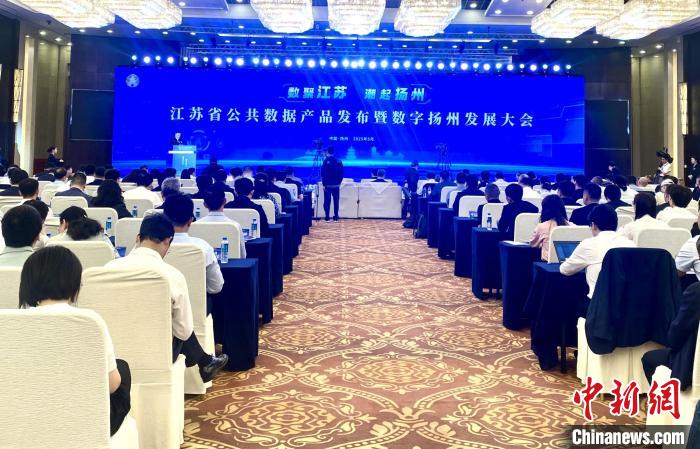
Core Insights - Jiangsu Province held a public data product launch and digital development conference, introducing two public data products, "Su She Fen" and "She Qi Fu," developed by the provincial credit company and Yangzhou Big Data Group, which are now available for trading on the provincial data exchange [1] - Yangzhou's digital economy has over 1,600 core enterprises, with a new generation information technology industry cluster reaching a scale of 118.5 billion yuan, and the city ranks third in the country for the number of new 5G factories added last year [1] - Yangzhou has accumulated over 10 billion units of data and is leading the construction of a "Digital Grand Canal" computing power community, becoming one of the three major computing power support areas in Jiangsu [1] Industry Developments - Yangzhou's municipal government plans to implement a new round of intelligent transformation and digital transition over the next three years, focusing on attracting high-value data businesses and launching the "Summit Plan" for high-value data [2] - The city aims to publish 100 scene construction demands and develop 40 typical data application cases to promote data empowerment across various industries [2] - Yangzhou will leverage digital industry funds and support policies, including "computing power vouchers" and "data vouchers," to enhance its digital cultural soft power and retain digital talent [2]
江苏扬州深度拥抱数字经济大潮 推动“数字游民下扬州”
Zhong Guo Xin Wen Wang· 2025-05-08 10:31
Core Insights - The development of the digital economy is essential for the growth of Yangzhou, aligning with broader trends and urban development needs [1][3] Group 1: Digital Economy Development - Yangzhou is embracing the digital economy, focusing on transforming traditional industries, strengthening emerging industries, and launching future industries through digital empowerment [3] - The core industries of Yangzhou's digital economy have over 1,600 enterprises, with the new generation information technology industry cluster reaching a scale of 118.5 billion [3] - Yangzhou ranked third nationally for new 5G factories added last year and has been listed among the top 100 cities for digital economy for three consecutive years [3] Group 2: Public Data Products and Initiatives - The Jiangsu Provincial Public Data Products "Su She Fen" and "She Qi Fu" were officially launched, aimed at financial and urban governance sectors based on provincial human resources data [3] - Yangzhou is initiating the construction of a "Digital Nomad" city, promoting the concept of "Yangzhou has data, nomads have homes" [3] Group 3: Policy and Strategic Framework - The Yangzhou government emphasizes a comprehensive approach to digital city construction, including top-level design and a "1+4+N" model for digital transformation [4] - Policies such as the "1+3" regulatory framework for data elements and the introduction of "computing power vouchers" and "data vouchers" have been implemented to stimulate development [4] - The city aims to create a stronger, more vibrant digital ecosystem, inviting businesses and talents from across the country and globally to invest and innovate in Yangzhou [4]