
英特尔酷睿Ultra系列处理器

Search documents
戴尔发布新款XPS 14:更强性能、轻薄设计与多元配置
Xin Lang Cai Jing· 2026-01-07 01:45
Core Viewpoint - Dell has launched the new XPS 14 laptop during the 2026 International Consumer Electronics Show, featuring multiple processor options and enhanced hardware specifications to meet diverse computing needs [1][4]. Group 1: Processor Options - The XPS 14 offers various processor choices, including Intel Core Ultra 5 325 and Core Ultra 7 355, both featuring an 8-core design with integrated 4-core graphics [1][4]. - Higher performance options include the Core Ultra X7 358H and Core Ultra X9 388H, which come with a 16-core CPU and a 12-core GPU combination [1][4]. Group 2: Hardware Configuration - The device supports up to 64GB LPDDR5x onboard memory and a 4TB solid-state drive, ensuring stability and smooth operation for complex tasks and multitasking [3][4]. - The laptop has been designed to be lightweight, with a total weight of 1.36 kilograms, enhancing its portability [3][4]. Group 3: User Experience Enhancements - The new model replaces the previous touch-sensitive function keys with physical function keys, optimizing key travel for improved input accuracy and efficiency [3][4]. - The touchpad features finely etched textures to clearly delineate operational areas and supports gesture controls for enhanced interactivity [3][4]. Group 4: Display Specifications - The XPS 14 is equipped with a 1920×1200 resolution LCD touchscreen, supporting 500 nits brightness and a 120Hz refresh rate [3][4]. - Users can opt for a 2880×1800 resolution OLED touchscreen, which also supports a 120Hz refresh rate and has a peak brightness of 400 nits for finer visual details [3][4]. Group 5: Additional Specifications - The laptop comes with a 100W USB-C power adapter, supports Wi-Fi 7 and Bluetooth 6.0 wireless technologies, and is pre-installed with Windows 11 [5]. - A version with Ubuntu 24.02 LTS will also be available in the future [5]. - The starting price for the new XPS 14 is set at $1650, approximately 11,530 Chinese Yuan [5].

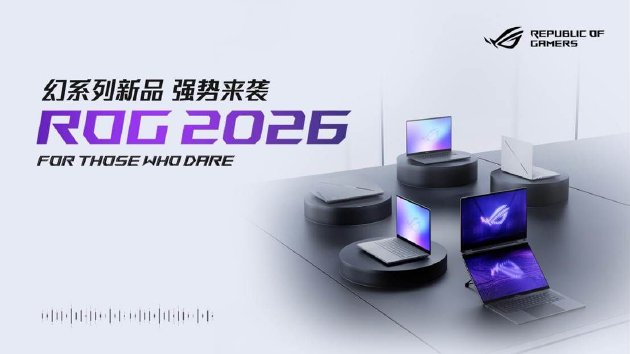
CES 2026:ROG发布全球首款16英寸双大屏旗舰全能本幻16双屏
Xin Lang Cai Jing· 2026-01-06 14:40
Core Insights - ROG Player's Republic launched multiple new products at CES 2026, including the world's first 16" dual-screen flagship laptop, ROG幻16 Dual Screen, and new professional lightweight laptops ROG幻14 Air and ROG幻16 Air, all equipped with the third-generation Intel Core Ultra processors [1][19]. Group 1: ROG幻16 Dual Screen - ROG幻16 Dual Screen is the world's first 16" dual-screen flagship laptop designed for complex creative needs, supporting five flexible modes for professional design, gaming, AI, programming, and entertainment [3][21]. - The dual screens provide an equivalent view of over 21 inches, featuring 2.8K resolution, 120Hz refresh rate, 0.2ms response time, and peak brightness of 1100 nits, ensuring color accuracy and dynamic performance [5][23]. - The laptop is powered by the Intel Core Ultra 9 386H processor and NVIDIA GeForce RTX 5090 GPU, with a total power consumption of up to 150W and GPU performance reaching 135W, showcasing its robust capabilities [9][23]. Group 2: ROG幻14 Air - ROG幻14 Air is a 14-inch professional lightweight laptop designed for creators, balancing professional performance and portability with a CNC metal chassis [10][26]. - It features the Intel Core Ultra 9 386H processor and up to RTX 5070 Ti GPU, weighing approximately 1.57kg and measuring 1.59cm in thickness, redefining high performance and long battery life [12][28]. - The upgraded ROG starry original screen offers 2.8K resolution, 120Hz refresh rate, and peak brightness of 1100 nits, ensuring color accuracy and exceptional HDR visual immersion [14][30]. Group 3: ROG幻16 Air - ROG幻16 Air is a 16-inch professional lightweight laptop that has been fully upgraded, featuring the Intel Core Ultra 9 386H processor and up to RTX 5090 GPU, with a maximum power release of 175W [15][31]. - The laptop maintains a weight of about 1.95kg and a thickness of 1.49cm, while its 16-inch screen boasts 2.5K resolution, 240Hz refresh rate, and peak brightness of 1100 nits, providing a high-quality visual experience [15][31]. - The design continues the minimalist futuristic style with upgraded features like a 35-segment light matrix and enhanced audio systems, ensuring a powerful performance and exceptional user interaction [33][35].

英特尔为安卓适配NPU驱动,这事可能并不简单
3 6 Ke· 2025-10-27 23:32
Core Viewpoint - Intel has released a new NPU driver update for Linux, which now includes support for the Android system, sparking speculation about its potential applications in the Android for PC project by Google [1][2]. Group 1: Intel's NPU Driver Update - The latest NPU driver update from Intel for Linux includes support for Android, marking a significant development in its technology offerings [1]. - This update has led to discussions among tech enthusiasts regarding its implications for future products [1]. Group 2: Speculations on Android for PC - There is a prevailing theory that Intel's adaptation of the NPU for Android is a preparatory move for Google's Android for PC project, which aims to merge Chrome OS and Android [2]. - The potential outcome could be the introduction of "Android PCs" that run on either Arm or x86 processors [2]. Group 3: Chrome OS Context - Chrome OS has historically targeted niche markets such as netbooks and cloud computers, relying heavily on web applications rather than local processing power [5]. - This design allows Chrome OS to operate on low-performance, low-power processors, resulting in longer battery life and lower costs [7]. Group 4: Hardware Considerations - If Android PCs are intended to succeed Chrome OS, they may not require advanced hardware compatibility, aligning better with the needs of their target users [12]. - Intel's N series processors, which lack NPU and focus on low power consumption, may be more suitable for this market than their higher-end processors [12]. Group 5: Broader Market Implications - Intel's adaptation of the NPU driver may not solely focus on Android PCs but could also cater to other markets, such as automotive applications, where Android interfaces are already in use [16]. - Recent developments in dual-OS tablets that support both Windows and Android suggest that Intel may be responding to market trends rather than solely focusing on Android PC [20].


终端 AI 奇点已至,英特尔点燃 PC 新范式
Cai Fu Zai Xian· 2025-10-11 04:11
Core Insights - Intel is leading the trend in the AI PC market through its XPU hybrid architecture, AI computing power, and an open software ecosystem [2][6][9] - The competition in the AI PC market is intensifying, with a focus on integrating AI seamlessly into personal devices, transforming them into proactive service environments [2][6] - The introduction of AI PCs is seen as a critical battleground for reshaping personal computing experiences, with significant growth expected in the coming years [6][12] Market Trends - According to Canalys, AI PC shipments are projected to reach 100 million units by 2025, accounting for 40% of the market, and will grow to 205 million units by 2028, with a CAGR of 44% from 2024 to 2028 [6] - The PC industry is undergoing an urgent upgrade, with chipmakers accelerating the integration of AI from the cloud to personal computers [6][9] Product Innovations - Intel's Core Ultra processors, based on the Meteor Lake architecture, represent a significant shift in design, integrating a dedicated NPU (Neural Processing Unit) for enhanced AI capabilities [7][8] - The NPU allows for efficient execution of deep learning algorithms, enabling complex tasks such as real-time video background blurring and voice noise reduction [7][8] Ecosystem Development - Intel is collaborating with global software developers to accelerate the deployment of 400 AI functionalities, creating a specific application ecosystem for AI PCs [8][12] - The AI PC can automate tasks such as meeting minutes generation, data analysis, and content creation, enhancing productivity and user experience [8][12] Competitive Landscape - The AI PC market is characterized by a diverse and competitive environment, with multiple companies vying for leadership beyond just hardware specifications [9][12] - Tech giants are exploring new terminal forms and investing in partnerships across the supply chain to establish strong ecosystem barriers in the AI era [12]
计算机行业:AI智能体Manus发布,阿里推出QwQ-32B
中国银河· 2025-03-11 08:27
Investment Rating - The report maintains a positive investment rating for the computer industry [4] Core Insights - The successful development of the "Zuchongzhi No. 3" quantum computing prototype by a Chinese research team has set a new world record in superconducting quantum computing, demonstrating significant performance improvements and establishing China's leading position in this field [2][33] - The launch of the AI agent Manus by a Chinese team marks a significant breakthrough in AI applications, with expected compound annual growth of 72.7% over the next five years [2][34] - Alibaba's introduction of the QwQ-32B model, with 320 billion parameters, showcases China's growing innovation and technological strength in the global AI industry [3][35] Summary by Sections Global Market Performance - U.S. tech stocks continued to decline, while Chinese and Hong Kong tech stocks, as well as A-share computer stocks, saw increases [11] - The Nasdaq China Golden Dragon Index rose by 4.93%, and the Hang Seng Tech Index increased by 8.43% [12] Industry News - The "Zuchongzhi No. 3" quantum computer features 105 readable qubits and 182 coupled qubits, achieving performance that is a trillion times faster than the fastest supercomputer [2][33] - The AI agent Manus can perform various tasks such as travel planning and stock analysis, indicating a major advancement in AI capabilities [2][34] - Alibaba's QwQ-32B model is designed for local deployment on consumer-grade graphics cards, reducing costs for enterprises [3][35] Key Technology Developments - Apple released the M3 Ultra chip, enhancing performance for Mac products with significant improvements in CPU and GPU capabilities [20] - Qualcomm introduced the X85 5G modem, which supports 5G Advanced and offers peak download speeds of up to 10 Gbps [22] - Intel expanded its Core Ultra series, significantly improving multi-core performance and productivity for business applications [25][26]