茯苓糕

Search documents
英山药材出山记(新春走基层)
Ren Min Ri Bao· 2026-02-03 20:19
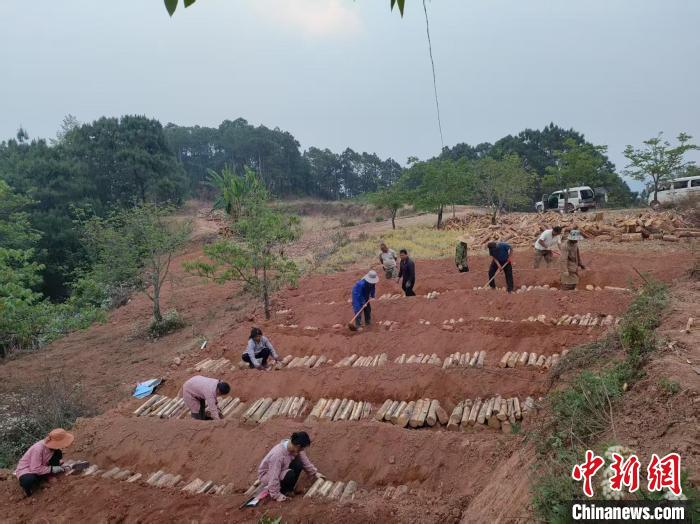
Core Viewpoint - The article highlights the innovative methods being adopted in Ying Shan County, Hubei Province, to enhance the cultivation and profitability of traditional Chinese medicinal herbs like Fuling and Tianma, leveraging modern agricultural techniques and ecological advantages [2][11]. Group 1: Traditional Cultivation Challenges - The cultivation of Fuling requires a growth period of at least 5 months, with land needing to rest for 3 to 5 years after harvest, while Tianma takes 2 years to mature, necessitating a similar resting period for the soil [5]. - The limited land availability and long cultivation cycles pose significant challenges for farmers seeking to increase their income from these crops [4][5]. Group 2: Innovative Agricultural Practices - A local company, Hubei Senrong Traditional Chinese Medicine Development Co., is producing Fuling mycelium at a rate of over 4,000 bags per hour, with sales reaching 5 million bags last year [7]. - The use of greenhouses allows for the cultivation of Tianma, reducing the growth cycle from 2 years to just 7 months, enabling farmers to capitalize on market demand more effectively [10]. - The integration of temperature control and modern farming techniques has led to improved yields and profitability for local farmers [10]. Group 3: Economic Impact and Future Prospects - The cultivation of medicinal herbs in Ying Shan generates over 15 million yuan annually, with the potential for further economic growth through value-added processing [11]. - Local initiatives are focused on enhancing the value of medicinal herbs, with companies developing products that significantly increase profit margins, such as instant drink formulations that can sell for 5 to 10 times the original value of raw materials [11]. - The county aims to leverage its ecological advantages to promote sustainable development and high-quality economic growth, aligning with the "Two Mountains" theory of ecological and economic integration [11].

“药都”樟树的“新药香叙事”
Xin Hua Wang· 2025-12-15 02:28
Core Viewpoint - Zhangshu, a city with over 1800 years of history in traditional Chinese medicine (TCM), is undergoing a significant transformation from a "medicine capital" to a "health and wellness capital" by integrating TCM culture with tourism, creating a new narrative of "TCM + cultural tourism" [1][4][5] Group 1: Historical Significance and Transformation - The saying "Without Zhangshu, medicine is not complete" highlights Zhangshu's unique position in the history of Chinese medicine [5] - Zhangshu has evolved from merely selling medicinal materials to offering scenic views, cultural experiences, and health services, reflecting a deep exploration of its cultural roots [4][5] - The city aims to break free from traditional industrial constraints and explore a new path where TCM culture and tourism coexist [4][5] Group 2: Cultural and Tourism Integration - The integration of TCM and tourism is not just an optional enhancement but a necessity for sustainable urban development and cultural transmission [7][8] - The newly developed Sanhuangli tourism and leisure district, which opened in October 2020, has been designed to reflect historical architecture while incorporating TCM cultural elements [10] - The district has attracted significant tourist traffic, with 198.3 million visitors in the first half of the year, leading to a 21.66% increase in hotel occupancy and a 15.38% rise in restaurant revenue [14] Group 3: Community Engagement and Experience - The city encourages immersive experiences where visitors can learn about TCM practices, such as acupuncture and herbal medicine, fostering emotional connections and cultural appreciation [8][22] - Educational initiatives, including hands-on workshops for children, are being implemented to deepen understanding and appreciation of TCM culture [20][25] - Local farmers are transitioning to cultivate both medicinal and ornamental herbs, significantly increasing their income [20] Group 4: Future Development and Challenges - The city is focused on avoiding homogenization in its tourism offerings by emphasizing its unique "Zhangbang" cultural heritage [24] - There is a strong demand for professionals who understand both TCM and tourism management, leading to increased enrollment in relevant educational programs [23] - The city aims to transform from a "medicinal material distribution center" to a "health lifestyle destination," enhancing its cultural and economic significance [30]

“哀牢秘境”双柏育出“黄金菌”:小茯苓“药”香四溢
Zhong Guo Xin Wen Wang· 2025-06-01 07:23
Core Insights - The article highlights the success of the mushroom industry, particularly the cultivation of Poria cocos (Fu Ling), in Shuangbai County, Yunnan Province, showcasing the transformation of local farmers into successful entrepreneurs [1][3]. Industry Overview - Shuangbai County is a significant production area for Poria cocos in China, with over 132,000 acres dedicated to its cultivation, accounting for one-seventh of the national total. Approximately 15% of the fresh Poria cocos in the national market originates from this county [1][3]. - The local government aims to establish Shuangbai as a "billion-level cloud Poria cocos industry county" by 2030, focusing on various aspects of the industry, including seed cultivation, planting, processing, marketing, and branding [4]. Company Insights - Yunnan Miaorong Biotechnology Company processes 8 to 10 tons of fresh Poria cocos daily, with a projected total output value exceeding 100 million yuan in 2024. The company not only cultivates its own mushrooms but also purchases from local farmers, contributing to their income [4]. - Local farmers, such as Yang Dingrong, benefit from the industry by renting land for mushroom cultivation and working in processing facilities, earning over 50,000 yuan annually, which is significantly higher than previous earnings from traditional crops like corn [6]. Agricultural Practices - Farmers like Luo Gang have successfully expanded their cultivation areas from 500 acres to 2,600 acres, increasing annual production from 10 tons to 130 tons, with an annual income exceeding 1 million yuan. This shift has allowed them to earn more while staying close to their families [3][6]. - The quality of local Poria cocos is emphasized, with extraction rates reaching up to 7.6%, significantly surpassing the national pharmacopoeia standard of 2.5%. The county collaborates with research institutions to develop superior strains and explore sustainable cultivation methods [6].