
茯苓

Search documents
【环球财经】刚果(布)官员:期待中国“零关税”举措惠及民众
Xin Hua She· 2026-02-27 06:35
Core Viewpoint - The "zero tariff" initiative by China is expected to create new opportunities for the agricultural and industrial development of the Republic of Congo, benefiting its citizens [1] Group 1: Economic Impact - The "zero tariff" measure will enhance the added value of agricultural and industrial products from the Republic of Congo, promote youth employment, and significantly improve the living standards of local people [1][1] - During the trade negotiation meeting, over 10 companies from both China and the Republic of Congo signed cooperation agreements, allowing products such as fungus, peanuts, and potassium salt from the Republic of Congo to be exported to China [1][1] Group 2: Bilateral Relations - The "zero tariff" initiative is described as a golden card for a new era of China-Africa cooperation and represents China's proactive approach to expanding unilateral openness [1][1] - China will implement the zero tariff policy for 53 African countries starting from May 1, 2026, while continuing to promote the signing of economic partnership agreements and expanding access for African products to China through upgraded "green channels" [1][1]
野菜排毒 浓茶祛湿?立春养生快“避雷”
Xin Lang Cai Jing· 2026-02-23 17:36
Group 1 - The article discusses common spring health practices, such as consuming wild vegetables and drinking strong tea, which may pose safety risks and could be harmful to health [1] - Wild vegetables, while believed to have some health benefits, do not effectively detoxify blood vessels and can cause discomfort if consumed in excess [2] - It is important to ensure the safety and source of wild vegetables, as they can be confused with toxic plants and may carry safety risks if foraged from uncontrolled environments [2] Group 2 - Drinking strong tea is discouraged due to high levels of tannins and caffeine, which can lead to health issues like stomach pain and osteoporosis [3] - The recommended approach to tea consumption is "light tea at a warm temperature," with choices based on individual constitution [3] - After the Rain Water solar term, dietary recommendations include consuming foods that are sweet and warm to strengthen the spleen, such as yam and millet [4] - It is advised to avoid cold, greasy, and spicy foods to prevent depleting vital energy and fluids [4]
节前忙碌、饮食不规律?试试假期“充电宝”!好吃又营养!
Xin Lang Cai Jing· 2026-02-07 23:55
Group 1 - The article emphasizes the importance of sweet foods, particularly in the context of traditional Chinese medicine, where "sweet" is associated with balancing health and enhancing physical strength [1][2] - It distinguishes between "sweet" in a culinary sense and "sweet" in a medicinal context, highlighting that some foods may not taste sweet but possess beneficial properties [2] - The arrival of spring is noted as a time to increase the intake of sweet foods to support digestive health, as the liver's activity can affect the spleen and stomach [3] Group 2 - Sweet foods are said to provide energy and boost immunity during the spring season, which coincides with travel peaks and the Chinese New Year holiday [4] - Specific foods like yam are highlighted as beneficial for those with weak digestive systems, serving as a natural source of nourishment [5] - Recipes for health-promoting teas and porridge using yam and other ingredients are provided, aimed at those with mild to moderate digestive issues [6] Group 3 - Malt is described as a remedy for common gastrointestinal issues encountered during travel, such as diarrhea and abdominal pain [7] - Sugarcane is referred to as a natural humidifier, helping to alleviate dryness during the transition from winter to spring [8] - The article also mentions the benefits of Buddha's hand for emotional well-being, acting as a natural remedy for stress and anxiety [8]
英山药材出山记
Ren Min Ri Bao· 2026-02-04 05:16
Group 1 - The village of Tiantang in Hubei Province is actively engaged in the cultivation of medicinal materials, particularly Fuling and Tianma, with significant economic benefits reported [1][2] - The cultivation of Fuling requires a growth period of at least 5 months and land must rest for 3 to 5 years, while Tianma takes 2 years to harvest, indicating challenges in increasing production due to land limitations and long growth cycles [3][4] - Innovative methods are being explored to enhance production efficiency, including the use of a mixing machine to produce Fuling mycelium at a rate of over 4,000 bags per hour, with significant sales reported [6][7] Group 2 - The local government emphasizes the importance of increasing the added value of medicinal materials, with a focus on enhancing processing capabilities to move from bulk sales to higher-value products [7] - Companies are developing new products that significantly increase the value of medicinal materials, such as "medicinal food homologous" products and instant drink formulations, which can enhance value by 5 to 10 times [7] - The ecological advantages of the region are highlighted as a key factor in development, with local industries relying on the natural environment to generate economic benefits for the community [7]
英山药材出山记(新春走基层)
Ren Min Ri Bao· 2026-02-03 20:19
Core Viewpoint - The article highlights the innovative methods being adopted in Ying Shan County, Hubei Province, to enhance the cultivation and profitability of traditional Chinese medicinal herbs like Fuling and Tianma, leveraging modern agricultural techniques and ecological advantages [2][11]. Group 1: Traditional Cultivation Challenges - The cultivation of Fuling requires a growth period of at least 5 months, with land needing to rest for 3 to 5 years after harvest, while Tianma takes 2 years to mature, necessitating a similar resting period for the soil [5]. - The limited land availability and long cultivation cycles pose significant challenges for farmers seeking to increase their income from these crops [4][5]. Group 2: Innovative Agricultural Practices - A local company, Hubei Senrong Traditional Chinese Medicine Development Co., is producing Fuling mycelium at a rate of over 4,000 bags per hour, with sales reaching 5 million bags last year [7]. - The use of greenhouses allows for the cultivation of Tianma, reducing the growth cycle from 2 years to just 7 months, enabling farmers to capitalize on market demand more effectively [10]. - The integration of temperature control and modern farming techniques has led to improved yields and profitability for local farmers [10]. Group 3: Economic Impact and Future Prospects - The cultivation of medicinal herbs in Ying Shan generates over 15 million yuan annually, with the potential for further economic growth through value-added processing [11]. - Local initiatives are focused on enhancing the value of medicinal herbs, with companies developing products that significantly increase profit margins, such as instant drink formulations that can sell for 5 to 10 times the original value of raw materials [11]. - The county aims to leverage its ecological advantages to promote sustainable development and high-quality economic growth, aligning with the "Two Mountains" theory of ecological and economic integration [11].

“纪委监督保障了我们特色产业发展”
Xin Lang Cai Jing· 2026-01-06 22:38
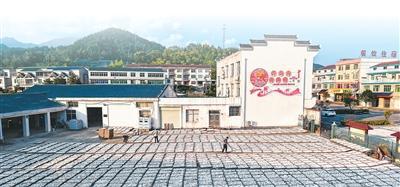
Core Viewpoint - The article highlights the successful development of a unique industry cluster centered around the cultivation of Fuling (a type of fungus) in Yangchang Township, Anshun City, which has significantly improved local employment and household incomes [1] Group 1: Industry Development - The Fuling cultivation area has been expanded annually, with plans to reach over 2,000 acres by 2025 [1] - The industry has formed a comprehensive cluster that includes planting, harvesting, and sales, contributing to local economic growth [1] Group 2: Community Impact - The return of previously withheld subsidies for Fuling cultivation has enabled increased investment in the industry [1] - The development of the Fuling industry has provided job opportunities for local villagers, helping families increase their income [1]
重庆市药品监督管理局关于5批次药品不符合规定的通告
Xin Lang Cai Jing· 2026-01-05 08:24
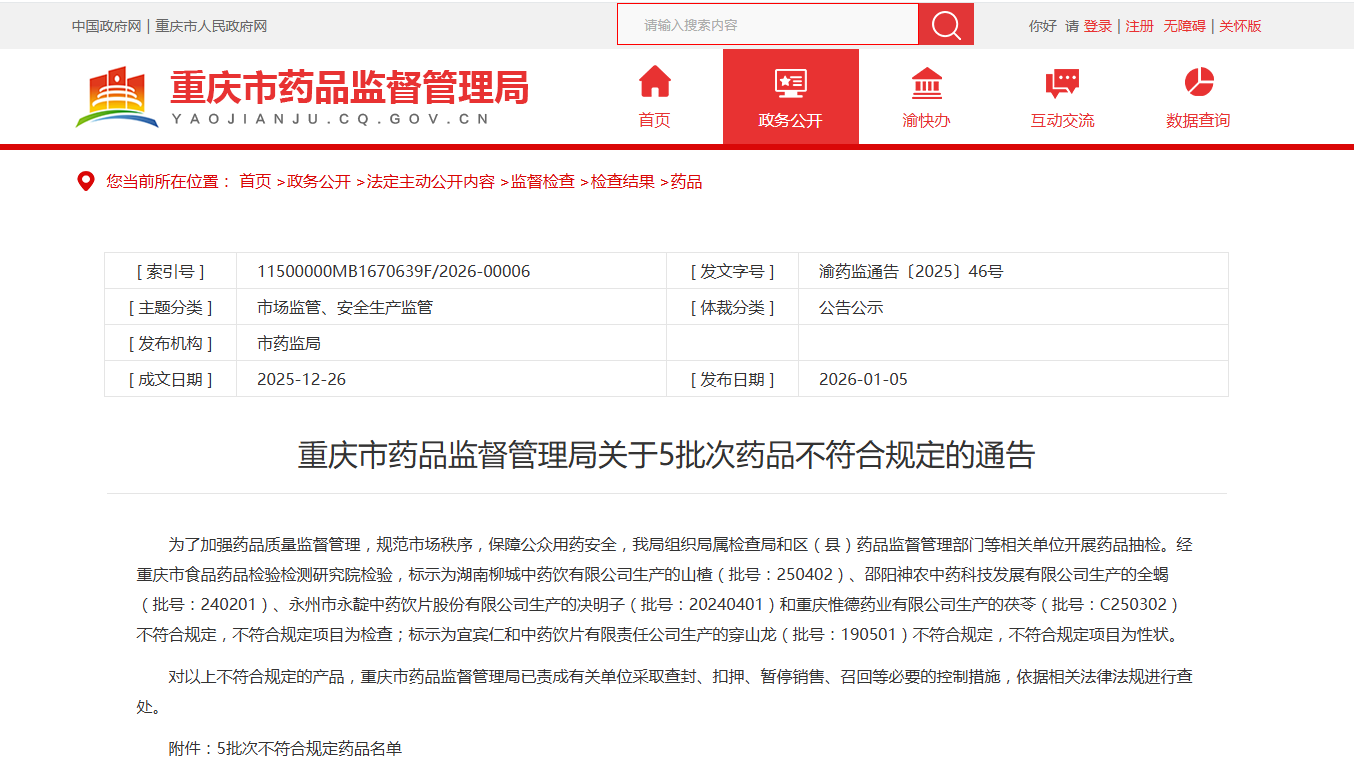
Core Viewpoint - The Chongqing Municipal Drug Administration has conducted inspections and found several traditional Chinese medicine products that do not meet regulatory standards, leading to enforcement actions against the manufacturers [3][4]. Group 1: Inspection Findings - Products from four companies were identified as non-compliant: Hawthorn from Hunan Liucheng Traditional Chinese Medicine Co., Ltd., Scorpion from Shaoyang Shennong Traditional Chinese Medicine Technology Development Co., Ltd., Cassia Seed from Yongzhou Yongdian Traditional Chinese Medicine Co., Ltd., and Poria from Chongqing Weide Pharmaceutical Co., Ltd. [3][4] - The specific non-compliance issues included various inspection criteria, with the Hawthorn and Scorpion failing checks, while the Cassia Seed and Poria were found non-compliant in specific measurement tests [3][4]. Group 2: Regulatory Actions - The Chongqing Municipal Drug Administration has mandated necessary control measures such as sealing, confiscation, suspension of sales, and recalls for the identified non-compliant products [4]. - The enforcement actions are based on relevant laws and regulations to ensure public safety in drug consumption [4].
湖北确定首批69种道地中药材
Xin Lang Cai Jing· 2026-01-03 07:56
Core Viewpoint - The Hubei Provincial Department of Agriculture and Rural Affairs, along with other health and regulatory agencies, has released the first batch of the "Hubei Province Authentic Medicinal Materials Directory," which includes 69 traditional Chinese medicinal materials such as Ai Ye (mugwort leaves), Ban Xia (pinellia), Huang Lian (coptis), Fu Ling (poria), Ju Hua (chrysanthemum), and Cang Zhu (atractylodes) [1] Group 1 - The directory specifies the common names, origins, and production areas of the listed medicinal materials [1] - For example, Ai Ye is identified as Qi Ai, derived from the dried leaves of the plant Artemisia argyi, primarily produced in Qichun and surrounding areas [1] - Huang Lian is referred to as Ji Zhua Huang Lian, sourced from the dried rhizomes of Coptis chinensis, found in counties such as Lichuan, Zhuxi, and Enshi [1] Group 2 - The directory also includes Fu Ling, which is recognized by the same name and is derived from the dried sclerotia of the fungus Poria cocos, mainly produced in counties like Luotian, Yingshan, and Macheng [1] - Hubei province boasts over 4,000 types of medicinal materials, establishing five major advantageous production areas: Dabie Mountains, Wuling Mountains, Qinba Mountains, Mufu Mountains, and Jianghan Plain [1]
2025年11月处方药销售全景洞察:数据驱动?精准破局
EqualOcean· 2025-12-28 06:02
Group 1 - The report focuses on advanced data collection technologies to ensure the accuracy, timeliness, and comprehensiveness of sales information, aiming to extract valuable industry trends and consumer insights from vast data for stakeholders in the pharmaceutical industry [6] - The data covers over 135,000 pharmacies nationwide, creating a large sample database that represents various regions, types, and scales of pharmacies, providing a broad basis for analysis [6] - The report successfully obtained information on 14 million prescription drug purchase orders, reflecting market dynamics and consumer demand [6] Group 2 - From January to November 2025, the order volume of prescription drugs in offline pharmacies showed a fluctuating upward trend, with the order index reaching 23.7 in November, indicating a strong growth momentum [9][19] - The distribution of orders varies significantly by province, with Guangdong, Sichuan, and Shandong leading in order share, while western provinces like Tibet and Qinghai have much lower shares, reflecting disparities in drug demand and healthcare resource allocation [24] - The order volume across provinces showed no significant fluctuations year-on-year, indicating a relatively stable market structure [25] Group 3 - In November 2025, the proportion of consumers aged 56 and above purchasing both Western and Chinese medicine slightly increased, with notable peaks in purchasing times for Western medicine around 10 AM and 7 PM, and for Chinese medicine around 11 AM [10][41] - The most common ailments among Western medicine consumers included influenza, particularly among those under 18, while Chinese medicine consumers primarily presented with Yin deficiency syndromes, showing significant differences across age groups and provinces [10][48] Group 4 - The report highlights that the purchasing preferences for specific drugs have shifted, with increased usage of Oseltamivir and Amlodipine in Western medicine, and rising popularity of Chinese herbs like Licorice and Goji Berries [11] - The sales rankings of various drugs differ significantly across provinces, with Fujian and Henan seeing increased sales of Oseltamivir and Cephalosporins, indicating regional variations in drug demand [11] Group 5 - The report provides a detailed analysis of consumer profiles, indicating an increase in the proportion of female consumers and those aged 56 and above in both Western and Chinese medicine purchases from November 2024 to November 2025 [35] - The report also notes that the purchasing behavior of consumers is influenced by their daily routines, with higher activity levels in the morning and evening, aligning with typical healthcare needs [41]
2025年11月处方药销售全景洞察:数据驱动,精准破局
EqualOcean· 2025-12-26 11:13
Group 1 - The report focuses on advanced data collection technologies to ensure the authenticity, timeliness, and comprehensiveness of sales information, aiming to extract valuable industry trends and consumer insights from vast data for stakeholders in the pharmaceutical industry [4][5] - The data covers over 135,000 pharmacies nationwide, creating a large sample database that represents various regions, types, and scales of pharmacies, providing a broad basis for analysis [4] - The report analyzes data from over 14 million prescription drug purchase orders, reflecting market dynamics and consumer demand [4] Group 2 - From January to November 2025, the order volume of prescription drugs in offline pharmacies showed a fluctuating upward trend, with the order index reaching 23.7 in November, indicating a strong growth momentum [5][14] - There are significant regional differences in order distribution, with provinces like Guangdong, Sichuan, and Shandong leading in order volume, while western provinces like Tibet and Qinghai have much lower shares, reflecting disparities in drug demand and healthcare resource allocation [5][20] Group 3 - In November 2025, the proportion of consumers aged 56 and above purchasing both Western and traditional Chinese medicine slightly increased, with female consumers also showing a slight rise [6][29] - The peak purchasing times for Western medicine are around 10 AM and 7 PM, while for traditional Chinese medicine, it peaks around 11 AM, indicating higher daytime purchasing activity [34] Group 4 - The report highlights that the proportion of consumers purchasing Western medicine for influenza significantly increased, particularly among the under-18 demographic, while traditional Chinese medicine consumers primarily presented with Yin deficiency syndromes [6][39] - The report identifies a rising trend in the use of specific Western medicines such as Oseltamivir and Amlodipine, with regional variations in popular products across provinces [7][20] Group 5 - The analysis of prescription drug consumers reveals that the proportion of consumers aged 56 and above has increased for both Western and traditional Chinese medicines, indicating a growing demand among older demographics [29][46] - The report provides insights into the disease patterns among different age groups, with influenza being the most prevalent among younger consumers, while chronic conditions like hypertension and diabetes are more common in older age groups [39][46] Group 6 - The report indicates that the disease composition among prescription drug consumers varies significantly by province and changes over time, with influenza and acute respiratory infections being common in regions like Chongqing and Guizhou, while hypertension is more prevalent in Sichuan [50][54] - The analysis of traditional Chinese medicine consumers shows that the most common syndromes include Yin deficiency and blood deficiency, reflecting diverse health concerns among consumers [57][71]