菜椒

Search documents
新春走基层丨“新农人”聊聊新农业(视频)
Zhong Guo Jing Ji Wang· 2026-02-17 08:01
Core Insights - The article highlights the successful operation of the "Sharing Harvest Farm" in Liu Zhuang Hu Village, which benefits from collective land ownership and a digitalized operational system [1][2]. Group 1: Economic Performance - In 2024, the collective economic income of Liu Zhuang Hu Village reached 3.62 million yuan, representing a 43% year-on-year increase, with an average income of approximately 21,500 yuan per household [1]. - The centralized land ownership facilitates efficient management and provides stable rental income for the village collective [1]. Group 2: Operational Efficiency - The farm utilizes an online e-commerce system that allows for precise matching of production and consumption, achieving a 90% match rate for agricultural products [1]. - The system is based on over ten years of accumulated customer order data, enabling the creation of a scientific planting forecast model [2]. Group 3: Future Planning - The farm can predict the annual demand for various crops, such as 10 tons of tomatoes and cucumbers, based on order trends for 2025, which informs their planting plans for 2026 [2].
“新农人”聊聊新农业(视频)
Zhong Guo Jing Ji Wang· 2026-02-17 02:03
Core Insights - The "Sharing Harvest Farm" in Liuzhuanghu Village, Shunyi District, Beijing, operates efficiently due to the collective ownership system, which simplifies land leasing and management [1] - In 2024, the collective economic income of Liuzhuanghu Village is projected to reach 3.62 million yuan, a 43% increase year-on-year, with an average income of approximately 21,500 yuan per household [1] - The farm utilizes a digital system for precise supply and demand matching, achieving a 90% match rate for agricultural products [1] Group 1 - The collective ownership model allows for unified negotiation and leasing of land, facilitating centralized planning and management [1] - The farm's operational efficiency is enhanced by a digital e-commerce system that connects production directly to consumers [1] - The farm has accumulated nearly 300,000 members on its retail platform, allowing for effective distribution of unsold products [1] Group 2 - A scientific planting prediction model has been developed based on over ten years of customer order data, enabling accurate forecasting of crop needs [2] - The model predicts specific quantities of crops needed for the upcoming years, guiding the farm's planting plans to align with market demand [2] - This data-driven approach allows the farm to implement a production strategy based on sales forecasts, ensuring that planting is demand-driven [2]
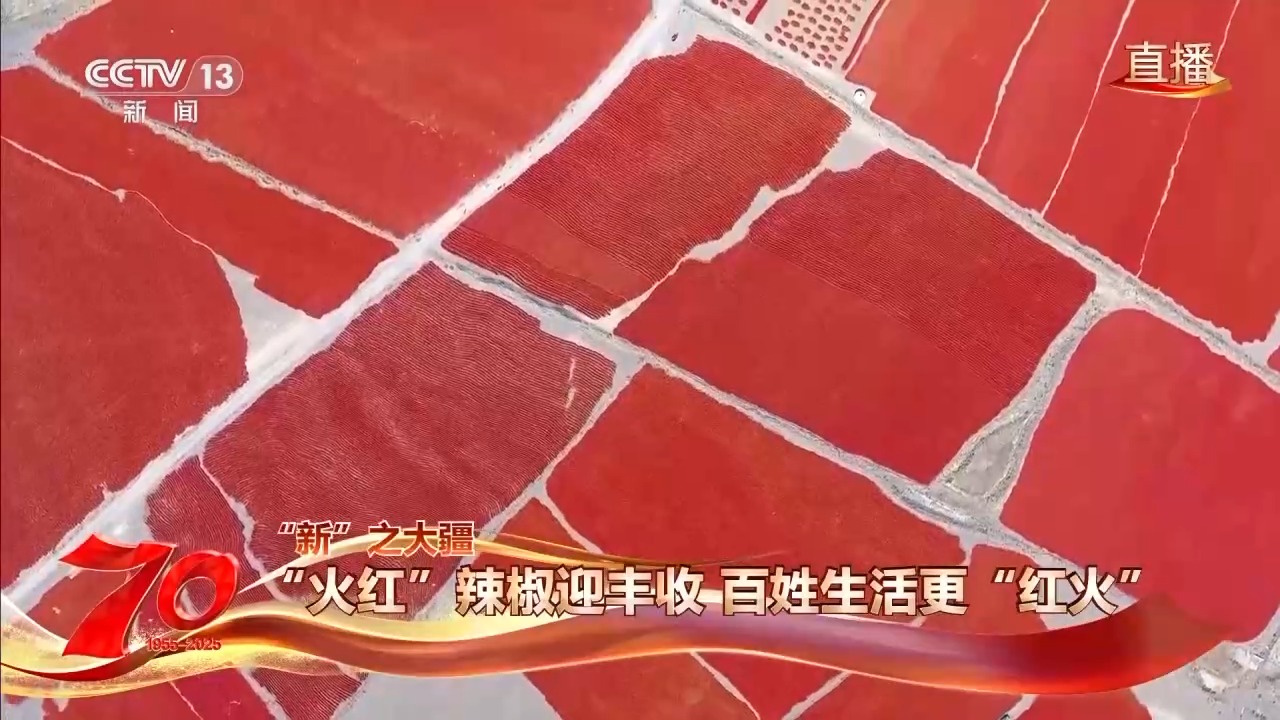
在新疆万亩戈壁晾晒场 看“火红辣椒”带来“红火日子”
Yang Shi Xin Wen Ke Hu Duan· 2025-09-25 07:18
Core Viewpoint - The article highlights the successful harvest of chili peppers in Xinjiang, particularly in the town of Anjiqi, which has become a significant producer of chili peppers in China, contributing to the local economy and agricultural development [1][3]. Group 1: Agricultural Production - Xinjiang is experiencing a bountiful harvest season, with chili peppers being a key crop, particularly in Shawan, where one in ten of the country's seasoning chili peppers is produced [1][3]. - The local farmers are busy drying freshly harvested chili peppers, which enhances their marketability and processing potential [3][8]. - The unique geographical conditions of Xinjiang, including abundant sunlight and significant temperature variations, contribute to the high quality and variety of chili peppers produced [6][8]. Group 2: Technological Advancements - The use of advanced machinery, such as intelligent chili harvesting machines, has improved efficiency, allowing farmers to harvest 10 acres in just one hour [8]. - The integration of drones for pest control and smart irrigation systems showcases the technological advancements in the agricultural practices of the region [8]. Group 3: Market Impact and Export - Anjiqi chili peppers have been registered as a national geographical indication product, which stabilizes prices and enhances brand recognition [9]. - The strategic location of the drying fields near major transportation routes facilitates the distribution of dried chili peppers across China and to international markets, including countries in Central Asia [11]. - Shawan's chili pepper production accounts for 10% of the national seasoning pepper market, with an annual export volume of approximately 1,000 tons to countries like South Korea, Japan, and Kazakhstan [11].