
诺安成长混合

Search documents
蔡嵩松出事2年后,诺安基金还好吗?
Sou Hu Cai Jing· 2025-11-15 02:15
Core Viewpoint - The article discusses the recent performance and challenges faced by Nuon Fund, highlighting the dramatic rise and fall of its star fund manager, Cai Song Song, and the implications for investors and the fund's future [2][8][30]. Group 1: Fund Performance - In Q3 2025, the public fund industry earned a total profit of 2.08 trillion, a 4.4 times increase compared to the previous quarter, with major firms like E Fund, Huaxia, and Harvest each exceeding 100 billion in profits [2]. - Nuon Fund's growth was significant under Cai Song Song, with its scale expanding from 380 million at the end of 2018 to nearly 33 billion by the end of 2020, an increase of 85 times [8]. - However, the fund suffered a 40.04% decline in 2022, resulting in a loss of 12.93 billion, leading to a drastic change in investor sentiment towards Cai Song Song [8][11]. Group 2: Management Changes and Challenges - Cai Song Song's abrupt resignation in September 2023 was followed by allegations of corruption, which raised concerns about the fund's leadership and future direction [10][11]. - Liu Huiying, who took over after Cai, continues to focus heavily on semiconductor investments, but without the favorable market conditions, this strategy may lead to increased volatility [11][30]. - The fund's assets have decreased from a peak of 33 billion to 18.52 billion, indicating a loss of 14.48 billion in value [13]. Group 3: Governance Issues - The founder of Nuon Fund, Qin Mouzhou, has been implicated in a bigamy case, which has further tarnished the fund's reputation [16][18]. - The fund has faced regulatory scrutiny, including a three-month suspension of ETF product registrations due to internal control failures [19][20]. Group 4: Strategic Direction - Nuon Fund's QDII products have underperformed significantly, with total assets dwindling to 1.014 billion, representing only 0.5% of the company's total scale [22]. - Despite past missteps, the fund has a strong technology research team and a balanced management structure, which may provide opportunities for recovery if volatility can be managed [26][29].


当基金营销开始“饭圈化”,你的钱包同意了吗?
Sou Hu Cai Jing· 2025-10-30 09:56
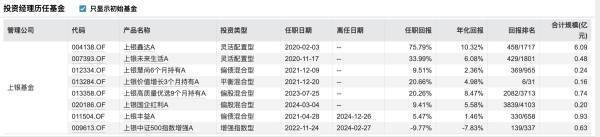
Core Viewpoint - The marketing strategy of Shangyin Fund, which promotes fund manager Chen Bo as a trendy figure, has sparked industry concerns about the "idolization" of fund managers and the potential risks associated with such marketing tactics [1][3][5]. Marketing Strategy - Shangyin Fund's marketing campaign focuses on creating a personal brand for Chen Bo, utilizing offline advertisements in key areas of Shanghai and online engagement through social media platforms like Xiaohongshu [3][5]. - The campaign has received mixed feedback, with users more interested in promotional giveaways than in the actual investment strategies or performance of the funds [3][5]. Performance and Risks - Chen Bo manages six funds, with most of them having assets under management below 50 million yuan, putting them at risk of liquidation [1][10][13]. - Year-to-date performance shows that only one of Chen Bo's funds has outperformed the CSI 300 index, while the others have significantly lagged behind [10][11]. Industry Context - The trend of "star-making" in the fund industry is not new, with previous examples like Wang Zonghe from Penghua Fund, whose performance ultimately disappointed investors [7][8]. - Regulatory bodies have emphasized the need for fund companies to move away from reliance on star fund managers and focus on a more integrated investment research system [9][14]. Structural Challenges - Shangyin Fund faces significant challenges in its equity business, with equity products accounting for less than 2% of its total assets under management, indicating a heavy reliance on fixed-income products [14][15]. - The fund's struggle to attract and retain talented equity fund managers reflects broader issues within bank-affiliated fund companies, which often prioritize lower-risk products [14][16].
人工智能基金经理大比拼:“五朵金花”争奇斗艳
Sou Hu Cai Jing· 2025-09-29 08:25
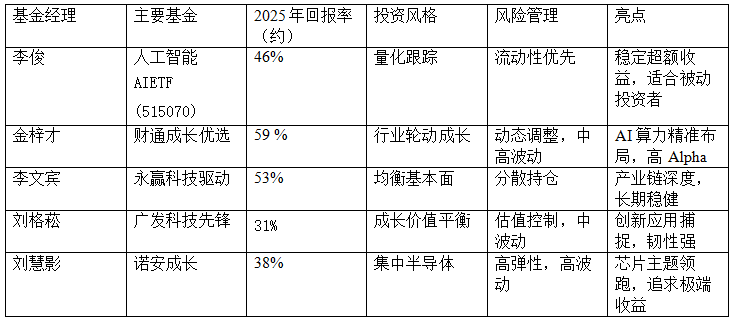
Core Insights - The article highlights the performance of five prominent fund managers in the AI-themed fund sector, showcasing their investment strategies and returns in 2025, with an average return rate exceeding 43%, significantly outperforming the market index [2][9]. Group 1: Fund Managers and Performance - Li Jun (Huaxia Fund) manages the AI ETF (515070) with a return rate of approximately 46.79% in 2025, focusing on AI chips, algorithm software, and application devices, benefiting from the surge in AI computing power demand [3][9]. - Jin Zicai (Caitong Fund) leads the Caitong Growth Select fund with a return rate of about 59.13%, emphasizing technology growth stocks and making precise investments in AI computing stocks [4][9]. - Li Wenbin (Yongying Fund) oversees the Yongying Technology Driven fund, achieving a return rate of around 53%, with a focus on high-quality growth stocks in AI and semiconductors [5][9]. - Liu Gesong (Guangfa Fund) manages the Guangfa Technology Pioneer fund, which has a return rate of approximately 31%, concentrating on strategic emerging industries like new energy and AI [6][9]. - Liu Huiying (Noan Fund) leads the Noan Growth fund with a return rate of about 38%, focusing on the semiconductor and AI hardware sectors [7][9]. Group 2: Investment Styles and Risk Management - Li Jun employs a quantitative investment style, prioritizing liquidity control and minimizing tracking errors, making it suitable for passive investors [3][9]. - Jin Zicai is recognized for his industry rotation skills, focusing on high-risk, high-return strategies, with a dynamic adjustment approach to mitigate risks [4][9]. - Li Wenbin emphasizes a balanced fundamental approach, focusing on risk-reward ratios and dynamic allocation strategies [5][9]. - Liu Gesong adopts a growth-value balance strategy, emphasizing long-term investment opportunities and valuation control [6][9]. - Liu Huiying's concentrated investment style targets the semiconductor AI industry, aiming for high elasticity returns, but carries higher volatility risks [8][9].
机构风向标 | 中芯国际(688981)2024年四季度已披露前十大机构持股比例合计下跌1.25个百分点
Xin Lang Cai Jing· 2025-03-28 01:06
Group 1 - SMIC (688981.SH) released its 2024 annual report on March 28, 2025, indicating that as of March 27, 2025, 535 institutional investors disclosed holding shares in SMIC A-shares, totaling 817 million shares, which accounts for 10.25% of SMIC's total share capital [1] - The top ten institutional investors include notable entities such as the National Integrated Circuit Industry Investment Fund II, China Merchants Bank, and various ETFs focused on the semiconductor sector, with the top ten collectively holding 7.17% of the shares [1] - Compared to the previous quarter, the combined holding percentage of the top ten institutional investors decreased by 1.25 percentage points [1] Group 2 - In the public fund sector, three funds reported a decrease in holdings compared to the previous quarter, with a total reduction of 0.95% [2] - A total of 31 new public funds were disclosed during this period, including various ETFs and mixed funds focused on large-cap indices and digital economy [2] - There were 230 public funds that did not disclose holdings in this period, including several semiconductor-focused ETFs and mixed funds [2]
