
谷歌Gemini系列

Search documents
2026全球AI竞速!科技主线关键仍看基座模型持续迭代及AI应用的渐进落地!
Sou Hu Cai Jing· 2025-12-27 06:43
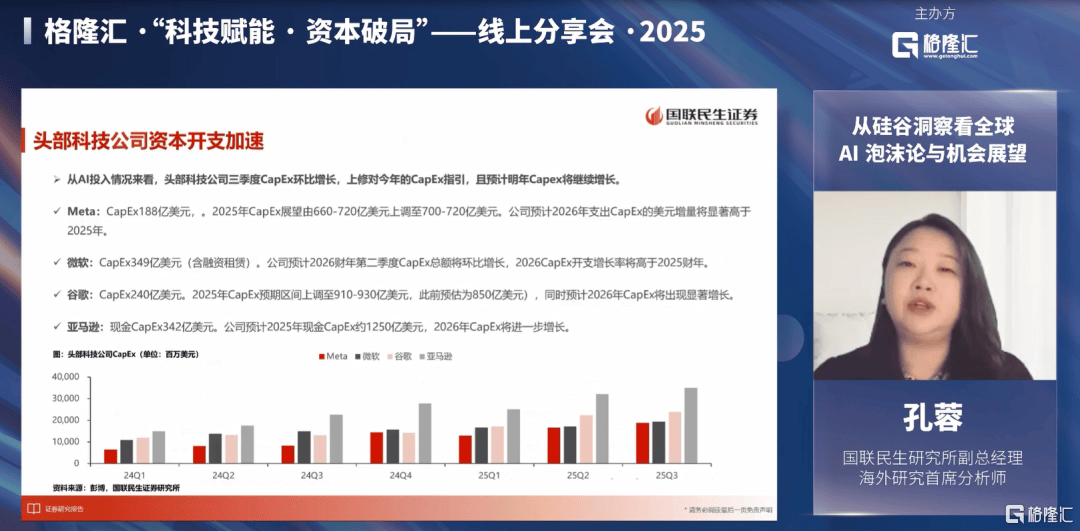
Core Insights - The discussion at the "Technology Empowerment · Capital Breakthrough" event highlighted the ongoing trends in global AI development, key technological advancements, and market opportunities, with a positive outlook for AI beyond 2026 despite current market skepticism regarding potential bubbles and sustainability of capital expenditures [1][3]. Group 1: AI Market Dynamics - The AI competition is expected to intensify in 2024, with significant discussions around whether there is a bubble in AI investments and the sustainability of capital expenditures for 2025-2027 [1][6]. - Major companies like Google, Meta, Microsoft, and xAI are anticipated to accelerate the release of new models, leading to heightened competition in the industry [6][21]. Group 2: Key Technological Advancements - The enhancement of multimodal capabilities is crucial for AI's evolution, impacting content creation across various dimensions and transforming advertising and e-commerce efficiency [8][10]. - Breakthroughs in memory and personalization capabilities will enable AI to transition from general tools to personalized assistants, increasing user engagement and driving commercial viability [15][16]. Group 3: Investment Opportunities in China - China's AI ecosystem is recognized for its strong competitive edge, with domestic models gaining international acclaim and major tech companies committing to sustained AI investments [29][30]. - The valuation of Chinese AI companies is currently more reasonable compared to their U.S. counterparts, providing a favorable investment landscape [31][32].



2026全球AI竞速!科技主线关键仍看基座模型持续迭代及AI应用的渐进落地!
格隆汇APP· 2025-12-27 06:10
Core Viewpoint - The article discusses the optimistic outlook for AI development beyond 2026, despite current market concerns about potential bubbles and sustainability of capital expenditures [2][6]. Group 1: AI Market Trends - There is ongoing debate in the market regarding whether AI is in a bubble and the sustainability of capital expenditures for 2025-2027 [3][4]. - Major tech companies are expected to shift focus from "infrastructure" to "application realization," with key observations on revenue growth from Google Cloud Platform (GCP), Microsoft Azure, and Amazon AWS [11]. - The release pace of large models is anticipated to accelerate, with major players like OpenAI, xAI, Meta, Microsoft, and Google continuing to launch new models, intensifying industry competition [12][28]. Group 2: Key Players and Innovations - Google has demonstrated strong capabilities with its self-developed technology and resources, maintaining a competitive edge [8]. - Meta is expected to regain market confidence by 2026 after restructuring and integrating top AI talent, aiming to launch competitive models [8]. - Microsoft is focusing on its own models while maintaining collaboration with OpenAI, looking for synergies between its large models and ecosystem [9]. - xAI, despite being a latecomer, is rapidly iterating its models and is considered a significant variable in the market [10]. Group 3: Model Capabilities and Applications - The enhancement of multi-modal capabilities is crucial for transforming content production in advertising and e-commerce, as well as improving user experiences with hardware like AR/VR devices [15][18]. - Breakthroughs in memory and personalization capabilities will allow AI to evolve from general tools to personalized assistants, increasing user engagement and driving token consumption [23][24]. - The overall improvement in model capabilities is fundamental for the commercialization of AI, leading to clearer paths for investment returns [25][26]. Group 4: China's AI Ecosystem - China's AI ecosystem is recognized for its strong competitive advantages, with domestic models gaining international acknowledgment [40]. - Major Chinese tech firms like Alibaba and Tencent are committed to ongoing investments in AI, indicating a long-term strategy [40]. - The country boasts the largest pool of engineers and a rapid product iteration culture, which is expected to replicate the "application innovation" seen in the mobile internet era, creating numerous investment opportunities [40][41]. - Current valuations of Chinese AI companies are considered reasonable compared to their U.S. counterparts, providing a favorable investment margin [41].



谷歌OCS和产业链详解
2025-10-27 00:31
Summary of Key Points from Google OCS and Industry Chain Analysis Industry Overview - The analysis focuses on the AI and cloud services industry, particularly highlighting Google's advancements in AI technology and its implications for the optical communication market [1][2][3]. Core Insights and Arguments - Google's Gemini series C-end products have exceeded penetration expectations, with enterprise applications such as meeting transcription and code assistance accelerating paid adoption. This has led to sustained high growth in inference demand on a daily, weekly, and monthly basis [1][2]. - Major cloud service providers, including Google, Oracle, Microsoft, and AWS, express confidence in long-term AI growth, increasing investments in GPU, TPU, smart network cards, switches, and high-speed optical interconnects. This indicates a shift towards a stable iterative investment cycle in AI [1][3]. - The demand for optical modules is expected to surge, with projections indicating that the demand for 800G optical modules could reach 45 to 50 million units by 2026, and the demand for 1.6T optical modules has been revised upwards to at least 20 million units, potentially reaching 30 million units under ideal conditions [3][16]. Implications for Optical Communication - AI applications are evolving towards multi-modal integration, necessitating multiple network communications during each intelligent agent upgrade, which enhances the value of optical interconnects. The inference demand requires long connections, high concurrency, and low latency, placing higher demands on optical interconnects within and outside data centers [5][7]. - Google has adopted the OCS solution and Ironwood architecture to reduce link loss and meet performance requirements for large-scale training. The Ironwood architecture allows for interconnection of 9,216 cards, optimizing AI network performance through 3D Torus topology and OCS all-optical interconnects [6][10]. Hardware Requirements - The inference phase emphasizes high-frequency interactions with both C-end and B-end, necessitating higher bandwidth networks compared to the training phase, which focuses more on internal server computations [7][8]. - The performance of Google's TPU V4 architecture is significantly influenced by the number of optical modules used, with each TPU corresponding to approximately 1.5 high-speed optical modules [9][10]. Market Dynamics - The optical module market is experiencing a supply-demand imbalance, which is expected to extend to upstream material segments, including EML chips, silicon photonic chips, and CW light sources. This imbalance is likely to drive growth in upstream industries as demand for optical modules increases [17]. - Key beneficiaries of the demand surge driven by Google include leading manufacturers such as Xuchuang, Newye, and Tianfu, which possess optimal customer structures and strong capacity ramp-up capabilities. Additionally, upstream companies like Yuanjie and Seagull Photon are likely to enhance their production capabilities to meet the growing demand [18]. Additional Important Insights - The OCS solution's cost structure includes significant components such as 2D MEMS arrays valued at approximately $6,000 to $7,000 each, with additional costs for other components like lens arrays and optical fiber arrays [11]. - The liquid crystal solution, while having a higher unit value, is simpler in structure compared to the MEMS solution, which is more mature and cost-effective but may have lower efficiency in practical applications [13][15]. This comprehensive analysis highlights the critical developments in Google's AI initiatives and their broader implications for the optical communication industry, emphasizing the expected growth in demand for optical modules and the strategic responses from key players in the market.