负载均衡器

Search documents
ETF盘中资讯|云计算进入密集涨价周期,厂商有望迎来估值重构!大数据ETF华宝(516700)大涨3.3%,拓维信息等3股涨停
Sou Hu Cai Jing· 2026-02-27 07:19
Group 1 - The cloud computing sector is experiencing a rise, particularly in domestic computing power (IDC, servers) and AI application areas, with the big data ETF (516700) seeing an intraday increase of 3.3% and currently up 2.23% [1] - Major stocks in the sector include YunDaliChuang-U, ChengDiXiangJiang, and TuoWeiInformation, which have seen significant price increases of 20.00%, 10.01%, and 10.00% respectively [2] - Hetzner, a leading European data center operator, announced a price increase for all products and services starting April 1 due to rising costs in multiple IT sectors, marking the second price hike this month [3] Group 2 - The IDC market in China is projected to reach approximately 430 billion yuan by 2026, surpassing 550 billion yuan by 2028, and reaching 650-680 billion yuan by 2030, with a compound annual growth rate of about 18% [3] - The demand for domestic AI computing power is expected to drive growth in cloud computing infrastructure, with companies that have a strong domestic computing base and overseas capabilities gaining a competitive edge [3] - The big data ETF managed by Huabao tracks the CSI Big Data Industry Index, which includes leading stocks such as ZhongKeShuGuang, KeDaXunFei, and others, focusing on various big data sectors [4]


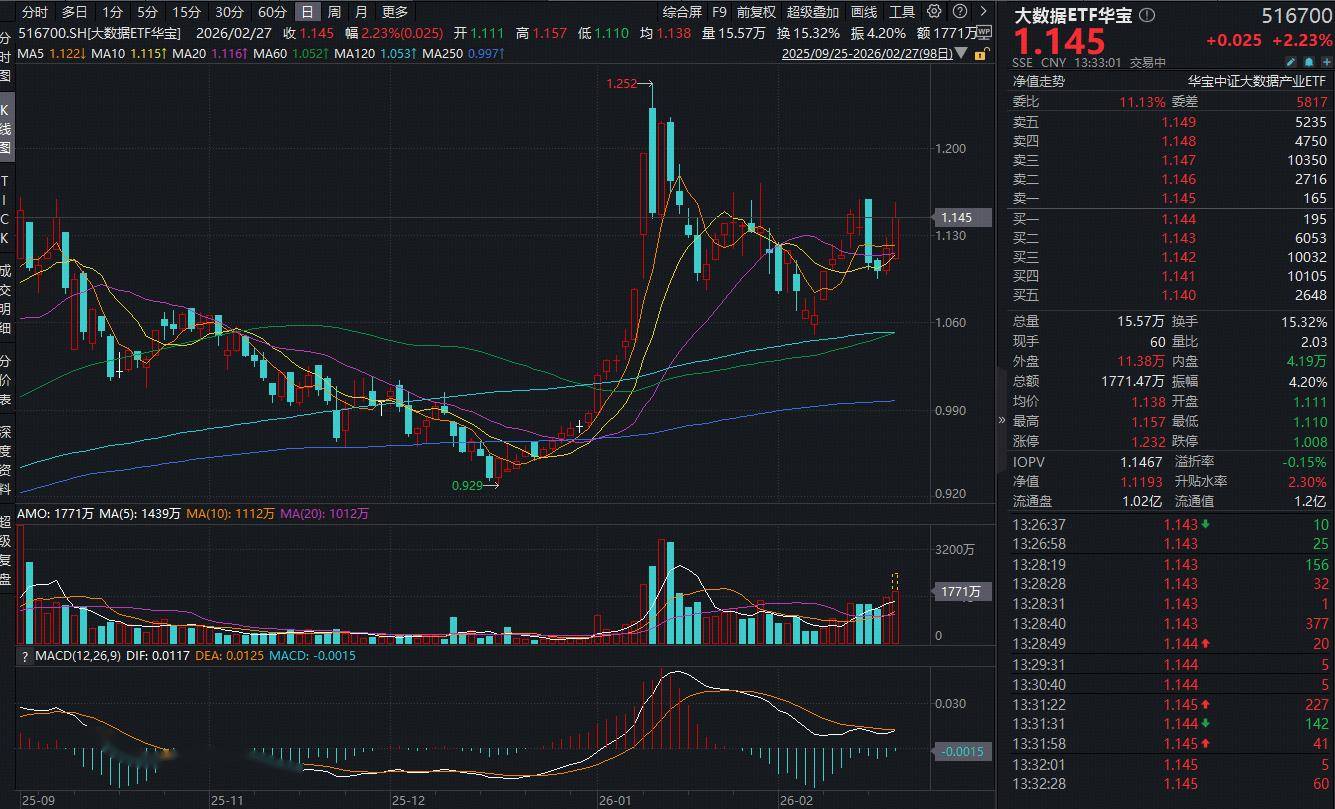
云计算进入密集涨价周期,厂商有望迎来估值重构!大数据ETF华宝(516700)大涨3.3%,拓维信息等3股涨停
Xin Lang Ji Jin· 2026-02-27 05:53
Group 1 - The cloud computing sector is experiencing a rise, particularly in domestic computing power (IDC, servers) and AI application areas, with the big data ETF (516700) seeing an intraday increase of 3.3% and currently up 2.23% [1] - Major data center operator Hetzner announced a price increase for all products and services starting April 1 due to significant cost increases in multiple IT sectors, marking the second price hike this month [2][3] - The IDC market in China is projected to reach approximately 430 billion yuan by 2026, surpassing 550 billion yuan by 2028, and reaching 650-680 billion yuan by 2030, with a compound annual growth rate of about 18% [3] Group 2 - The demand for AI computing power is expected to drive growth in cloud computing infrastructure, with companies possessing independent computing capabilities and overseas expansion advantages becoming more prominent [3] - The big data ETF (516700) passively tracks the CSI Big Data Industry Index, focusing on areas such as big data storage devices, analysis technologies, and applications, with key stocks including Inspur Information and China Software [6] - By the end of 2025, the index's weight for computing power concepts is expected to reach 40.91%, while AI application concepts will account for 37.43% [6]
研判2025!中国负载均衡器行业分类、产业链及市场规模分析:凭借软件定义与云原生架构创新突破,推动国产化替代进入规模化应用与份额提升新阶段[图]
Chan Ye Xin Xi Wang· 2025-12-17 01:41
Core Insights - The Chinese load balancer industry is undergoing rapid technological iteration and accelerated domestic substitution, driven by digital transformation, cloud computing becoming mainstream, and the surge in demand for 5G and edge computing scenarios. The market size is expected to reach approximately 18.65 billion yuan in 2024, reflecting a year-on-year growth of 6.88% [1][6]. Industry Overview - Load balancers are network devices, software, or services that intelligently distribute network or application traffic across multiple servers. They ensure balanced server load distribution and enhance system performance, availability, and fault tolerance [2][3]. Industry Development History - The development of the Chinese load balancer industry has evolved through four key stages, closely aligned with the rise of the internet, cloud computing, and digital transformation [3]. Industry Supply Chain - The upstream of the load balancer industry includes processors, chips, network interface modules, and various software and system components. The midstream involves the manufacturing of load balancers, while the downstream applications span finance, IT, telecommunications, government, public services, IoT, edge computing, and healthcare [4][5]. Market Size - The load balancer market in China is expanding, with a projected market size of approximately 18.65 billion yuan in 2024, marking a 6.88% increase year-on-year. This growth indicates a strong demand for traffic scheduling and high availability solutions, as domestic manufacturers advance in software-defined and cloud-native architectures [6][7]. Key Companies' Performance - The market is characterized by a dual oligopoly in hardware led by Deepin Technology and Sangfor Technologies, with cloud services dominated by Alibaba Cloud, Tencent Cloud, and Huawei Cloud. Sangfor has penetrated government and financial sectors, while Deepin excels in customized services for telecom operators and large enterprises [7][8]. Industry Development Trends 1. **Integration of Cloud Native and AI Technologies**: Load balancers are transitioning from traditional hardware to intelligent cloud-native solutions, utilizing AI-driven algorithms for dynamic resource allocation [10]. 2. **Accelerated Domestic Substitution**: Domestic manufacturers like Sangfor and Huawei are gaining market share through the use of domestic chips and operating systems, supported by policy and market demand [11]. 3. **Diversified Market Demand**: Emerging technologies such as 5G, IoT, and AI are driving the growth of load balancer demand across various sectors, including finance, healthcare, and education [12].