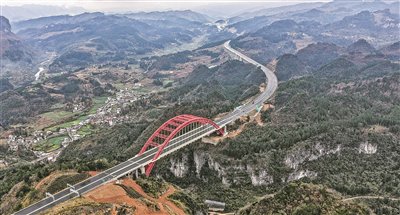
贵平高速

Search documents
交通固定资产投资保持高位,多项重大工程交付使用
Di Yi Cai Jing· 2025-12-27 02:41
Investment Overview - In the first eleven months, the national transportation fixed asset investment reached 3.27 trillion yuan, with road and water transport investments amounting to 2.22 trillion yuan and 193.5 billion yuan respectively [1] Major Infrastructure Developments - The G0711 Urumqi to Yili Highway, spanning 324.7 kilometers, was opened on December 26, featuring the world's longest highway tunnel and the deepest vertical shaft, significantly improving local logistics and reducing travel time from Urumqi to Korla from 7 hours to 3.5 hours [1] - The G7522 Guiyang to Beihai Highway's Guiyang to Pingtang section, with a total investment exceeding 39.2 billion yuan, also commenced operations on December 26, reducing travel time from 2.5 hours to about 1 hour and shortening transportation distance to the Beibu Gulf by nearly 200 kilometers [2] Regional Economic Impact - The opening of the G331 border tourism corridor in Jilin Province enhances local product distribution and has led to the establishment of over 100 new businesses along the route, promoting economic development [3][5] - Multiple highways in Guangxi, including the Yanglu Road and He Ba Road connection, were completed, facilitating regional tourism and economic growth [5] Future Projections - The Ministry of Transport anticipates that by 2025, transportation fixed asset investment will exceed 3.6 trillion yuan, with plans for over 2,000 kilometers of new high-speed railways and approximately 8,000 kilometers of new highways [6][7]

贵平高速通车运营,西部陆海新通道关键路段打通
2 1 Shi Ji Jing Ji Bao Dao· 2025-12-26 09:36
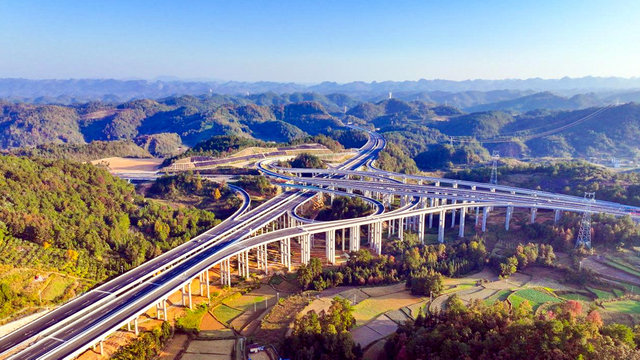
Core Viewpoint - The G7522 Guiyang to Beihai Expressway, specifically the Guiyang to Pingtang section, has officially opened for operation, marking a significant development in the transportation infrastructure of the southwestern region of China [1][3]. Group 1: Project Overview - The Guiyang to Pingtang section of the G7522 expressway spans 174.018 kilometers with a total investment exceeding 39.2 billion yuan, featuring a high-standard design of six lanes in both directions and a speed limit of 100 km/h [1][3]. - The expressway connects Guiyang in Guizhou Province to the Guangxi region, linking to the Tian'e to Beihai expressway, thus enhancing regional connectivity [1]. Group 2: Economic and Social Impact - The completion of the expressway is expected to transform the transportation landscape of the surrounding areas and promote high-quality development in the southwestern region [3]. - Travel time from Guiyang to Pingtang has been reduced from 2.5 hours to approximately 1 hour, while the transportation distance to the Beibu Gulf Port has been shortened by nearly 200 kilometers, resulting in a reduction of over 4 hours in cargo transport time [3]. - The expressway features 12 toll stations designed with "narrow island + intelligent + intensive" concepts, achieving 100% ETC coverage and supporting mobile payments, which enhances traffic efficiency by 40% compared to traditional toll stations [3]. Group 3: Connectivity and Development - The expressway includes 5 hub interchanges, 13 access interchanges, and a 50.649-kilometer rural connecting line, effectively linking industrial parks, tourist attractions, and rural areas [3]. - As a key segment of the new western land-sea corridor, the Guiyang to Pingtang expressway will serve as an important passage for the central Guizhou economic zone to connect with the Chengdu-Chongqing economic zone, the Yangtze River economic belt, the Guangdong-Hong Kong-Macau Greater Bay Area, and countries involved in the Belt and Road Initiative, injecting new vitality into the southwestern region [3].
贵州新增一条出海大通道:贵阳至平塘高速通车运营
Zhong Guo Xin Wen Wang· 2025-12-26 02:59
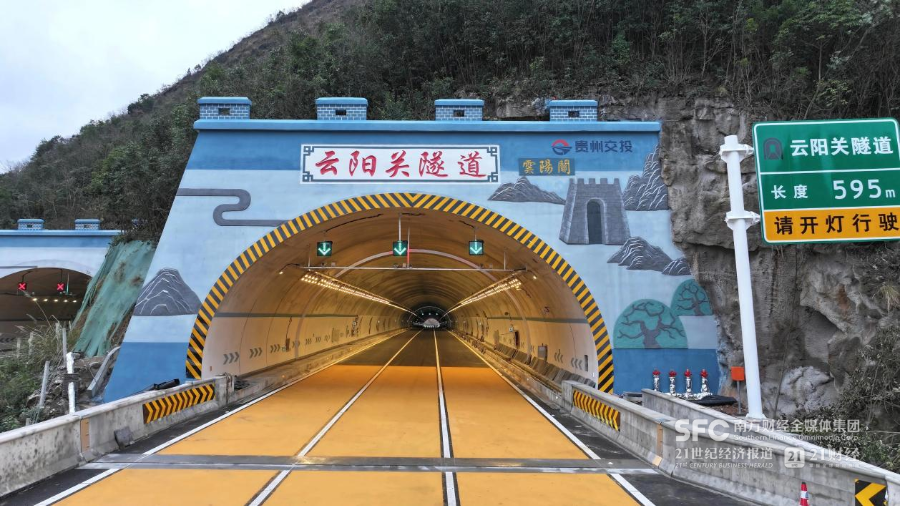
Core Viewpoint - The opening of the Guiyang to Pingtang Expressway significantly reduces travel time and enhances connectivity between Guizhou and Guangxi, facilitating economic development and trade in the region [1][7]. Group 1: Project Overview - The Guiyang to Pingtang Expressway (G7522) spans 174.018 kilometers, with a total investment exceeding 39.2 billion RMB [2]. - The expressway features a dual six-lane design with a speed limit of 100 km/h, serving as a vital link between central Guizhou and the Beibu Gulf [2][7]. Group 2: Engineering Challenges - The project has a high bridge-tunnel ratio of 50.7%, including 119 bridges and 36 tunnels, navigating through complex geological conditions [2]. - The construction of the 4,050-meter-long Liudong Tunnel faced significant challenges, including traversing over 100 karst caves, with innovative techniques employed to manage geological risks [5]. Group 3: Economic Impact - The expressway reduces the transportation distance to the Beibu Gulf port by nearly 200 kilometers and decreases cargo transport time by over 4 hours [7]. - It serves as a crucial passage for the Guizhou region to connect with the Chengdu-Chongqing Economic Circle, the Yangtze River Economic Belt, and the Guangdong-Hong Kong-Macau Greater Bay Area, injecting new vitality into the southwest region's openness [7].
贵州贵平高速公路项目通过交工验收
Zhong Guo Jing Ji Wang· 2025-12-25 08:21
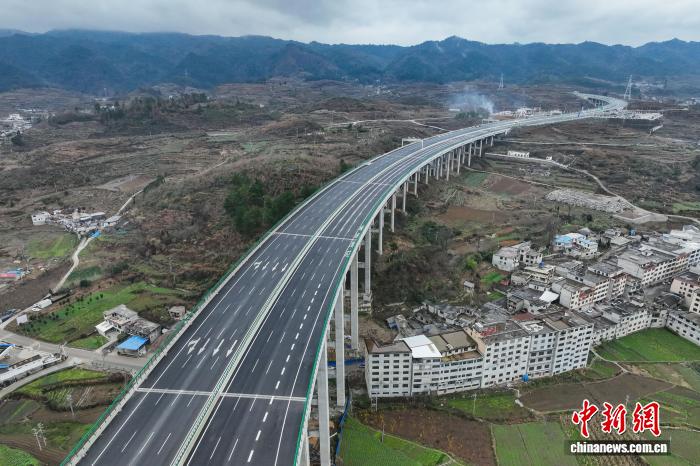
Core Viewpoint - The Guiyang to Beihai Expressway, specifically the Guiyang to Pingtang section, has passed engineering acceptance and is set to commence operations, marking a significant infrastructure development in Guizhou Province [1] Group 1: Project Overview - The Guiyang to Pingtang Expressway (GuiPing Expressway) is the longest and largest investment highway project currently under construction in Guizhou Province, spanning approximately 174 kilometers [1] - The expressway features a dual six-lane design with a maximum speed of 100 kilometers per hour [1] Group 2: Economic Impact - Upon completion, the expressway will create an efficient vertical corridor connecting Guiyang to the Beibu Gulf region, significantly reducing travel times: the journey from Guiyang to Pingtang will be shortened to about one and a half hours, and the trip from Guiyang to Baise, Guangxi, will decrease from approximately seven hours to four and a half hours [1] - This infrastructure project is expected to play a crucial role in advancing Guizhou's transportation development, solidifying its position as a southwestern land transportation hub, and injecting strong momentum into the development of the Central Guizhou Economic Zone and the new urbanization process [1]
贵平高速项目通过验收
Xin Lang Cai Jing· 2025-12-24 18:49
Core Insights - The G7522 Guiyang to Beihai Expressway, specifically the Guiyang to Pingtang section, has successfully passed engineering acceptance, marking a significant milestone in its construction and entering the operational preparation phase [2] Group 1: Project Overview - The Guiyang to Beihai Expressway is a crucial segment of the national highway network and an important part of the western land-sea corridor, providing the most convenient route from Guiyang to Nanning [2] - The expressway spans 174 kilometers with a designed speed of 100 km/h and is constructed to a dual six-lane standard, making it the longest and largest investment highway project currently under construction in Guizhou Province [2] Group 2: Strategic Importance - Once operational, the expressway will create an efficient vertical corridor from Guiyang to the Beibu Gulf region, significantly contributing to the construction of a strong transportation network in Guizhou and reinforcing its status as a southwestern land transportation hub [2] - Travel time from Guiyang to Pingtang will be reduced to approximately 1.5 hours, and the journey from Guiyang to Baise, Guangxi, will decrease from about 7 hours to approximately 4.5 hours [2] Group 3: Environmental and Cultural Integration - The construction of the expressway has taken into account the complex geological conditions and environmental sensitivities, passing through several protected areas, including the Pingtang Geological Park and the Pingtang National Wetland Park [3] - The project aims to harmonize construction with local ecology and culture, featuring cultural landscapes and service areas that reflect local customs and traditions, thereby promoting rural revitalization along the route [3] Group 4: Additional Infrastructure - The project also includes the completed Guizhou to Longli connecting line, which is 22.9 kilometers long and built to a dual four-lane standard, enhancing urban transit between Guiyang, Longli, and Guiding [3]