超薄硅钢产品

Search documents
未来两年年均增长目标约4% AI助力钢铁行业更智能更绿色
Yang Shi Xin Wen· 2025-09-24 03:10
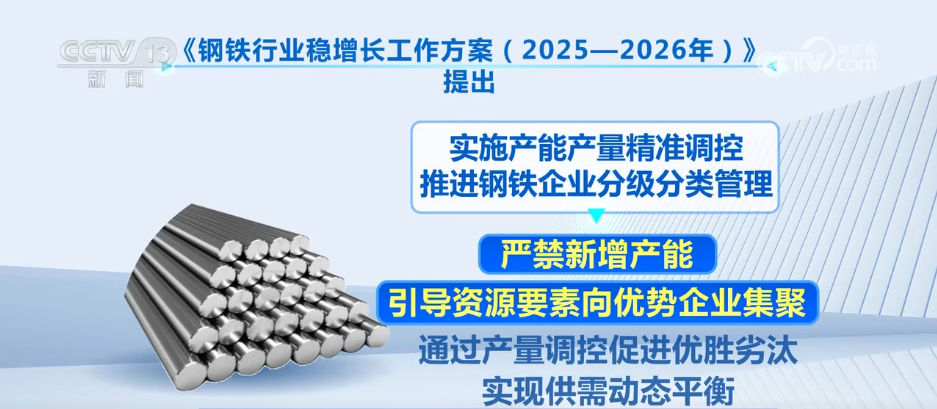
Core Viewpoint - The Ministry of Industry and Information Technology and other departments have jointly issued the "Steel Industry Growth Stabilization Work Plan (2025-2026)", setting an average annual growth target of around 4% for the steel industry's added value over the next two years, focusing on "stabilizing growth and preventing internal competition" to guide structural adjustments and high-quality development in the Chinese steel industry [1]. Group 1 - The work plan emphasizes precise control of capacity and output, prohibits new capacity, and encourages resource allocation towards leading enterprises to achieve dynamic balance between supply and demand [2]. - The plan identifies "equipment renewal" and "low-carbon transformation" as the two core competitive issues for the future [2]. - The plan aims to strengthen the coordination of supply and demand, effectively stabilizing industry development expectations [3]. Group 2 - The work plan promotes the updating of processes and equipment, focusing on high-end, intelligent, and green development, with an annual growth of 15% in R&D investment [4][12]. - The steel industry has launched over 120 new products this year, indicating a rapid response to market demands, with a shift from generic to customized steel products [9]. - The application density of robots in the steel industry has reached 65 units per 10,000 people, with over 80% of enterprises establishing intelligent centralized control centers [11]. Group 3 - The plan includes the integration of artificial intelligence in the steel industry, which is expected to significantly reduce R&D cycles and enhance green production [13][15]. - AI-assisted systems have reduced the average R&D cycle for high-end special steel products by 56%, and quality verification processes have been shortened from 72 hours to 8 hours [15]. - The development of smart blast furnaces is projected to reduce coal and raw material usage, leading to lower carbon emissions [17].


“稳增长、防内卷”方案为钢铁业高质量发展指明方向 “AI+钢铁”锻造新动能
Yang Shi Wang· 2025-09-22 06:56
Core Viewpoint - The "Steel Industry Growth Stabilization Work Plan (2025-2026)" aims for an average annual growth target of around 4% for the steel industry over the next two years, focusing on "stabilizing growth and preventing internal competition" to guide structural adjustments and high-quality development in the sector [1] Group 1: Policy and Strategic Directions - The plan emphasizes precise control of capacity and output, prohibits new capacity, and encourages resource allocation towards competitive enterprises to achieve dynamic supply-demand balance [3] - The plan mandates that by the end of 2025, over 80% of steel production capacity must complete ultra-low emission transformations [3] - The plan aims to enhance process and equipment upgrades, promote high-end, intelligent, and green development, and expand effective investments to optimize the steel industry's structure [5] Group 2: Industry Challenges and Responses - The steel industry currently faces an oversupply and insufficient effective demand, leading to a supply-demand imbalance that affects quality and efficiency [4] - In July, China's crude steel production was 79.66 million tons, a year-on-year decrease of 4.0%, while steel product output reached 122.95 million tons, a year-on-year increase of 6.4% [8] Group 3: Technological Advancements - The industry has seen a surge in new product launches, with over 120 globally launched products this year, driven by structural demand from advanced manufacturing sectors like electric vehicles and smart home appliances [8] - The integration of artificial intelligence in the steel industry is being promoted to enhance high-end, green development, with AI expected to play a core role in creating new productive forces [9][13] - AI-assisted systems have significantly reduced the average R&D cycle for high-end steel products by 56%, and quality verification processes have been expedited from 72 hours to 8 hours [11] Group 4: Future Outlook - The plan sets the stage for a paradigm shift in the steel industry towards high-end, intelligent, and green production models, with a focus on integrating AI across processes [13][15] - The industry is expected to transition from generic to customized steel products in response to rapid growth in demand from sectors like electric vehicles and advanced manufacturing [8]