人工智能+钢铁

Search documents
钢材铁矿周度报告-20260313
Zhong Hang Qi Huo· 2026-03-13 10:03
1. Report Industry Investment Rating - No relevant content provided 2. Core View of the Report - The short - term price of steel and iron ore is affected by multiple factors. For steel, the price mainly follows the cost side, and the market is in the post - holiday recovery stage. For iron ore, the short - term price is driven by overseas supply expectations, rising oil prices, and potential restocking demand from downstream steel mills [7][40][42] 3. Summary According to the Directory 3.1 Report Summary - In February, the global blast furnace steel mill pig iron output was 97.76 million tons, a month - on - month decrease of 9.32 million tons (8.7% decline) and a year - on - year increase of 0.7%. Excluding mainland China, the sample output of other countries and regions was 33 million tons, a month - on - month decrease of 3.27 million tons (9.0% decline) and a year - on - year decrease of 0.5% [5] - From March 2nd to 8th, the total iron ore inventory at seven major ports in Australia and Brazil was 13.179 million tons, a month - on - month increase of 396,000 tons, and the inventory level was the second - highest since the beginning of the year [6] - Kazakhstan's steel producer Qarmet is promoting the development of the Kentobe iron ore deposit, with a designed annual capacity of 2.1 million tons and a current output of about 750,000 tons per year [6] - Due to the situation in the Strait of Hormuz, several iron ore cargo ships originally destined for the Middle East have changed their routes to China [6] - In March 2026, China Mineral Resources Group stopped purchasing BHP's core products and required trading partners not to resell or accept new ship cargo orders after April [6] - Since the beginning of 2026, domestic machine tool enterprises have seen a significant increase in orders, and many enterprises are expanding production capacity [6] - During the Two Sessions in 2026, representatives and committee members proposed suggestions on steel industry development, focusing on capacity control, combating "involution - style" competition, and supporting "AI + steel" [6] - The US will launch a 301 investigation against 16 trading partners including China [6] - Hot - rolled coil production decreased, while rebar production increased. Steel enterprise profits improved slightly. After the holiday, steel mills' demand gradually recovered, and the rate of steel inventory accumulation slowed down. Global iron ore shipments decreased slightly, and freight rates increased slightly. Port congestion decreased slightly, steel mill inventories continued to decline, and port inventories remained high. The activity of forward iron ore spot transactions declined, while port spot transactions increased. Both molten iron production and steel mills' daily iron ore consumption decreased [7] 3.2 Multi - empty Focus 3.2.1 Steel Products - Bullish factors: Firm furnace charge prices provide cost - side support; After the Two Sessions, it enters the traditional "Golden March and Silver April" demand peak season [11] - Bearish factors: Limited expected demand increase; High inventory levels in factories and society [11] 3.2.2 Iron Ore - Bullish factors: Geopolitical conflicts lead to rising energy prices, increasing subsequent transportation costs; Steel mills' low inventory levels indicate potential restocking demand; There are frictions in Sino - Australian iron ore procurement, and some spot purchases are restricted [13] - Bearish factors: Steel mills mainly consume their own inventories, with weak restocking momentum; High port inventory levels [13] 3.3 Data Analysis - **Output**: As of the week of March 13th, rebar production was 1.953 million tons, a month - on - month increase of 219,900 tons; hot - rolled coil production was 2.9526 million tons, a month - on - month decrease of 58,500 tons. The blast furnace capacity utilization rate of 247 steel enterprises was 82.92%, a month - on - month decrease of 2.4%, and the capacity utilization rate of independent electric arc furnace steel mills was 50.44%, a month - on - month increase of 29.73% [15] - **Profit**: As of March 13th, the blast furnace production profit of rebar for sample enterprises was 81 yuan/ton, and the hot - rolled coil blast furnace profit was 4 yuan/ton. The electric arc furnace production cost of rebar was 3,417 yuan/ton [17] - **Demand**: As of the week of March 13th, rebar consumption was 1.7681 million tons, a month - on - month increase of 785,800 tons; hot - rolled coil consumption was 2.9536 million tons, a month - on - month increase of 137,900 tons. The daily trading volume of hot - rolled coils also gradually recovered to the normal level [23] - **Inventory**: As of March 13th, the in - factory inventory of rebar was 2.3962 million tons, a month - on - month increase of 16,900 tons; the social inventory in 35 cities was 6.5455 million tons, a month - on - month increase of 168,000 tons. The in - factory inventory of hot - rolled coils was 892,800 tons, a month - on - month decrease of 8,000 tons; the social inventory in 33 cities was 3.8231 million tons, a month - on - month increase of 7,000 tons [24] - **Iron Ore Shipment and Freight**: From March 2nd to 8th, the global iron ore shipment volume was 28.978 million tons, a month - on - month decrease of 4.429 million tons. The shipment volume from Australia and Brazil was 23.421 million tons, a month - on - month decrease of 3.485 million tons. The shipment volume from non - mainstream regions was 5.556 million tons, a month - on - month decrease of 945,000 tons. As of March 12th, the freight rate from Port Hedland to Qingdao Port for iron ore Capesize ships was 12.2 US dollars/ton, a slight increase from the previous period [28] - **Port and Mill Inventory**: As of the week of March 6th, the iron ore arrival volume at 45 ports was 26.099 million tons, an increase of 4.63 million tons from the previous period. As of the week of March 13th, the imported iron ore inventory at 45 ports was 171.8752 million tons, an increase of 696,600 tons from the previous period; the daily average congestion volume was 3.179 million tons, an increase of 68,200 tons from the previous period; the imported iron ore inventory of 247 steel enterprises was 89.291 million tons, a decrease of 824,700 tons from the previous period [30] - **Transaction Volume**: As of the week of March 6th, the daily average spot trading volume of iron ore at major Chinese ports by traders was 806,000 tons, a month - on - month increase of 136,000 tons. The daily average forward spot trading volume of iron ore was 763,000 tons, a decrease of 716,000 tons from the previous period [32] - **Molten Iron and Iron Ore Consumption**: As of March 13th, the daily average molten iron output of 247 sample steel enterprises was 2.212 million tons, a decrease of 63,900 tons from the previous period; the daily average consumption of imported iron ore was 2.7195 million tons, a decrease of 89,000 tons from the previous period [34] - **Rebar - Hot - Rolled Coil Spread**: As of March 12th, the price difference between the main contracts of rebar and hot - rolled coils was 155 yuan/ton, an increase from the previous week [36] - **Basis Structure**: The basis structure of steel and iron ore was stable. The spot price reflected weak real - world demand, and the futures price indicated that market expectations had not improved significantly, with limited expected driving force and a difficult - to - expand basis [39] 3.4 Market Outlook - For steel, the recent prices of rebar and hot - rolled coils mainly follow the cost side. The steel market is in the post - holiday recovery stage, lacking fundamental driving force. After the Two Sessions, attention should be paid to the inventory reduction during the "Golden March and Silver April" peak season [40] - For iron ore, the short - term price is driven by changes in overseas supply expectations, rising oil prices, and potential restocking demand from downstream steel mills. Attention should be paid to the restocking momentum brought by the recovery of downstream demand, the impact of fuel costs on transportation costs after the increase in energy prices due to geopolitical conflicts, and the negotiations between Chinese and Australian miners [42]
瑞达期货螺纹钢产业链日报-20260310
Rui Da Qi Huo· 2026-03-10 09:58
1. Report Industry Investment Rating - Not provided in the given content 2. Core Viewpoints of the Report - On Tuesday, the RB2605 contract adjusted with a reduction in positions. During the Two Sessions in 2026, many NPC deputies and CPPCC members put forward suggestions on the development of the steel industry, focusing on capacity regulation, rectifying "involution - style" competition, and supporting the development of "AI + steel". The weekly output of rebar increased, terminal demand also rose, but inventory was increasing, and the supply - demand situation remained relatively loose. Trump said that the war with Iran might end soon, international oil prices fell from high levels, market panic decreased, and commodity prices generally corrected. Technically, the 1 - hour MACD indicator of the RB2605 contract showed that DIFF and DEA were adjusting at high levels, and the red column turned green. It is recommended for short - term trading and attention should be paid to risk control [2] 3. Summary by Relevant Catalogs Futures Market - The closing price of the RB main contract was 3,104.00 yuan/ton, down 15 yuan; the trading volume was 1,731,363 lots, down 9,469 lots; the net position of the top 20 in the RB contract was - 2,322 lots, up 30,995 lots; the RB5 - 10 contract spread was - 28 yuan/ton, unchanged; the RB warehouse receipt at the Shanghai Futures Exchange was 24,151 tons, unchanged; the HC2605 - RB2605 contract spread was 152 yuan/ton, up 1 yuan [2] Spot Market - The price of HRB400E 20MM in Hangzhou (theoretical weight) was 3,270.00 yuan/ton, down 20 yuan; the price of HRB400E 20MM in Hangzhou (actual weight) was 3,354 yuan/ton, down 21 yuan; the price of HRB400E 20MM in Guangzhou (theoretical weight) was 3,400.00 yuan/ton, unchanged; the price of HRB400E 20MM in Tianjin (theoretical weight) was 3,150.00 yuan/ton, unchanged; the basis of the RB main contract was 166.00 yuan/ton, down 5 yuan; the spot price difference between hot - rolled coils and rebar in Hangzhou was 10.00 yuan/ton, up 10 yuan [2] Upstream Situation - The price of 60.8% PB iron ore fines at Qingdao Port was 770.00 yuan/wet ton, down 8 yuan; the price of first - grade metallurgical coke at Tianjin Port (FOB) was 1,540.00 yuan/ton, unchanged; the price of 6 - 8mm scrap steel in Tangshan (tax - excluded) was 2,170.00 yuan/ton, unchanged; the price of Q235 billets in Hebei was 2,960.00 yuan/ton, up 30 yuan; the inventory of iron ore at 45 ports was 171.2272 million tons, up 264,100 tons; the inventory of coke at sample coking plants was 630,300 tons, up 4,400 tons; the inventory of coke at sample steel mills was 6.7153 million tons, down 35,300 tons; the blast furnace operating rate of 247 steel mills was 77.69%, down 2.55%; the blast furnace capacity utilization rate of 247 steel mills was 85.30%, up 13.19%; the inventory of billets in Tangshan was 2.3265 million tons, down 21,800 tons [2] Industry Situation - The weekly output of rebar at sample steel mills was 1.7331 million tons, up 82,100 tons; the capacity utilization rate of rebar at sample steel mills was 37.99%, up 1.80%; the inventory of rebar at sample steel mills was 2.3793 million tons, up 50,900 tons; the social inventory of rebar in 35 cities was 6.3775 million tons, up 699,900 tons; the operating rate of independent electric arc furnace steel mills was 35.42%, up 23.96%; the monthly output of domestic crude steel was 68.18 million tons, down 1.69 million tons; the monthly output of Chinese steel bars was 13.75 million tons, up 190,000 tons; the net export volume of steel was 10.78 million tons, up 3.3111 million tons [2] Downstream Situation - The national real - estate climate index was 91.45, down 0.44; the cumulative year - on - year growth rate of fixed - asset investment was - 3.80%, down 1.20%; the cumulative year - on - year growth rate of real - estate development investment was - 17.20%, down 1.30%; the cumulative year - on - year growth rate of infrastructure construction investment was - 2.20%, down 1.10%; the cumulative value of housing construction area was 6.5989 billion square meters, down 38.24 million square meters; the cumulative value of new housing construction area was 587.7 million square meters, down 53.13 million square meters; the area of unsold commercial housing was 402.36 million square meters, down 8.75 million square meters [2] Industry News - According to data from the General Administration of Customs on March 10, from January to February 2026, China's cumulative steel exports were 15.591 million tons, a year - on - year decrease of 8.1%. From January to February 2026, China's cumulative steel imports were 827,000 tons, a year - on - year decrease of 21.7%. From March 2nd to March 8th, the total transaction (signing) area of newly - built commercial housing in 10 key cities was 1.0084 million square meters, a month - on - month decrease of 23.6% and a year - on - year decrease of 34.4%. During the same period, the total transaction (signing) area of second - hand housing in 10 key cities was 1.6341 million square meters, a month - on - month increase of 25% and a year - on - year decrease of 29% [2]

瑞达期货焦煤焦炭产业日报-20260310
Rui Da Qi Huo· 2026-03-10 09:57
1. Report Industry Investment Rating - No relevant information provided 2. Core View of the Report - The fundamentals of coking coal and coke are loose, which exerts pressure on prices. In the short - term, geopolitical factors and Two Sessions policies provide support. It is expected that the futures prices will fluctuate widely [2]. 3. Summary by Relevant Catalogs 3.1 Futures Market - JM主力合约收盘价为1121.50元/吨,环比下降46.50元;J主力合约收盘价为1680.50元/吨,环比下降59.50元 [2]. - JM期货合约持仓量为608649.00手,环比增加7413.00手;J期货合约持仓量为41618.00手,环比减少3249.00手 [2]. - 焦煤前20名合约净持仓为 - 82084.00手,环比减少13916.00手;焦炭前20名合约净持仓为 - 3587.00手,环比增加1156.00手 [2]. - JM9 - 5月合约价差为97.00元/吨,环比增加13.50元;J9 - 5月合约价差为76.00元/吨,环比增加12.50元 [2]. - 焦煤仓单为18000.00张,环比增加18000.00张;焦炭仓单为1310.00张,环比无变化 [2]. 3.2 Spot Market - 干其毛都蒙5原煤价格为1060.00元/吨,环比增加40.00元;唐山一级冶金焦价格为1665.00元/吨,环比无变化 [2]. - 俄罗斯主焦煤远期现货(CFR)价格为165.00美元/湿吨,环比增加2.50美元;日照港准一级冶金焦价格为1470.00元/吨,环比无变化 [2]. - 京唐港澳大利亚进口主焦煤(场地价)为1580.00元/吨,环比增加10.00元;天津港一级冶金焦价格为1570.00元/吨,环比无变化 [2]. - 京唐港山西产主焦煤(场地价)为1610.00元/吨,环比无变化;天津港准一级冶金焦价格为1470.00元/吨,环比无变化 [2]. - 山西晋中灵石中硫主焦价格为1387.00元/吨,环比无变化;J主力合约基差为 - 15.50元/吨,环比增加59.50元 [2]. - 内蒙古乌海产焦煤出厂价为1280.00元/吨,环比无变化;JM主力合约基差为183.50元/吨,环比增加46.50元 [2]. 3.3 Upstream Situation - 314家独立洗煤厂精煤产量为19.90万吨,环比增加3.00万吨;314家独立洗煤厂精煤库存为288.50万吨,环比减少10.40万吨 [2]. - 314家独立洗煤厂产能利用率为0.27%,环比增加0.04%;原煤产量为43703.50万吨,环比增加1024.20万吨 [2]. - 煤及褐煤进口量为3094.27万吨,环比减少2765.73万吨;523家炼焦煤矿山原煤日均产量为182.90万吨,环比增加31.30万吨 [2]. - 16个港口进口焦煤库存为485.74万吨,环比减少8.70万吨;独立焦企全样本炼焦煤总库存为796.15万吨,环比减少33.31万吨 [2]. - 焦炭18个港口库存为270.71万吨,环比增加9.01万吨;独立焦企全样本焦炭库存为63.20万吨,环比增加1.01万吨 [2]. - 全国247家钢厂炼焦煤库存为775.64万吨,环比减少16.82万吨;全国247家样本钢厂焦炭库存为671.26万吨,环比减少3.85万吨 [2]. - 独立焦企全样本炼焦煤可用天数为12.41天,环比减少0.24天;247家样本钢厂焦炭可用天数为12.53天,环比增加0.12天 [2]. 3.4 Industry Situation - 炼焦煤进口量为1376.98万吨,环比增加303.87万吨;焦炭及半焦炭出口量为100.00万吨,环比增加28.00万吨 [2]. - 炼焦煤总供给为5478.50万吨,环比增加238.97万吨;独立焦企产能利用率为72.29%,环比下降0.54% [2]. - 独立焦化厂吨焦盈利情况为17.00元/吨,环比增加24.00元;焦炭产量为4274.30万吨,环比增加104.00万吨 [2]. 3.5 Downstream Situation - 全国247家钢厂高炉开工率为77.71%,环比下降2.51%;247家钢厂高炉炼铁产能利用率为85.32%,环比下降2.13% [2]. - 粗钢产量为6817.74万吨,环比下降169.36万吨 [2]. 3.6 Industry News - During the Two Sessions in 2026, many NPC deputies and CPPCC members put forward suggestions on the development of the steel industry, focusing on capacity control, rectifying "involution - style" competition, and supporting the development of "AI + steel" [2]. - The G7 finance ministers held a phone call to discuss how to deal with the soaring oil prices caused by the war between the US, Israel and Iran. They basically reached a consensus not to release strategic oil reserves for the time being. US President Trump said that the war against Iran might end soon, which led to a rapid decline in US oil prices [2]. 3.7 Viewpoint Summary - On the supply side, the operating load of coking enterprises has been reduced, the in - plant inventory has continued to accumulate, and the profit per ton of coke has turned positive. On the demand side, affected by the Two Sessions, the steel mill's start - up and hot metal production have declined [2]. - Technically, the intraday coking coal main contract closed down 3.86% to 1121.5, below the 20 - day and 60 - day moving averages, with the MACD red column shrinking, and DIFF and DEA below the 0 - axis. Affected by Trump's statement that the war may end soon, crude oil dropped sharply, driving the coal sector to weaken synchronously [2]. - The coking coal and coke fundamentals are loose, which exerts pressure on the futures prices. In the short - term, there is certain support from geopolitical sentiment and Two Sessions policy expectations. It is expected that the futures prices will fluctuate widely [2].
格林大华期货早盘提示:钢矿-20260310
Ge Lin Qi Huo· 2026-03-10 02:07
Report Industry Investment Rating - Not provided Core View of the Report - Raw materials are leading the rise, and it is expected that finished products and iron ore will be bullish in the short term. Attention should be paid to the demand recovery situation. [2] Summary by Related Catalogs Market Review - On Monday, rebar, iron ore, and hot-rolled coils all closed higher, and they continued to close higher during the night session. [1] Important Information - In February 2026, the national industrial producer price index decreased by 0.9% year-on-year, with the decline narrowing by 0.5 percentage points compared to the previous month; it increased by 0.4% month-on-month, the same as the previous month. The industrial producer purchase price index decreased by 0.7% year-on-year, with the decline narrowing by 0.7 percentage points compared to the previous month; it increased by 0.7% month-on-month, with the increase expanding by 0.2 percentage points compared to the previous month. From January to February, the average industrial producer price index decreased by 1.2% compared to the same period last year, and the industrial producer purchase price index decreased by 1.1%. [1] - According to data released by Clarkson on March 6, in February this year, the global new ship order volume was 163 vessels with 5.21 million compensated gross tons (CGT). Calculated by CGT, it increased by 15% compared to 4.52 million CGT in the same period last year and decreased by 23% compared to 6.76 million CGT in January this year. Among them, Chinese shipyards received 131 new ship orders with 4.15 million CGT, accounting for 80% of the global market share, ranking first, and the market share reached a new high since 93.67% in August 2024; South Korean shipyards received 17 orders with 0.57 million CGT, accounting for 11% of the global market share, ranking second. [1] - During the Two Sessions in 2026, many NPC deputies and CPPCC members actively put forward suggestions on the development of the steel industry, mainly focusing on capacity control, rectifying "involutionary" competition, and supporting the development of "artificial intelligence + steel". [1] Market Logic - The prices of raw materials, coking coal and coke, soared and once hit the daily limit. [1] - Overseas iron ore supply decreased significantly again. The total global iron ore shipment volume this period decreased by 4.429 million tons to 28.978 million tons month-on-month, a decrease of 13.26%, reaching the lowest level in the same period in the past five years. Among them, the shipment volume from Australia decreased by 3.485 million tons to 17.532 million tons, and the shipment volume from Brazil decreased by more than 20% to 5.89 million tons compared to last week. The shipment volume from non-mainstream regions also decreased significantly. However, the arrival volume of foreign ore increased significantly this period. The total arrival volume at 47 ports in China increased by 4.675 million tons or 20.96% to 26.975 million tons month-on-month, approaching a one-and-a-half-month high. [1] - From March 2 to March 8, 2026, the total global iron ore shipment volume was 28.978 million tons, a decrease of 4.429 million tons month-on-month. The total shipment volume of iron ore from Australia and Brazil was 23.421 million tons, a decrease of 3.485 million tons month-on-month. The shipment volume from Australia was 17.532 million tons, a decrease of 1.953 million tons month-on-month. Among them, the volume shipped from Australia to China was 14.659 million tons, a decrease of 1.051 million tons month-on-month. The shipment volume from Brazil was 5.89 million tons, a decrease of 1.533 million tons. The total shipment volume of iron ore from 19 ports in Australia and Brazil was 22.695 million tons, a decrease of 3.479 million tons month-on-month. The shipment volume from Australia was 16.949 million tons, a decrease of 1.848 million tons month-on-month. Among them, the volume shipped from Australia to China was 14.077 million tons, a decrease of 1.015 million tons month-on-month. The shipment volume from Brazil was 5.745 million tons, a decrease of 1.631 million tons. [1] - On Monday, the spot prices of rebar and hot-rolled coils both increased. The price of Shanghai Zhongtian rebar was 3,220 yuan/ton, an increase of 30 yuan/ton. The RB2605 contract broke through the previous resistance level of 3,120. [1] Trading Strategy - The support level for rebar is 3,000, and the resistance level is 3,200. The support level for hot-rolled coils is 3,180, and the resistance level is 3,300. The support level for iron ore is 730, and the resistance level is 800. [2] - For single-sided trading, continue to hold existing long positions in rebar and hot-rolled coils and set stop-losses. For arbitrage, continue to hold long hot-rolled coil and short rebar arbitrage orders. It is recommended to set a stop-loss at 110 and a take-profit at over 200. [2]
南钢股份:“钢铁侠”荣膺“领航级”智能工厂
Shang Hai Zheng Quan Bao· 2025-11-27 00:33
Core Insights - Nanjing Steel Co., Ltd. (南钢股份) is transforming into a smart manufacturing enterprise through the implementation of JIT+C2M technology, enhancing production efficiency and customization capabilities [4][5][7] - The company has established a Smart Operations Center that integrates manufacturing, operations, and ecology, leading to a 10% improvement in production stability, a 2% increase in output, and a 10% reduction in costs [5][6] - Nanjing Steel is recognized as a leading smart factory in China, reflecting its successful transition from traditional manufacturing to a more intelligent and data-driven approach [8][9] Digital Transformation - The company has adopted a digital governance framework that utilizes over 138 intelligent models for operational efficiency, resulting in a 20% reduction in quality costs and a 20% increase in labor efficiency [6][9] - Nanjing Steel's digital research institute successfully produced customized steel parts using advanced technologies like digital twins and 3D printing, showcasing its innovative capabilities [5][7] Market Positioning - By restructuring its sales, research, manufacturing, and service processes, Nanjing Steel has shifted from a product manufacturer to a materials solution provider, allowing it to better meet customer demands for small-batch and personalized orders [7] - The company aims to enhance market prediction accuracy for key materials from 70% to over 80% through the development of a comprehensive data-driven forecasting model [9][10] Future Outlook - Nanjing Steel is collaborating with Huawei to advance its AI capabilities and has launched the "Yuan Ye·Steel Big Model" framework to further enhance its smart manufacturing and digital operations [9][10] - The company is committed to driving innovation and technological advancements in the steel industry, positioning itself for high-quality growth in the future [10]


林武在日照临沂调研并主持召开钢铁产业提质升级专题座谈会
Da Zhong Ri Bao· 2025-11-06 01:05
Core Viewpoint - The focus is on upgrading the steel industry in Shandong province towards high-end, intelligent, and green development, aiming to create a nationally competitive advanced steel industry base [1][2]. Group 1: Industry Development Strategy - The provincial government emphasizes the need to implement Xi Jinping's directives to accelerate the transformation and upgrading of the steel industry, achieving positive results in recent years [2]. - The strategy includes focusing on high-end product supply, extending the industrial chain, and enhancing overall efficiency through intelligent development [2]. - A commitment to reducing carbon emissions and pollution is highlighted, with a push for green and low-carbon transformation in the industry [2]. Group 2: Key Initiatives - The government aims to strengthen industrial bases, promote project advancement, and enhance enterprise cultivation as part of the upgrade process [2]. - There is a focus on optimizing product structure, leading technological advancements, and controlling production levels [2]. - The integration of artificial intelligence with the steel industry is prioritized to enhance operational efficiency [2]. Group 3: Market Expansion and Safety - The government plans to explore both domestic and international markets to increase consumption potential and effective demand [2]. - Safety production measures are to be strictly implemented to prevent major accidents in the industry [2]. - A high-quality development plan for the steel industry in the province is to be formulated, emphasizing responsibility and support [2].
“稳增长、防内卷”方案为钢铁业高质量发展指明方向 “AI+钢铁”锻造新动能
Yang Shi Wang· 2025-09-22 06:56
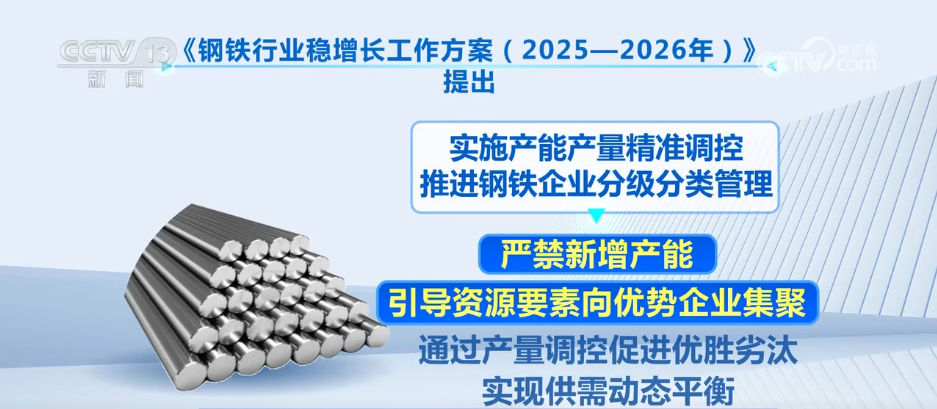
Core Viewpoint - The "Steel Industry Growth Stabilization Work Plan (2025-2026)" aims for an average annual growth target of around 4% for the steel industry over the next two years, focusing on "stabilizing growth and preventing internal competition" to guide structural adjustments and high-quality development in the sector [1] Group 1: Policy and Strategic Directions - The plan emphasizes precise control of capacity and output, prohibits new capacity, and encourages resource allocation towards competitive enterprises to achieve dynamic supply-demand balance [3] - The plan mandates that by the end of 2025, over 80% of steel production capacity must complete ultra-low emission transformations [3] - The plan aims to enhance process and equipment upgrades, promote high-end, intelligent, and green development, and expand effective investments to optimize the steel industry's structure [5] Group 2: Industry Challenges and Responses - The steel industry currently faces an oversupply and insufficient effective demand, leading to a supply-demand imbalance that affects quality and efficiency [4] - In July, China's crude steel production was 79.66 million tons, a year-on-year decrease of 4.0%, while steel product output reached 122.95 million tons, a year-on-year increase of 6.4% [8] Group 3: Technological Advancements - The industry has seen a surge in new product launches, with over 120 globally launched products this year, driven by structural demand from advanced manufacturing sectors like electric vehicles and smart home appliances [8] - The integration of artificial intelligence in the steel industry is being promoted to enhance high-end, green development, with AI expected to play a core role in creating new productive forces [9][13] - AI-assisted systems have significantly reduced the average R&D cycle for high-end steel products by 56%, and quality verification processes have been expedited from 72 hours to 8 hours [11] Group 4: Future Outlook - The plan sets the stage for a paradigm shift in the steel industry towards high-end, intelligent, and green production models, with a focus on integrating AI across processes [13][15] - The industry is expected to transition from generic to customized steel products in response to rapid growth in demand from sectors like electric vehicles and advanced manufacturing [8]