
跨境电商零售进口食品

Search documents
两部门联合出手! 跨境电商零售进口食品召回新规来了
Mei Ri Jing Ji Xin Wen· 2026-02-25 11:13
Core Viewpoint - The announcement by the State Administration for Market Regulation and the Ministry of Commerce aims to strengthen the responsibility of cross-border e-commerce enterprises in food safety and recall processes, addressing existing industry issues and enhancing consumer protection [1][2]. Group 1: Regulatory Framework - Cross-border e-commerce enterprises are now required to delegate a domestic food production and operation enterprise to handle food recall processes and report this information to the e-commerce platform [1]. - The announcement mandates immediate cessation of sales and notification for recalls when quality safety risks are identified, with timely reporting to regulatory authorities [2]. Group 2: Industry Impact - The cross-border e-commerce food sector has seen significant growth, with a projected import scale reaching 18.48 trillion yuan by 2025, marking China as the second-largest import market globally [2]. - The new regulations are expected to promote a more robust service system among larger food enterprises while potentially challenging smaller brands that may lack adequate service structures [4]. Group 3: Quality Assurance and Market Dynamics - The announcement emphasizes the need for a recall mechanism to effectively mitigate food safety risks, which is crucial given the increasing import volumes, including a 6.7% year-on-year growth in fruit imports [2]. - The regulatory changes are anticipated to facilitate industry consolidation, improving the quality and service of imported food products, thereby benefiting overall market dynamics [4]. Group 4: Future Projections - The cross-border e-commerce market is projected to reach 17.66 trillion yuan by 2024, with a compound annual growth rate of approximately 17% from 2013 to 2024, indicating a strong growth trajectory for the sector [4].
中国加强跨境电商零售进口食品召回监管
Xin Lang Cai Jing· 2026-02-14 01:56
Core Viewpoint - The announcement by China's National Market Supervision Administration and Ministry of Commerce aims to strengthen the regulatory framework for the recall of cross-border e-commerce retail imported food, emphasizing the responsibility of e-commerce companies in ensuring food safety [1] Group 1: Responsibilities of E-commerce Companies - Cross-border e-commerce companies are required to take on the primary responsibility for food safety related to imported products [1] - Companies must delegate the recall work to a domestic food production and operation enterprise [1] Group 2: Recall Procedures - Upon identifying quality safety risks or issues, e-commerce companies must immediately halt sales and notify the entrusted enterprise to recall the affected products [1] - The recall and handling status must be reported promptly to market supervision authorities [1] Group 3: Regulatory Oversight - E-commerce platforms are mandated to urge companies to enhance risk prevention measures and ensure effective recall processes [1] - Platforms will suspend services to companies that fail to take proactive recall actions [1] - Regulatory authorities will intensify oversight on recalls and impose strict penalties on non-compliant e-commerce companies and their entrusted domestic partners [1]
事关跨境电商零售进口食品召回 两部门发布公告
Xin Hua She· 2026-02-13 11:48
Group 1 - The core viewpoint of the article is the announcement by the State Administration for Market Regulation and the Ministry of Commerce regarding enhanced supervision of cross-border e-commerce retail imported food recalls to ensure consumer safety [1] Group 2 - The announcement clarifies the responsibilities of entities involved in cross-border e-commerce retail imported food recalls [1] - The initiative aims to effectively prevent food safety risks associated with cross-border e-commerce retail imports [1]
加强跨境电商零售进口食品召回监管
Sou Hu Cai Jing· 2026-02-13 11:08
Core Viewpoint - The announcement aims to enhance the regulatory framework for cross-border e-commerce retail imports of food, ensuring consumer safety and establishing clear responsibilities for e-commerce enterprises and platforms [1][2]. Group 1: Responsibilities of Cross-Border E-Commerce Enterprises - Cross-border e-commerce enterprises are responsible for food safety and must appoint a domestic food production and operation enterprise to handle food recall processes [1]. - Upon identifying quality safety risks, cross-border e-commerce enterprises must immediately halt sales, notify the appointed enterprise for recalls, and report the situation to market regulation authorities [1]. Group 2: Role of Cross-Border E-Commerce Platforms - Cross-border e-commerce platforms are required to urge enterprises to strengthen quality safety risk prevention and ensure proper recall procedures are followed [1]. - Platforms must suspend services to any cross-border e-commerce enterprises that fail to take proactive recall measures [1]. Group 3: Regulatory Enforcement - Market regulation departments will strictly enforce laws against non-compliance by cross-border e-commerce enterprises, appointed enterprises, and platforms, and will report violations for credit management [2].

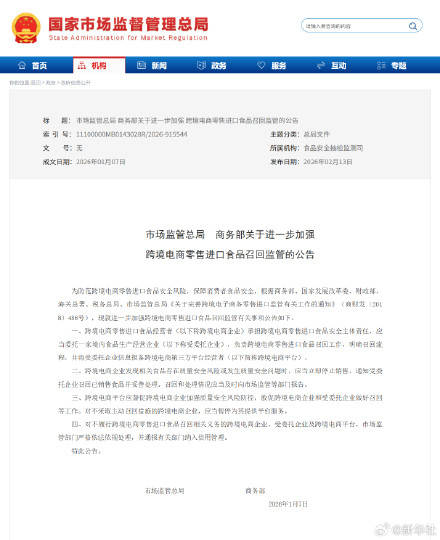
市场监管总局、商务部最新发布!事关跨境电商零售进口食品召回
Mei Ri Jing Ji Xin Wen· 2026-02-13 10:13
Group 1 - The announcement emphasizes the responsibility of cross-border e-commerce enterprises for food safety in retail imports, requiring them to delegate recall responsibilities to a domestic food production and operation enterprise [1] - Upon identifying quality safety risks or issues, cross-border e-commerce enterprises must immediately halt sales, notify the delegated enterprise for recalls, and report the situation to regulatory authorities [1] - Cross-border e-commerce platforms are required to urge enterprises to enhance risk prevention and ensure proper recall procedures, with penalties for those failing to take proactive recall measures [1][2] Group 2 - Regulatory authorities will strictly enforce laws against cross-border e-commerce enterprises, delegated enterprises, and platforms that do not fulfill recall obligations, including credit management implications [2]
两部门:进一步加强跨境电商零售进口食品召回监管
Yang Shi Xin Wen Ke Hu Duan· 2026-02-13 09:33
Core Viewpoint - The announcement by the State Administration for Market Regulation and the Ministry of Commerce aims to strengthen the recall management of cross-border e-commerce retail imported food, emphasizing the responsibilities of various stakeholders involved in the process [1][2][3]. Group 1: Responsibilities of Cross-Border E-Commerce Entities - Cross-border e-commerce companies are designated as the main responsible entities for the safety of imported food, and they must delegate a domestic food production and operation enterprise to handle recall tasks [3]. - Upon identifying quality safety risks or issues with imported food, cross-border e-commerce companies are required to immediately halt sales, notify the delegated enterprise to recall the affected products, and report the recall status to market regulation authorities [3]. Group 2: Regulatory Measures and Enforcement - The regulatory authorities will intensify oversight on recalls, imposing strict legal consequences on cross-border e-commerce companies, domestic enterprises, and platforms that fail to fulfill their recall obligations [2]. - Cross-border e-commerce platforms are mandated to urge companies to enhance quality safety risk management and ensure proper recall procedures are followed; failure to initiate recalls may result in the suspension of platform services for non-compliant companies [3].
7方面24条措施守每一道防线江苏强化食品安全全链条监管
Xin Hua Ri Bao· 2026-01-09 00:19
Core Viewpoint - The provincial government has issued measures to strengthen the full-chain supervision of food safety, proposing 24 specific measures across seven areas to ensure safety from "farm to table" [1][2] Group 1: Strengthening Food Safety Supervision - The measures emphasize enhancing the supervision of edible agricultural products by controlling risks at the source and regulating the use of agricultural inputs [1] - Key issues such as drug residue in specific agricultural products will be targeted for resolution [1] - The establishment of a traceability platform for edible agricultural products is encouraged, along with the exploration of source coding [1] Group 2: Food Production and Operation Supervision - Strict examination of food production and operation licenses will be enforced [1] - Collaboration in managing food safety in schools and centralized dining units will be strengthened [1] - New models and scenarios in food operations will be subject to enhanced safety supervision [1] Group 3: Storage, Transportation, and Delivery Supervision - A collaborative regulatory mechanism for food storage, transportation, and delivery will be established [1] - Safety management for food delivery services will be reinforced [1] Group 4: Online Food Business Regulation - New online food sales models will be governed through collaborative management [1] - Responsibilities of online food business operators will be emphasized [1] - Comprehensive supervision of the entire online food ordering process will be implemented [1] Group 5: Special Food Regulation - The measures include improving the regulation of special foods and traditional specialty foods [2] - Management of the use of titles and marks for "Jiangsu Old Brands," "Jiangsu Fine Products," and geographical indication products will be standardized [2] - Collaborative supervision of imported foods and cross-border e-commerce retail imports will be enhanced [2] Group 6: Collaborative Supervision and Emergency Response - A collaborative regulatory team will be developed, along with a foundational platform for cooperation [2] - The integration of artificial intelligence in food safety governance will be promoted [2] - Strengthening collaborative emergency response measures is a key focus [2]